




Automated Lot Number management with Barcode is the key to lightning-fast traceability. Last month, our partner seafood factory faced a major crisis. They received an emergency recall order from the EU. The cause was discovering a shrimp batch contaminated with antibiotics. The supervisor and warehouse team had to dig through 5 cardboard boxes. These boxes contained thousands of crumpled production orders. They had to find which finished product batches the raw materials were mixed into.
The company spent exactly 3 relentless days and nights to isolate the issue. However, the financial damage had already reached billions. Goods were stuck at the port awaiting processing. They should have applied Lot Number management via Barcode scanning earlier. This tracing operation would have taken exactly 3 seconds then. Everything just needs a single mouse click on the ERP software.
Key Takeaways:
- Eliminate Paperwork: Completely replace manual bookkeeping with Barcode scanning terminals directly on the shop floor.
- Lightning-Fast Traceability: The ability to trace backward from a defective finished product to the exact original raw material batch, or trace forward from a raw material batch to see which products it formed in the blink of an eye.
- Prevent Human Error: The system will sound a warning beep and block the operation command if a worker mistakenly picks an expired raw material batch (applying FEFO).
- Transparent Inventory: Real-time data helps the warehouse accountant and production manager know the exact location, quantity, and status of each batch.
- Solid Technological Foundation: Apply specialized MES solutions to integrate this process into the core ERP system.
1. The pain of factory workers when checking batch codes via paperwork
1.1. The burden of manual recording
Have you ever visited the shop floor at 5 PM right before shift change? The air is dusty and the machines are deafening. Sweaty workers are squinting their eyes. They have to write long sequences of batch numbers into a notebook. The notebook is covered in grease. Numbers like LOT-2026-07A-XYZ are easily misread. Writing a zero as the letter O is very common. Lacking an automated Lot Number management tool is the root cause of many errors.
1.2. Consequences of “phantom inventory”
The consequence of this is “phantom inventory”. The warehouse accountant checks the software and sees 500kg of material A remaining. But in reality, the shop floor used it all up last week. The reason is workers mistakenly issued an old batch and forgot to record it. This data discrepancy creates a massive bottleneck. Departments pass the buck to each other. Especially whenever a product quality issue arises.
Illustration
Below is a practical comparison table to help you self-diagnose. Let’s see if your factory is falling into this “waste trap”.
| Symptoms on the shop floor (Paperwork) | Corresponding technological solution |
|---|---|
| Workers spend 15 minutes per shift just writing batch codes and material codes on paper. | Barcode/QR scanners record transaction data in 0.5 seconds. |
| Frequently use newly imported materials first, leaving old materials to expire. | The MES system automatically blocks the operation if scanning a Lot code violates the FEFO (First Expired, First Out) rule. |
| When a problem occurs, it takes days of flipping through books to find the source of the defective material. | The 360-degree traceability tree on the ERP digitizes the entire product lifecycle. |
| Month-end inventory checks always have data discrepancies without clear causes. | Data is authenticated right at the Point of Entry via shop floor terminals. |
2. How to achieve high-speed Lot Number management with Barcode technology
2.1. Digitizing the inbound process
The key is not forcing workers to be more careful. Instead, we must equip them with tools so they cannot do it wrong. Automated Lot Number management operates in a closed-loop process. This process starts from warehouse receipt until factory dispatch.
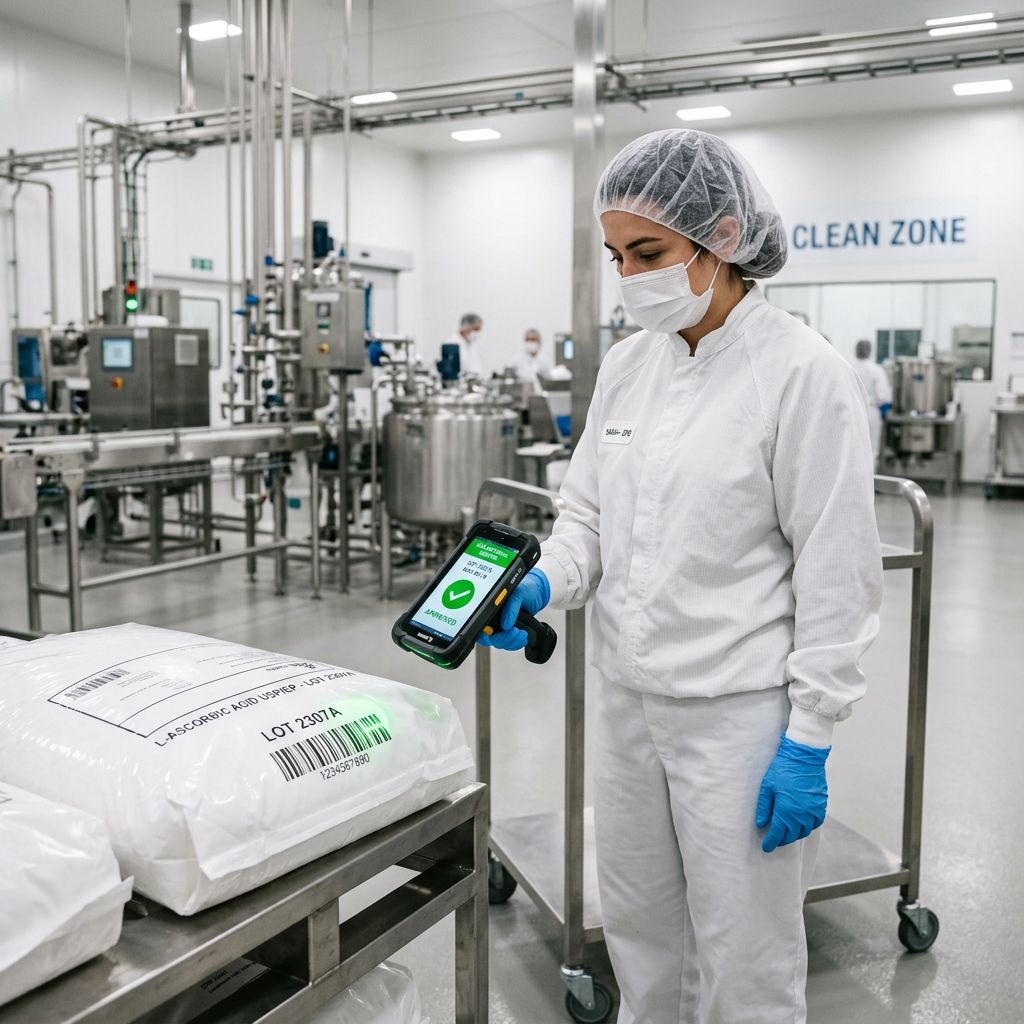
At a Pharmaceutical plant, the process runs very smoothly. A batch of paracetamol raw materials arrives at the warehouse door. QA staff immediately affix a Barcode label on it. The internal Lot code on the label is automatically generated by the system. The batch officially gets a digital “ID card”.
Next, workers push the material cart to the terminal upon receiving an order. Instead of grabbing pen and paper, they hold a barcode scanner. A beep sounds when scanning the packaging. The system instantly verifies the data. Is it the right chemical? Is it the designated Lot number? Is it still within its expiration date?
The screen turns green if everything is valid. Workers are allowed to pour the materials into the mixing tank. If they accidentally pick a different batch, the system flashes red. The operation is immediately blocked. All events are directly updated to the management screen. Data reaches the cost accountant without any delay.

Illustration
2.2. Controlling shrinkage and risks
Let’s look at the Packaging manufacturing industry. This industry often cuts jumbo film rolls into many smaller rolls. From an accountant’s perspective, tracking shrinkage is very difficult. Tracking a jumbo roll (Parent Lot) slit into child Lots on Excel is a nightmare. Everything changes when applying barcodes. Each child film roll automatically inherits the Parent Lot code. This makes cost allocation much easier. The actual cost is calculated accurately down to the penny.
In the Electronics assembly sector, tracking Lot codes is crucial. Tracking every tiny microchip is a matter of survival. Suppose a resistor batch is found to be defective from the supplier. By this time they have already been soldered onto circuit boards. The Barcode system will immediately scan backwards. It helps isolate all TVs or phones using that resistor batch. A synchronized Lot Number management standard brings many benefits. The factory can isolate the risk very narrowly. They do not need to recall all products from an entire shift.
3. Beas Manufacturing Terminal is the launching pad for transparency
3.1. Practical applications at the factory
You cannot use standard retail barcode software. They do not ensure smooth barcode scanning operations on the shop floor. You need a specialized MES Solution like Beas Manufacturing. This solution is developed by Boyum Solutions. It provides the Beas Terminal application. This application is specifically designed for harsh environments.
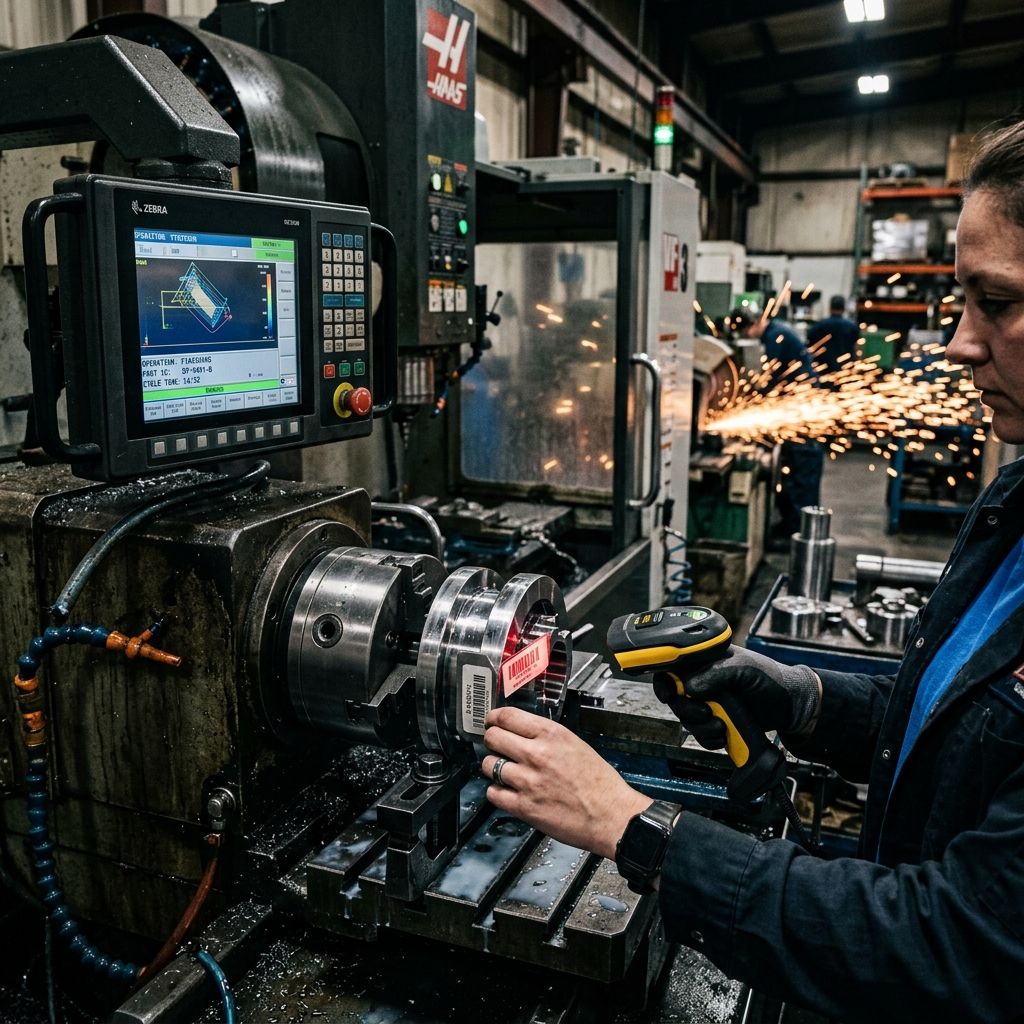
A precision engineering factory in VSIP made a huge change. They completely removed cumbersome desktop computer stations. CNC milling machines are now directly equipped with industrial touch screens. Workers just swipe their ID cards. Then they scan the steel billet Lot code and press Start.
All material consumption operations are automated. Recording scrap and forwarding goods also happen automatically. Product recalls are no longer a disaster now. You only need to enter the defective finished product Lot code. The system pops up a tree diagram. It pinpoints exactly which raw steel roll was defective. You also know who operated the machine that day. Other finished products sharing the steel roll are also displayed for isolation.
3.2. Minimizing recall risks
This scenario also saves a Wooden Furniture Factory. Natural wood needs its moisture content tracked by drying batch. The Beas Terminal is placed right at the kiln door. Workers scan the barcode to record wood Lot A. The wood batch must reach the standard 12% moisture level before moving to carpentry.
The table might crack later due to wet wood. This is when the Lot Number management system comes into play. Managers only take a few seconds to scan the Barcode under the table. They know exactly which wood batch it was made from. The kiln information and date and time are also clearly displayed.
Illustration
Do not let product recall risks crush your brand’s reputation. Register to experience a Demo of the MES System custom-tailored for your factory’s operational layout at INFOASIA today. If your business needs a more comprehensive management solution, please refer to our ERP software ecosystem.
4. FAQs – Practical Questions
My factory has many Subcontracting stages, how can we keep track of the Lot Number when delivering goods to a third party?
When issuing raw materials to a processing unit, the ERP system will create an issue slip carrying that exact Lot code. When receiving semi-finished products back from the partner, you scan the Lot code again or generate a new Lot that has a Genealogy link with the parent Lot, ensuring the traceability chain is unbroken.
Is the hardware investment cost (scanners, barcode printers) for this expensive?
In reality, the value of the hardware system only accounts for about 10-15% of the total project cost. You can start with basic industrial barcode scanners from Zebra or Honeywell at very affordable prices. The biggest cost lies in the core software and implementation quality.
What if the barcode label is torn or blurred by chemicals on the shop floor, what should the workers do?
The software at Beas Terminal stations always supports two parallel mechanisms. One is automatic scanning via a Barcode gun. The second is Manual Entry via an on-screen virtual keyboard. If the label is torn, workers can still type the Lot code sequence by hand to continue working without disrupting the assembly line.
InfoAsia Việt Nam trở thành nhà cung cấp dịch vụ phần mềm số hóa nhà máy sản xuất cho thương hiệu giày hàng đầu thế giới NEW BALANCE
Công ty TNHH Mây Tre Hà Linh
SAP ERP MES and IOT Project for FVIV Factor
Buwon Industry Co, Ltd
KANGLONGDA VIETNAM PROTECTION TECHNOLOGY COMPANY LIMITED
Shini Group
TA TING PLASTIC (HAI DUONG ) CO., LTD
CÔNG TY TNHH MTV BIÊN HOA SCM