




In the context of modern manufacturing and the Industry 4.0 revolution, ERP MES has become the decisive platform duo for the operational capacity of any factory. However, many boards of directors still fall into a matrix of confusion: Should we invest in ERP first, MES first, or proceed with synchronous ERP MES system integration from the beginning?
The following article from InfoAsia will help you redefine the management nature of the ERP MES system, dissect the differences at the business layer, determine the deployment timing for each scale, and especially clarify how to “re-architect” the data flow between the executive office and the shop-floor space.
1. What is an ERP (Enterprise Resource Planning) System?
The ERP system is an overall enterprise resource planning platform, often known as a comprehensive business management software, playing a role in connecting all commercial and financial value chains of an organization into a single data center. If the factory is a production machine, then ERP is the “management brain,” responsible for coordinating the flow of capital, goods, and supply capacity from a medium- to long-term perspective.
When an enterprise reaches a complex scale, using disparate software will lead to the “data silos” phenomenon. Bringing ERP into the ERP MES picture will completely resolve this bottleneck with the following core characteristics:
- Single Source of Truth: Aggregating Accounting, Purchasing, Sales, Human Resources, and Logistics data into a single database. Any business change is continuously reflected to the relevant departments.
- Core process automation: Eliminating repetitive data entry between departments, thereby standardizing order processing, payment, and debt control workflows.
- Strategic analysis support: Providing Management reports (BI Dashboard), balance sheets, and market demand forecasts for the board of directors to make decisions based on real data.
- Security access control and authorization: Clearly defining data access rights and approval limits according to each level, complying with enterprise risk management standards.
2. What is an MES (Manufacturing Execution System) System?
The MES system is a manufacturing execution and management software, acting as an “operational nervous system” closely following every shift on the shop-floor. The task of the MES part in the overall ERP MES architecture is to convert macro plans from ERP into detailed coordinating actions for each machine, worker, and material in real-time.
In a Lean Manufacturing environment, MES brings practical value through advanced features:
- Real-time Shop-floor Tracking: Connecting IoT sensors, PLCs to accurately monitor the production output every second, every minute of each processing machine.
- Dynamic production order coordination: Dividing the master Production Order into detailed Routing Orders, arranging appropriate load on each Work Center to avoid Work-in-Progress (WIP) stagnation.
- In-line QC/QA: Collecting inspection parameters right on the production line, detecting product defects early and locking the process if machine parameters exceed allowable thresholds.
- Genealogy / Traceability: Attaching Barcode/QR Code to each batch of inputted materials and outputted finished products, transparentizing the production history of each order.
- Preventive Maintenance: Monitoring the machine running cycle, giving advance warning of technical stopping points to minimize Downtime.
- Overall Equipment Effectiveness (OEE) Measurement: Analyzing 3 factors: Machine availability – Speed performance – Quality yield to identify Bottlenecks in the factory.
3. Comparing MES and ERP Systems
To plan the IT architecture for the factory, the board of directors needs to clearly understand that ERP and MES do not compete or replace each other; they solve two management problems in two distinct spatial layers.
3.1. Similarities
- Common management goals: Both are designed to optimize resources, reduce waste costs, and increase the overall competitive capacity of the factory.
- Digital operating platforms: Both are centralized management software solutions focused on data collection, digital transformation, and information flow transparency.
- Foundational roles in Smart Factory: They are two mandatory “pillars” if the enterprise aims for the Industry 4.0 standard Smart Factory model.
3.2. Differences
The technical comparison table below shows a clear boundary demarcation between ERP and MES:
| Criteria | ERP System | MES System |
|---|---|---|
| Application scope | Covers the entire enterprise: Finance, Supply Chain, Sales, HR, Back-office management. | Focuses deeply on the shop-floor space: Production lines, Machines, Production workers, QC/QA. |
| Operational level | Top-floor / Management Level, master planning. | Shop-floor Level, physical operation execution and monitoring. |
| Data granularity | Aggregated data, conventionally by financial cycles (Day, Week, Month, Quarter). | High-granularity data, recorded instantly in Seconds, Minutes, every machine cycle. |
| Core features | Costing, Inventory management, Material Requirements Planning (MRP), Business reporting. | OEE tracking, Shift scheduling, Batch traceability, On-site scrap control. |
| Integration capability | Peripheral integration with CRM, SCM, E-invoicing, Bank payment gateways. | Technical layer integration with SCADA, PLC, IoT Sensors, Barcode scanners, WMS Systems. |
| Application flexibility | Highly standardized, few sudden changes to maintain the integrity of financial reports. | Extremely flexible, immediate adjustments in case of machine downtime incidents, material shortages on the line. |
| Target users | Board of Directors (CFO, CEO), Chief Accountant, Procurement Manager, Sales Staff. | Factory Manager, Production Engineer, Shift Leader, Line Workers, QC Department. |
4. Should Manufacturing Enterprises Choose MES or ERP?
There is no one-size-fits-all formula for every factory. Prioritizing which solution to invest in first depends on the “biggest bottleneck” the enterprise is facing at the current time.
4.1. Enterprises should use ERP when
ERP is the number one priority if the enterprise’s problem lies in the overall resource planning and finance – supply chain management. You should choose ERP when: * Loss of control over macro cash flow and costs: Accounting has to manually reconcile debt figures, cost of goods sold, and administrative costs across multiple departments. * Broken supply chain: Unable to balance the Material Requirements Planning (MRP) with the Sales Forecast, leading to dead inventory excess while still lacking materials to run orders. * Multi-branch, multi-facility scale: Needs a unified operational standard for the head office, commercial branches, and various manufacturing plants. * Delayed business reporting data: The board of directors often has to wait until the end of the first week of the month to get the Profit & Loss (P&L) statement of the previous month.
4.2. Enterprises should use MES when
If the office already has a basic management system but severe losses occur in the production area, perfecting the ERP MES model at the lower layer (MES) is the core solution. Choose MES when: * Uncontrolled scrap rate and material loss: The actual amount of material put into the machine always far exceeds the standard norm without identifying the cause from which stage. * Frequent late delivery schedules: The manager cannot grasp which machine is idle, which machine is overloaded, leading to overlapping production scheduling. * Strict traceability requirements: Enterprises outsourcing for FDI partners or exporting in Food, Pharmaceutical, Electronic Components industries, where detailed genealogies of each product Batch are mandatory. * Excessively high Downtime: Need to automate OEE measurement to find bottlenecks and apply predictive maintenance.
5. Comprehensive Integrated ERP MES Solution for Enterprises
5.1. The trend of integrated ERP MES operations in manufacturing
Entering the advanced digitization phase, the boundary between ERP and MES is no longer separate. The Hybrid ERP MES (Unified Planning and Execution Integration) model is the standard architectural trend for Smart Factories. This combination breaks down the “information wall” between the planning department (Office) and the production department (Shop-floor), shifting the factory model from passive reaction to proactive control based on real-time data.
5.2. System integration methods
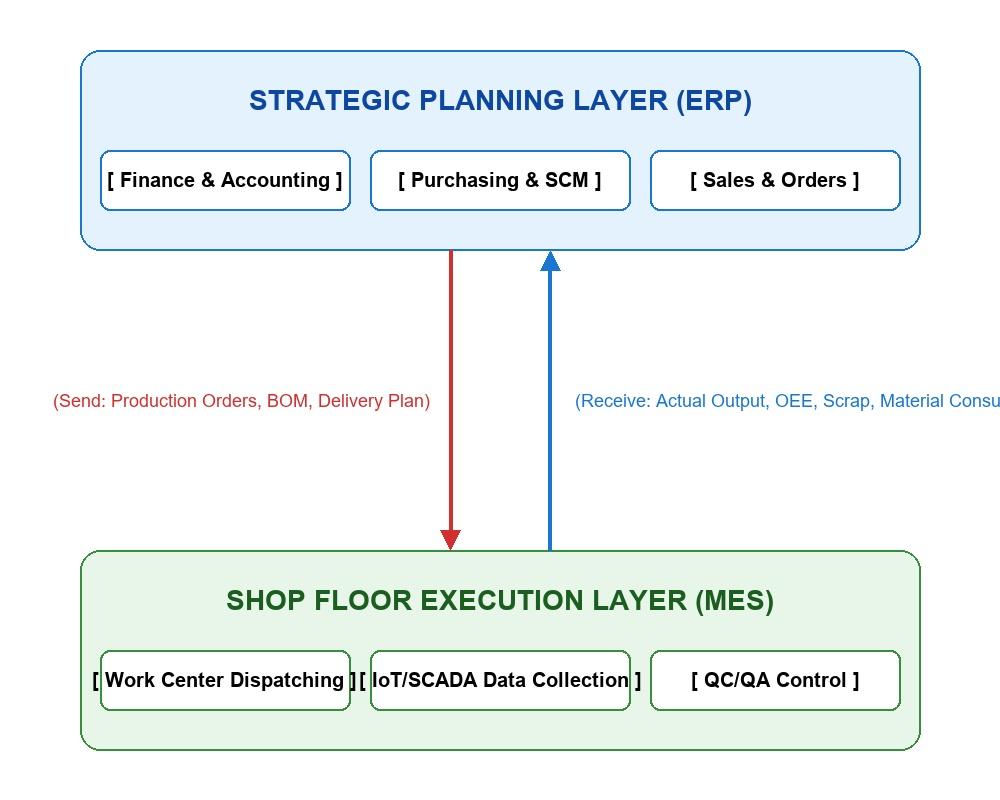
Technically, linking the two halves of the ERP MES system is done via standard connectivity protocols (such as RESTful APIs, Service Layer, or Middleware/ESB hubs). The synchronization mechanism occurs bi-directionally: * Downstream (ERP to MES): ERP sends Production Orders, standard BOM lists, delivery date requirements, and ex-factory Batch numbers down to the MES system. * Upstream (MES to ERP): MES returns the actual quantity of finished products produced, rejected scrap volume, machine run/stop time, and total actual material consumption up to the ERP as soon as the shift closes.
5.3. Benefits of an integrated ERP MES architecture
- System-wide data synchronization: The entire business chain from Planning -> Raw Material Issue -> Processing -> Finished Goods Receipt -> Accounting is connected into a single flow. There is no longer a data discrepancy between the accounting “book inventory” and the factory “physical inventory.”
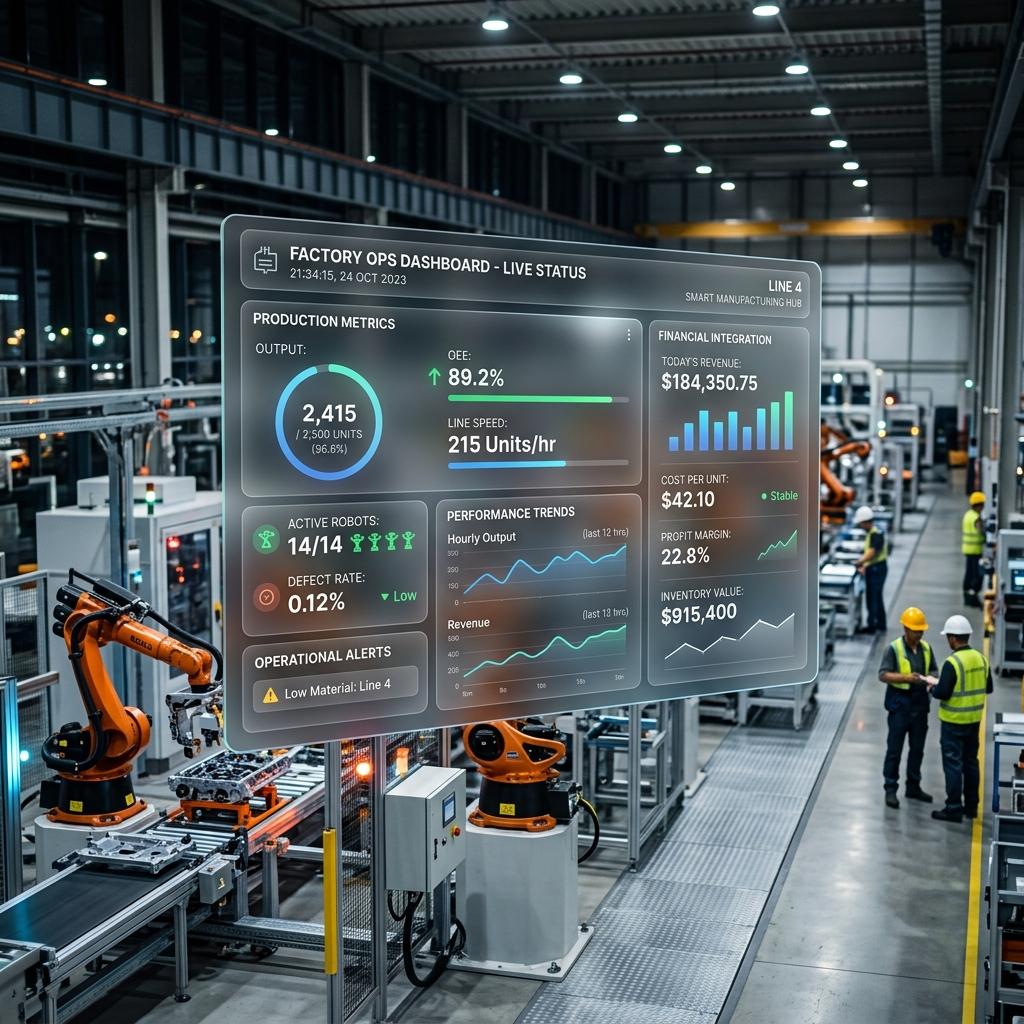
- Operational monitoring based on real-time actual data: The board of directors not only sees the planned targets on the ERP but also tracks the vivid, second-by-second status of the factory. If a production line alarms a speed reduction on the MES, the ERP planning system immediately records the risk of order delay for the sales department to notify the partner early.
- Optimizing the production flow and rapid response to incidents: When the shop-floor encounters a material shortage incident at processing station number 3, the MES sends a signal to the ERP. The warehouse department immediately receives an order to transfer supplementary materials promptly according to the Just-In-Time (JIT) principle, avoiding the whole line standing by.
- Enhancing product traceability: By combining purchasing data (supplier, goods receipt date) from the ERP with processing data (production shift, machine temperature parameters, machine operator) from the MES, the enterprise possesses a 360-degree traceability profile. In just 1 minute of barcode scanning, a manager can trace backwards from a complained finished product to the original raw material batch.
- Improving the overall efficiency of the factory (Actual Costing): This is the greatest financial value of the ERP MES network. Instead of calculating costs based on guessed norms, the integration helps Cost Accounting on the ERP to receive exactly the actual material consumption and actual machine shift running time from the MES, thereby calculating accurate net profit margins for each product code.
6. How to choose the right ERP MES system provider
A good solution lies not only in the technology but relies heavily on the capabilities of the consulting and implementation partner. To invest effectively in an ERP MES system, the enterprise board of directors should selectively choose providers based on strict criteria:
- Deep understanding of specific manufacturing industry expertise: The processing workflow of Pharmaceuticals and Food is completely different from Mechanical Engineering or Plastics/Packaging. The partner must be capable of consulting to solve specific problems such as: Recipe/Formula management, Work Center load balancing, or Unit of Measure (UoM) conversion management.
- Reputable practical project portfolio: Prioritize units that have successfully deployed for factories with similar scale and operational structures.
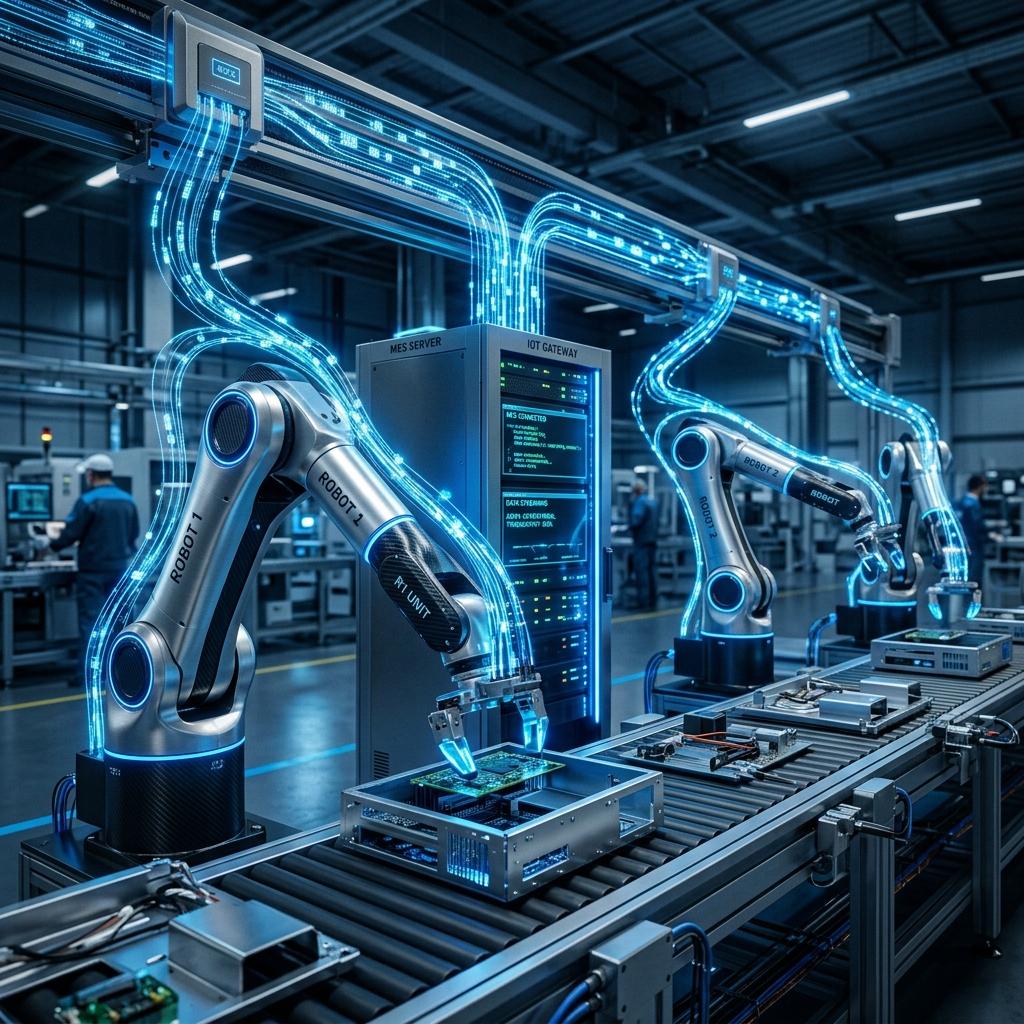
- System architecture and integration capabilities: The technical team must have precise connectivity solutions between the high-level management system and the shop-floor automation layer (SCADA, PLC, IoT, WMS).
- Customization and scalability: The software must be a flexible platform, capable of adapting to factory scale growth over the next 5-10 years without rebuilding from scratch.
- Support services and Change Management: Having a practical training process closely following each user group: from Directors, Accountants to Factory Workers, accompanied by fast technical support services after official operation (Go-live).
- Sustainable technology vision: The partner must be a unit that masters or distributes international standard platforms, continuously updated with new technologies according to the global digital transformation orientation.
InfoAsia – Strategic Partner for Deploying International Standard Production Management Systems Accompanying the Vietnamese manufacturing enterprise community on the digitalization roadmap, InfoAsia is proud to be the official SAP Partner Vietnam, bringing a comprehensive integrated solution ecosystem. With a practical capability profile, we have successfully consulted and implemented systems for many large corporations and brands such as New Balance, Camimex, finely tuned precisely according to the specific characteristics of each industry sector: – Global Standard ERP System (for medium and large enterprises): The standard enterprise resource planning solution, helping to automate finance, procurement, warehouse management, and material requirements planning (MRP) with high accuracy. – Beas Manufacturing (Specialized MES Solution integrated with ERP System): An advanced, specialized production management solution, perfectly designed for seamless integration into the ERP System. Beas Manufacturing thoroughly resolves complex manufacturing operations of the Plastics, Chemicals, Food & Beverage, Pharmaceuticals, and Electronic Components industries, delivering OEE measurement capabilities, quality control, and real-time actual production costing.
Contact InfoAsia’s team of experts today for consultation on an ERP MES system integration roadmap tailored specifically for your factory!
7. Frequently Asked Questions (FAQs)
Q1: Should a small factory with under 100 workers invest in ERP MES right from the start? A1: For a small scale, deploying synchronous ERP MES right from the start can cause great pressure regarding costs and changing personnel habits. The recommendation is to apply ERP first to master financial – inventory data, then gradually integrate production management modules (MES) when the team’s capacity is ready.
Q2: Does integrating ERP and MES require the factory to be equipped with the latest modern machinery? A2: Not mandatory. Today’s MES systems can collect data in many ways: manual entry via tablets (Terminal), barcode scanning (Barcode), or using an intermediary IoT Gateway device to read signals from old standard mechanical machines without having to invest in entirely new CNC machines.
Q3: How long does it take to fully deploy an integrated ERP MES project? A3: The time depends on the complexity of the factory processes. Typically, operating an ERP takes about 4-6 months. Once the ERP platform runs stably, expanding the MES system integration at the shop-floor will take about 3-5 more months. The phased approach helps enterprises control risks better.
Q4: How does Actual Costing take place between the 2 software programs? A4: Instead of waiting for month-end scrap inventory like the old way, the MES will immediately report the actual material consumption for each production order. The ERP automatically takes this consumption figure multiplied by the purchase unit price to post the finished goods cost instantly (Real-time), bringing an absolutely accurate net profit margin to the board of directors.
InfoAsia Việt Nam trở thành nhà cung cấp dịch vụ phần mềm số hóa nhà máy sản xuất cho thương hiệu giày hàng đầu thế giới NEW BALANCE
Công ty TNHH Mây Tre Hà Linh
SAP ERP MES and IOT Project for FVIV Factor
Buwon Industry Co, Ltd
KANGLONGDA VIETNAM PROTECTION TECHNOLOGY COMPANY LIMITED
Shini Group
TA TING PLASTIC (HAI DUONG ) CO., LTD
CÔNG TY TNHH MTV BIÊN HOA SCM