




In the context of global manufacturing entering the digital era with the strict standards of the Industry 4.0 revolution, business managers always face a core dilemma: How to balance overall strategic efficiency with real-time response speed on the factory floor?
Among countless management technology solutions, ERP (Enterprise Resource Planning) and MES (Manufacturing Execution System) are always considered two inseparable puzzle pieces. However, deciding which system to implement first, how to allocate resources, or how to optimally combine them always causes much debate in strategic C-level meetings. This article will thoroughly analyze the nature, differences, symbiotic relationship, as well as the ultimate integration solution from the InfoAsia ecosystem to help businesses shape a sustainable digital transformation path.
1. Core Concepts: What is ERP, what is MES, and easy-to-understand real-world examples?
To fully understand how these two systems operate, we first need to clearly define each concept with a practical example in an electronics manufacturing plant:
1.1. What is ERP? (Enterprise Resource Planning System)
ERP is an overall enterprise management software platform operating based on a single centralized database (Single Source of Truth). ERP manages all core resources of an organization including: finance – accounting, human resources, purchasing, logistics, sales, and macro-level strategic planning.
Practical example of ERP: When a customer orders 5,000 electronic components, the Sales department enters the order into the ERP system. Immediately, the ERP checks the customer’s credit limit, automatically calculates the material requirements (MRP) to see if there is enough copper in stock, and creates a master purchasing plan for the coming month.
1.2. What is MES? (Manufacturing Execution System)
MES is a specialized software system that manages, monitors, and directly coordinates manufacturing activities on the factory floor in real-time. If ERP is the “brain” for planning, then MES is the “arm” directly controlling every machine, assembly line, and worker.
Practical example of MES: When production line number 3 starts assembling the 5,000 components mentioned above, the MES system accurately records the start time, checks the soldering machine temperature, measures the machine speed, tracks the product defect rate (scrap) right on the line, and reports the completion progress minute by minute.
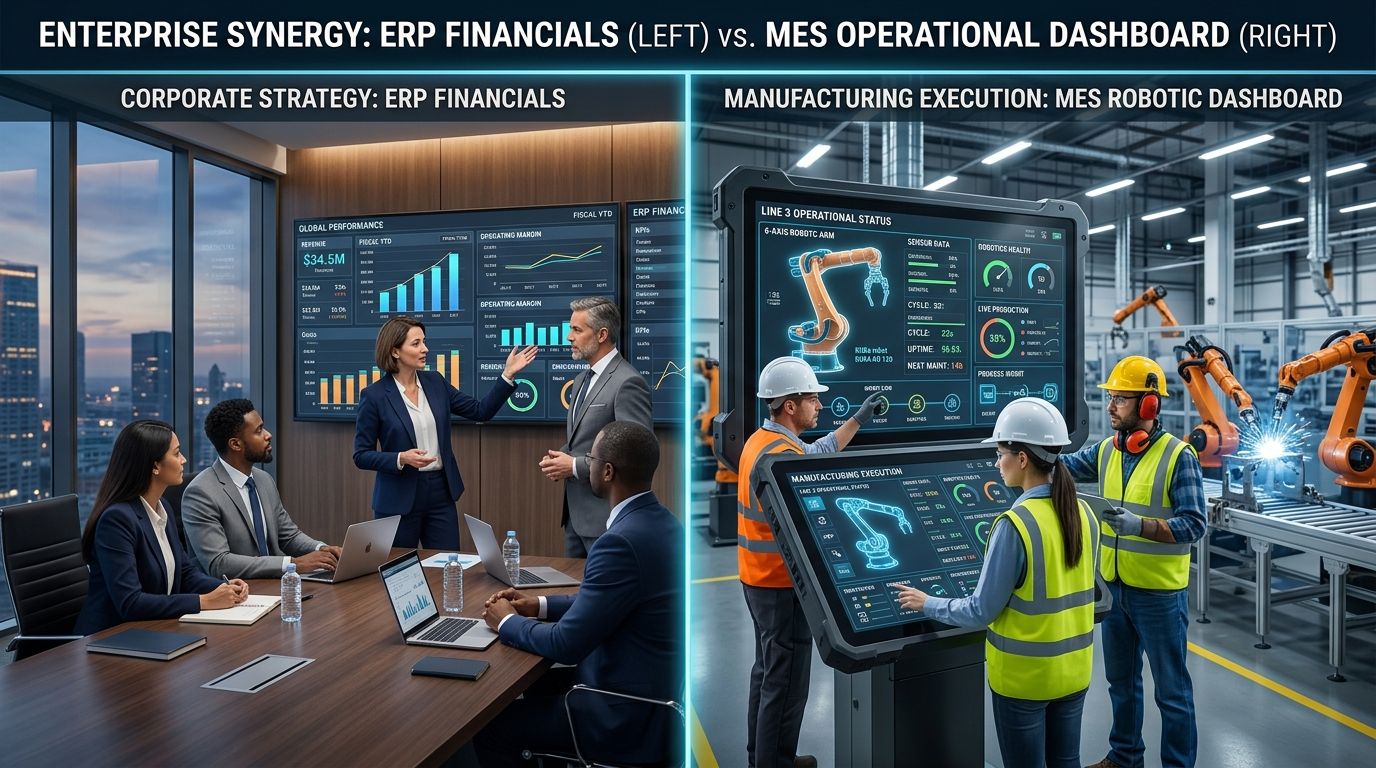
Image for illustration purposes
2. Technical Nature and Standard Definitions: Digging deep into the operational structure
To understand more deeply, we need to refer to technical standards published by leading software development organizations like SAP and modern manufacturing management methodologies.
2.1. Technical Nature of SAP ERP
The ERP system seamlessly connects modules:
– Finance and Accounting (FI/CO): Manages the general ledger, cash flow, accounts for cost of goods manufactured/sold (COGM/COGS), and prepares financial reports compliant with VAS or IFRS standards.
– Material Management and Supply Chain (MM/SD): Controls purchasing, warehousing, high-level Bill of Materials (BOM), and customer relationship management.
2.2. Technical Nature of MES
The core functions of MES include:
– Automatic Data Collection: Directly acquires data from IoT sensors and machinery regarding temperature, pressure, and operating speed.
– Progress and WIP (Work in Progress) Management: Closely monitors the status of each order and each stage of semi-finished products on the line.
– Quality Management (QMS) and OEE: Measures Overall Equipment Effectiveness (OEE), detects product defects directly at the source, and triggers corrective processes.
3. In-depth Comparison Table: Defining the boundaries between ERP and MES
To help managers easily compare and make accurate investment decisions, the analysis table below dissects the core differences between the two systems based on technical and operational criteria:
| Comparison Criteria | ERP System (Example: SAP S/4HANA / SAP Business One) | MES System (Manufacturing Execution System) |
|---|---|---|
| Application Scope | Covers the entire enterprise (Finance, HR, Purchasing, Sales, Master planning). | Focuses specifically on the production floor, workshops, and machinery. |
| Nature of Analysis | Strategic management, business data management (Orders, Invoices, Financial Ledgers). | Operational execution, real-time operational data management (Machine runtime, temperature, scrap, WIP quantity). |
| Response Time | Periodic (Batch, by day, week, month). | Real-time (Calculated in seconds/minutes). |
| Data Granularity | High-level overview, summarized by accounting and administrative objects. | Extremely detailed down to each product, shift, worker action, and machine parameter. |
| Typical Tasks | Standard costing, master MRP planning, debt management, invoice issuance. | Detailed production scheduling (APS), plant recipe management, predictive equipment maintenance. |
| Integration Capability | Broad integration with e-commerce systems, CRM, bank payment gateways. | Deep integration with hardware, IoT sensors, PLCs, CNC machines on the factory floor. |
| Return on Investment (ROI) | Optimizes cash flow, reduces general operating costs (Medium term: 12-24 months). | Reduces machine downtime, directly increases machine productivity (Short term: 6-12 months). |
4. Why manufacturing businesses cannot solely rely on ERP but definitely need MES?
A classic question often asked by Chief Operating Officers (COO) is: “Our SAP ERP system already has a production module (PP/MM), so why invest in an MES system?”. To answer this, we need to look at reality through three major operational “pain points”:
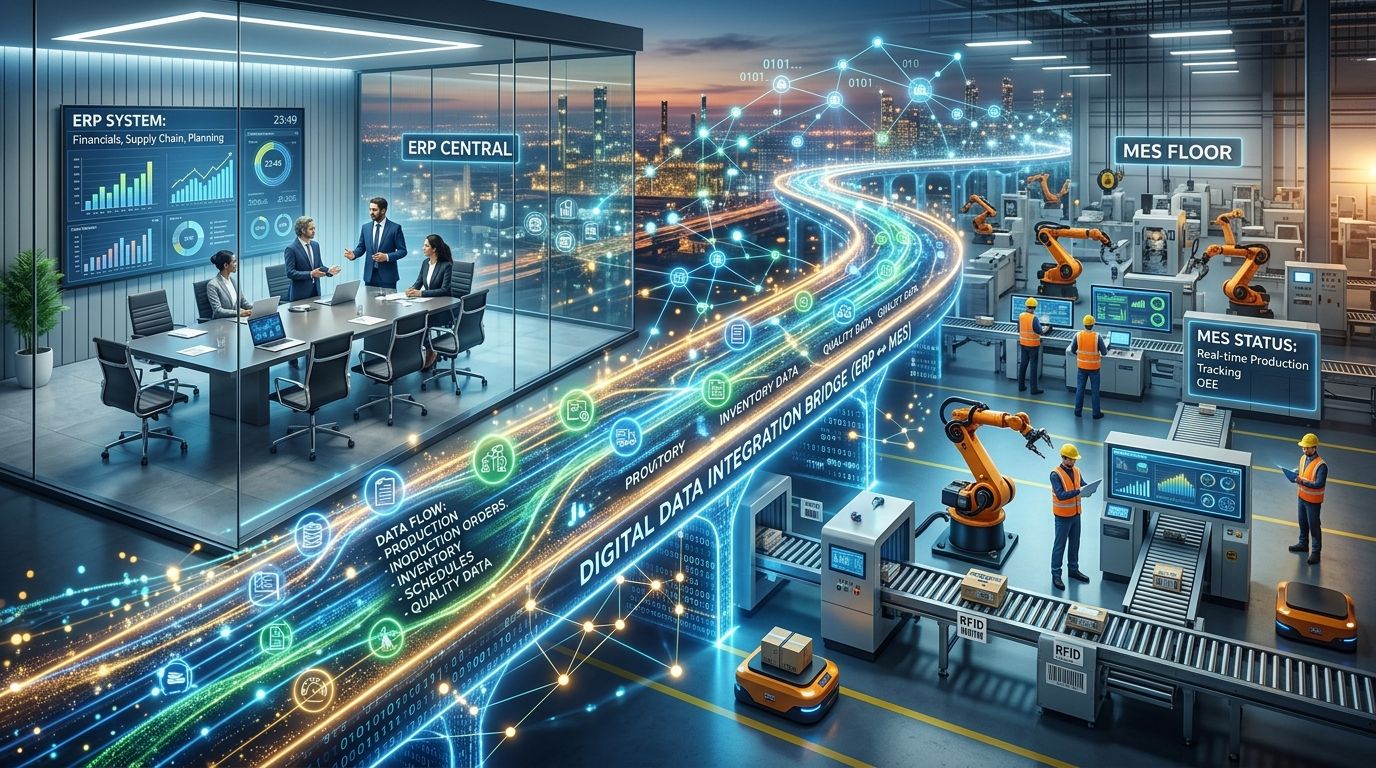
Image for illustration purposes
4.1. The information gap between the boardroom and the factory floor
ERP operates at a strategic vision, when ordering the production of 1,000 products, the system only records figures on paper or through manual data entry at the end of the shift. It is completely “blind” to actual fluctuations on the factory floor such as: Machine number 3 has a jammed cutting blade, the incoming raw material batch has a technical defect, or workers are operating slower than standard. MES is exactly the “bridge” that fills this data gap.
4.2. ERP knows “why”, MES knows “how”
ERP solves the macro question: “Why do we have to produce this order?” (based on market demand, cash flow, and contracts). Meanwhile, MES solves the micro question: “How to optimally execute that production order on a specific machine line with existing resources?”.
4.3. The problem of quality control and equipment maintenance
Standard ERP modules are not designed to connect directly with electronic signals from machinery. Meanwhile, modern management models (researched and developed based on principles from Boyum Solutions) point out that: Only MES is capable enough to execute Predictive Maintenance algorithms and accurately calculate the OEE index, thereby saving the business from massive damage caused by sudden assembly line breakdowns.
5. Integrating ERP and MES: The golden key to entering the Industry 4.0 era
In the smart manufacturing trend of the Industry 4.0 era, the disjointed operation between a strategic planning system (ERP) on one side and an operational execution system (MES) on the other is considered a strategic structural mistake. The information disconnect between these two management layers creates massive cost blind spots, slowing down the business’s reaction speed to market fluctuations.
To thoroughly resolve this problem, top solution consultants always aim for a Closed-loop Integration model between SAP ERP and MES. This model establishes a seamless, automatic, and bi-directional data flow, transforming the entire factory into a unified entity based on the following profound aspects:
5.1. Seamless Bi-directional Data Flow
Top-tier integration doesn’t stop at manual file exchanges via Excel or re-entering data by hand, but rather a complete synchronization in real-time through standard API gateways:
– Top-down: When the Planning department receives an order and runs the Material Requirements Planning (MRP) algorithm on SAP ERP, the system automatically generates Production Orders along with a detailed Bill of Materials (BOM) and pushes them straight down to the MES system in the factory without manual human intervention.
– Bottom-up: As soon as the workshop starts running the order, the MES system continuously collects actual operational data from machine sensors, PLCs, and worker operation stations. All figures regarding Good Qty, Scrap Qty, exact machine runtime, or actual materials consumed are automatically posted back to the warehouse and financial general ledger of SAP ERP (FI/CO).
5.2. Solving the Actual Costing and COGM accounting problem
One of the biggest “pain points” for Chief Financial Officers (CFOs) in manufacturing plants is the lag and discrepancy between the Standard Cost calculated on paper and the Actual Cost incurred on the line. When deeply integrating SAP ERP and MES:
– MES accurately records every hour workers spend on each stage, the actual runtime of machinery, and the scrap generated due to operational errors or material defects.
– All these cost fluctuations are automatically converted and accounted into the Work in Progress (WIP) and Cost of Goods Sold (COGS) journal entries on SAP ERP. Thanks to this, the leadership board has a transparent financial picture every second, knowing exactly which product is bringing the highest profit margin.
5.3. Optimizing Advanced Planning and Scheduling (APS) combined with WIP control
When combining real-time machine capacity data from MES with the order data and material supply schedule of SAP ERP, the Advanced Planning and Scheduling (APS) system maximizes its power:
– The system automatically calculates the load of each machine line, forewarning bottlenecks when any machine is at risk of overload or about to break down (based on predictive maintenance algorithms from the Boyum Solutions ecosystem).
– Strictly controls the amount of semi-finished goods inventory on the line (WIP – Work in Progress), avoiding material congestion at one stage while other stages have to stop machines to wait for materials.
5.4. Completely eliminating manual intervention and Human Error
The ultimate goal of integrating ERP and MES in a 4.0 factory is to realize an autonomous operational process. Humans only play the role of setting strategy, monitoring exceptions, and making macro decisions, while all repetitive tasks such as:
– Automatically confirming the completion of production orders (Order Confirmation).
– Automatically deducting raw material inventory as soon as the machine starts processing.
– Automatically generating warnings when the product defect rate exceeds the allowable threshold.
All are 100% automated on the tightly integrated platform between SAP and MES, creating an absolute competitive advantage in On-Time In-Full (OTIF) delivery speed for the business.
Image for illustration purposes
6. Top-tier integration deployment capabilities from InfoAsia
Understanding the specific challenges of manufacturing businesses in Vietnam during their digital transformation journey, InfoAsia is proud to be a reliable strategic partner, providing comprehensive architectural solutions.
6.1. Extensive experience and solid foundation
Established in 2016, InfoAsia is a member company directly under Cadmen Taiwan – a technology group with a long history of operation since 1980 and maintains the position of SAP’s exclusive Gold Partner in the region. With a team of technical experts with over 10 years of experience, InfoAsia possesses deep capabilities in consulting, configuring, and synchronously integrating SAP ERP solutions, MES systems, and IoT technology.
6.2. Practical marks through global projects
InfoAsia has affirmed its capabilities through a series of large-scale factory digitalization projects for multinational corporations and key industrial parks (typically such as factory automation solutions for the global shoe brand New Balance, FVIV factory, Buwon Industry, Shini Group, etc.).
6.3. Smart localization solution
The outstanding strength of InfoAsia is the ability to perfectly combine the strict international management standards of SAP with the financial accounting standards system in Vietnam (VAS), helping businesses both achieve global operational standards and be completely assured about the domestic legal corridor.

Image for illustration purposes
7. Frequently Asked Questions (FAQs)
Q1: Do Small and Medium Enterprises (SMEs) have to invest in both ERP and MES from the beginning?
Answer: Not mandatory. For SMEs, the optimal strategy is to start with a solid foundational ERP system (like SAP Business One) to standardize finance and logistics, and then gradually integrate MES modules or expansion solutions when the factory scales up.
Q2: How long does the integration between SAP ERP and MES take?
Answer: Depending on the complexity of the production line and the readiness of the equipment infrastructure. Typically, a standard integration project lasts from 3 to 6 months under the leadership of a specialized consulting team.
Q3: How to solve the problem of garbage data when connecting MES with ERP?
Answer: Before integration, InfoAsia’s expert team always conducts a survey and Business Process Reengineering (BPR), cleaning the master database and standardizing the Item Master to ensure both systems “speak the same language”.
Q4: Is the factory operational data transmitted over the Cloud secure?
Answer: Completely assured. The solutions deployed by InfoAsia always strictly comply with top international security standards such as ISO 27001 and SOC 2, applying multi-layer encryption technology to absolutely protect the business’s internal information.
Q5: How does InfoAsia provide support after the system officially goes live (Go-live)?
Answer: InfoAsia provides 24/7 technical and operational support services in the early stages, closely monitoring the synchronized data flow between the workshop and the accounting department, while performing periodic maintenance and expansion upgrades according to the business’s growth rate.
8. Conclusion
Choosing between MES and ERP is not a matter of “picking one over the other”, but the perfect art of combination between overall management strategy and lean execution capabilities at the production floor. In the Industry 4.0 era, the synchronization between these two systems is the ultimate weapon to help businesses optimize costs, break through productivity, and lead the market.
Don’t let competitors get ahead in the digital transformation race! Contact InfoAsia’s expert team today to get advice on the most optimal roadmap for deploying an integrated SAP ERP and MES solution for your operational model.

InfoAsia Việt Nam trở thành nhà cung cấp dịch vụ phần mềm số hóa nhà máy sản xuất cho thương hiệu giày hàng đầu thế giới NEW BALANCE
Công ty TNHH Mây Tre Hà Linh
SAP ERP MES and IOT Project for FVIV Factor
Buwon Industry Co, Ltd
KANGLONGDA VIETNAM PROTECTION TECHNOLOGY COMPANY LIMITED
Shini Group
TA TING PLASTIC (HAI DUONG ) CO., LTD
CÔNG TY TNHH MTV BIÊN HOA SCM