




In today’s era of digital transformation, a company’s responsiveness is measured by its ability to adapt operational processes. Traditional ERP systems, with their closed architectures and prolonged implementation cycles, are gradually becoming “bottlenecks” rather than catalysts. The advent of No-code ERP – a new generation of enterprise resource planning systems – has completely changed the game, allowing organizations to build, customize, and govern systems based on visual drag-and-drop mechanics instead of complex lines of code.
1. The Essence of No-code ERP: Democratizing Technology in Management
No-code ERP is not just a software solution, but a new management mindset. Unlike legacy ERP systems that require dedicated programming teams to modify even a minor data field, No-code ERP is built on Visual Application Development platforms.
The core differentiator is the “democratization” of technological power. In this model, business domain experts – the people who best understand the flows of finance, logistics, or manufacturing – directly design the system. All changes in logic and processes are executed through drag-and-drop interfaces, bridging the gap between “management thinking” and “technological execution”. This represents a massive leap forward in helping businesses achieve complete autonomy in their digitalization journey.
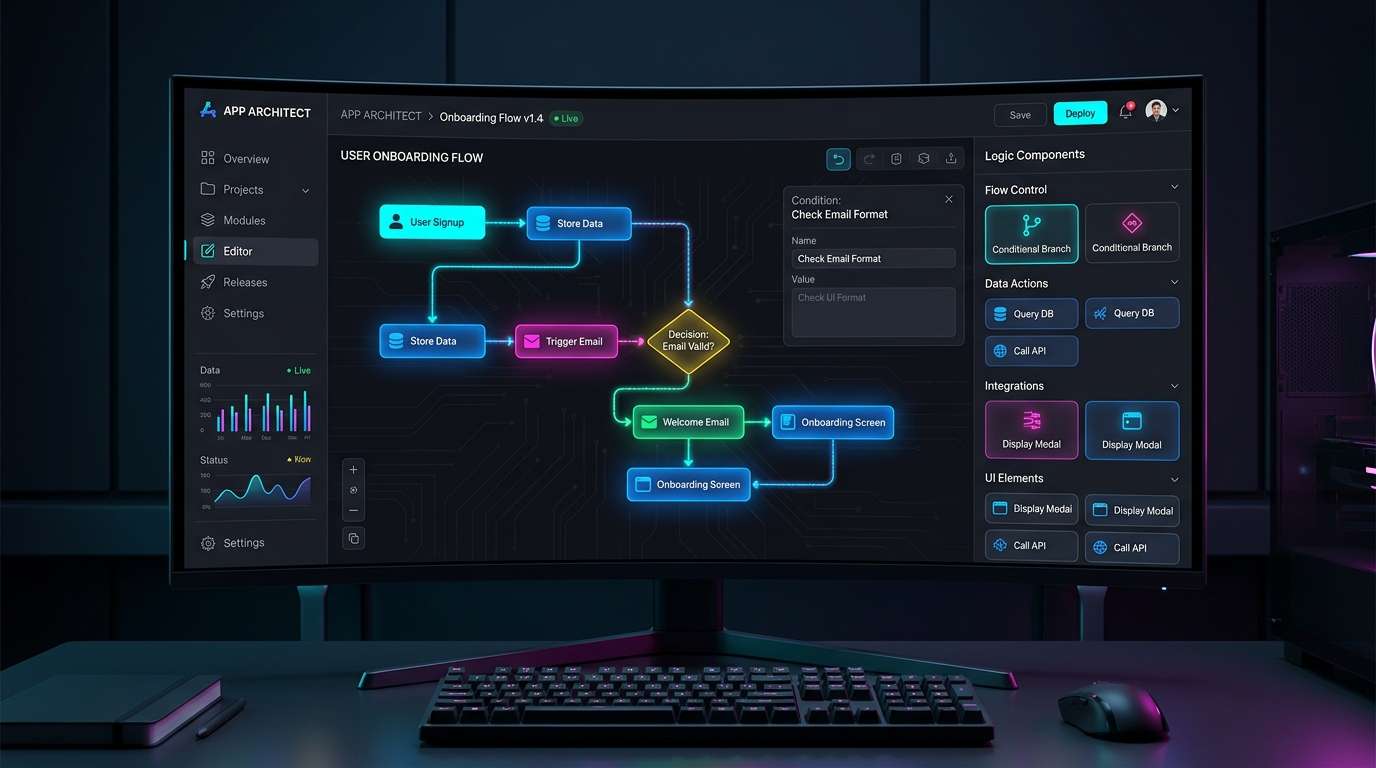
2. Architecture and Operations of a No-code ERP Builder
A modern No-code ERP Builder operates on four advanced technical pillars, ensuring stability and performance on par with traditional specialized systems:
- Dynamic Data Modeling Architecture: Instead of rigid database schemas, this platform utilizes dynamic relational data modeling. Users configure entities such as “Goods Issue Notes”, “Bill of Materials” (BOM), or “Supplier Invoices” and establish visual data constraints. The system automatically generates tables and manages data integrity on the backend.
- Visual Business Logic Engine: This is the “brain” of the system. Through flowchart-based process maps, users configure complex logical conditions. For example: “If inventory falls below the minimum threshold (Min) and the order originates from Workshop A, automatically trigger a Purchase Request (PR) to the preferred supplier.” All these logical rules are compiled into source code running on the server in real time, without requiring any coding effort.
- Component-based UI: With a rich UI kit library, administrators can independently design specialized Dashboards. A Production Director may need real-time charts to track machine efficiency (KPIs), while a Chief Financial Officer prioritizes instantaneous balance sheets. Everything can be dragged and dropped, automatically connecting with the underlying APIs.
- Automated API & Webhooks Infrastructure: An ERP system cannot function in isolation. No-code ERP automates the creation of API gateways, allowing businesses to easily “plug in” other systems such as CRM, e-commerce, or MES software without deeply interfering with the core architecture.
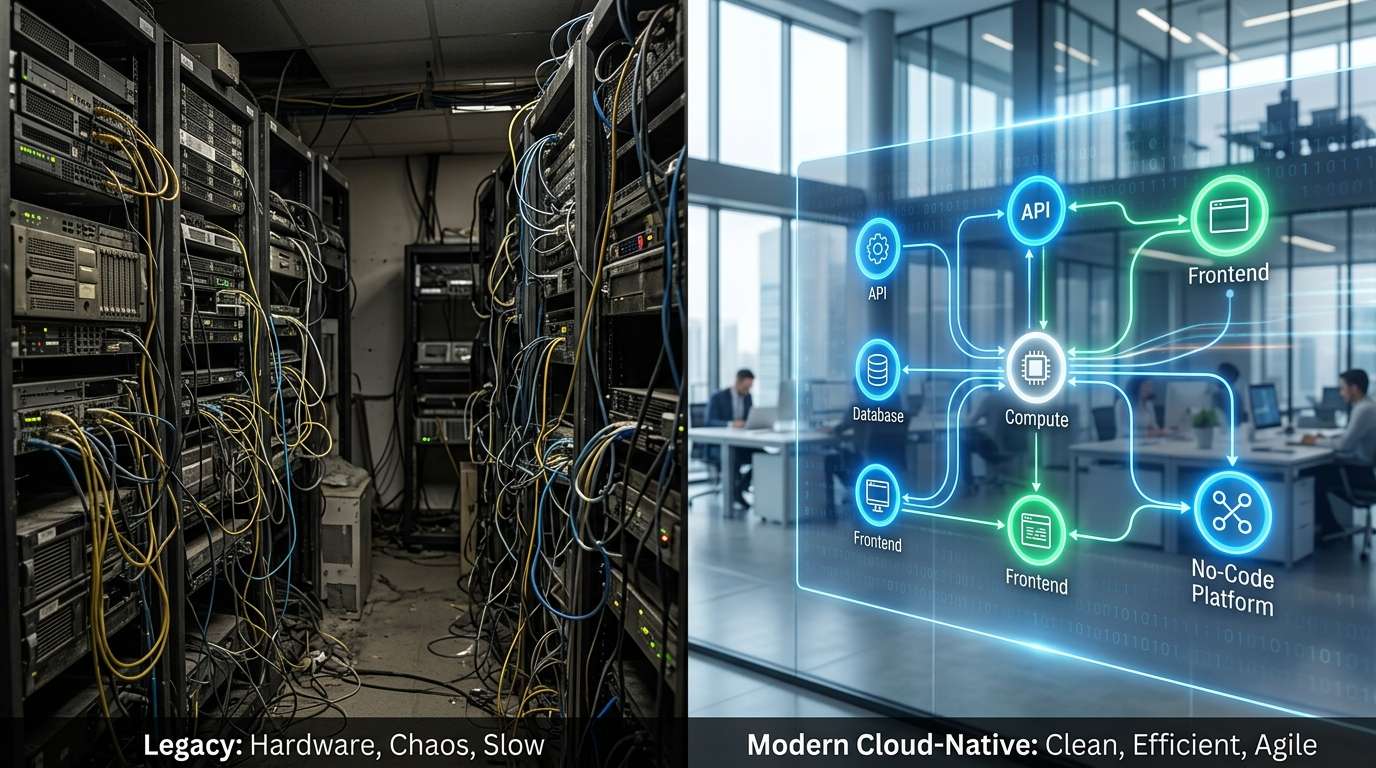
3. In-depth Comparison: Traditional ERP vs. No-code ERP
The difference between these two models represents a paradigm shift: from an “outsourcing – dependent mindset” to an “autonomous – agile mindset”.
| Comparison Criteria | Traditional ERP (Legacy) | No-code ERP (Modern Builder) |
|---|---|---|
| Development Architecture | Closed architecture (Monolithic), difficult to modify. | Open architecture (Cloud-native), highly flexible. |
| Time-to-market | 6 – 24 months to go-live. | 2 – 8 weeks to deploy core modules. |
| Personnel Role | Fully dependent on IT & consultants. | Business Key Users take ownership of the system. |
| Customization Capability | High risk, prone to errors during version upgrades. | Deep customization via configuration, error-free. |
| Total Cost of Ownership (TCO) | Extremely high (Licenses, servers, maintenance). | Optimized (SaaS, reduced technical staffing). |
| Technical Debt | Accumulates massively over decades of code customization. | Non-existent, always running on the latest platform version. |
| Integration Capability | Complex, requires custom programming for connections. | Automated API/Webhooks, fast connectivity. |
4. 5 Strategic Benefits Driving Business Breakthroughs
- Shortened Innovation Cycles: The ability to instantly refine processes enables businesses to execute new strategies as soon as the market fluctuates, instead of waiting for lengthy software upgrade cycles.
- Optimized Total Cost of Ownership (TCO): Eliminates numerous hidden costs related to on-premise server infrastructure and reduces outsourcing budgets for basic programming by 40-60%.
- Internal Knowledge Systematization: Standardizes successful “management know-how” into software tools, helping businesses prevent knowledge loss during personnel turnover.
- Sustainable Scalability: The system is designed for horizontal scaling. You can add hundreds of users or expand across dozens of branches simply through configuration, rather than hardware replacement.
- Data Transparency: Displays real-time metrics, helping leadership make data-driven decisions based on accurate figures rather than intuition.

5. Practical Applications and Quantitative Outcomes (ROI)
When implementing a No-code ERP in actual operations, managers can expect impressive performance conversion metrics:
- Increases manufacturing productivity by 15-20%: By applying automated logical processes (APS/MRP) on the No-code platform, businesses minimize machine downtime and optimize material coordination.
- Reduces inventory checking time by 30%: Integrating barcode scanning and real-time inventory updates ensures that end-of-month stocktakes are no longer a nightmare.
- Saves 40% of time on financial closing: Automating journal entries and invoice reconciliation helps the accounting team resolve workloads significantly faster than manual data entry.
- Cuts module development costs by 50%: Instead of hiring an external dev team at a cost of thousands of dollars per new feature, internal staff can complete the task in just a few working hours.
- Boosts On-Time In-Full (OTIF) delivery rates by 25%: Seamless connectivity across Sales – Warehouse – Production minimizes delivery delays.

6. Partnering with InfoAsia: Your Methodical Digital Transformation Consultant
Deploying a No-code ERP is not merely about dragging and dropping buttons; it involves restructuring the operational mindset. A highly capable consulting firm will help you avoid “design flaws” from the very beginning.
InfoAsia – leveraging extensive experience inherited from Cadmen Group (Taiwan), a pioneer in industrial software since 1980 – deeply understands that every business is a unique entity. At InfoAsia, we provide comprehensive solutions:
- Business Process Reengineering (BPR): We work directly with the management team to standardize processes before digitalization.
- Methodical No-code Architectural Design: InfoAsia helps you build a flexible foundation that meets current needs while being scalable for the future.
- Training & Capability Transfer: Our goal is not to lock in customers through maintenance contracts, but to train your team to become “operational experts”, granting your business complete autonomy.
7. Frequently Asked Questions (FAQs)
Q1: Do SME-sized businesses need to invest in a No-code ERP right now?
Answer: If you are experiencing fragmented data in Excel, time-consuming manual processes, and excessively high IT costs, a No-code ERP is the “catalyst” you need to optimize resources. This is an investment to prevent data leakage and accelerate decision-making speeds.
Q2: Can a No-code ERP handle complex manufacturing operations (Multi-level BOM)?
Answer: Absolutely, for small to medium-sized structural models. However, for highly complex manufacturing plants, the optimal practical solution is to leverage No-code as an agile frontend and workflow layer, synchronously integrated with specialized core computational engines. This ensures the solution remains flexible while maintaining high practicality without being “oversold”. At InfoAsia, we will help you architect this logical workflow with absolute precision.
Q3: What is the primary difference between No-code and Low-code in ERP implementation?
Answer: No-code focuses on business professionals (Key Users) with a fully drag-and-drop interface. Low-code provides a more flexible framework, allowing users with technical knowledge to intervene deeply in the code to handle “hyper-specific” requirements.
Q4: How can data security be guaranteed on a Cloud platform?
Answer: Modern platforms comply with international standards such as ISO 27001, SOC 2 Type II, and AES-256 encryption standards. You can configure granular access permissions down to individual data fields, ensuring information is always under control.
Q5: If we want to change the entire operational workflow after one year, is the system easy to modify?
Answer: This is its greatest strength. No-code ERP possesses no “technical debt”. You can adjust workflows, add modules, or alter the entire approval flow within a few hours on the design interface, without any system downtime.
8. Conclusion: The Future is Autonomy
No-code ERP represents an inevitable paradigm shift from “passive technology investment” to “digital transformation autonomy”. As the gap between management ideas and software realization narrows, businesses will reach peak agility. With the support of modern platforms and experienced implementation partners like InfoAsia, your journey to conquer digital transformation will become faster, more flexible, and more sustainable than ever before. Learn more about reputable ERP platforms worldwide such as SAP.

InfoAsia Việt Nam trở thành nhà cung cấp dịch vụ phần mềm số hóa nhà máy sản xuất cho thương hiệu giày hàng đầu thế giới NEW BALANCE
Công ty TNHH Mây Tre Hà Linh
SAP ERP MES and IOT Project for FVIV Factor
Buwon Industry Co, Ltd
KANGLONGDA VIETNAM PROTECTION TECHNOLOGY COMPANY LIMITED
Shini Group
TA TING PLASTIC (HAI DUONG ) CO., LTD
CÔNG TY TNHH MTV BIÊN HOA SCM