



For factory owners and manufacturing executives, the single biggest hesitation when considering digital transformation is rarely the software license cost—it is the dread of prolonged implementation timelines. Leaders candidly confess: “We fear signing the contract only to see the project drag on endlessly for years, draining our management bandwidth as team members juggle dual data entry while trying to hit production targets.”
This concern is entirely valid. The industry has witnessed numerous ERP projects stall or overrun their estimated duration due to flawed deployment methodologies and unorganized master data.

So, how long does it truly take to implement SAP ERP for a manufacturing plant? Which core factors determine whether Go-Live happens in 3 months or gets delayed for over a year? And how can manufacturers fast-track deployment without compromising stability? This comprehensive guide provides milestone-by-milestone insights from Infoasia’s senior ERP consultants.
1. Realistic Deployment Timelines by Factory Scale
There is no one-size-fits-all timeline for an international standard ERP like SAP. Duration directly hinges on production process complexity, number of workshops, and master data readiness:
- Small to Medium Plants (SMEs – Under 150 Workers): Average deployment takes 3 to 4 months utilizing pre-configured industry packages (Fast-track) from SAP ERP Manufacturing Solutions.
- Medium Plants with Multi-Stage Routing (150 to 500 Workers): Duration ranges from 4 to 6 months to meticulously structure multi-level Bills of Materials (BOM), machine routing, warehouse bins, and electronic Work Orders.
- Large Enterprises & Multi-Site Operations (500+ Personnel): Projects typically span 6 to 9+ months (structured in sequential phases) to ensure full risk mitigation and tight integration with MES systems and automated shop floor equipment.
2. 5 Key Phases of a Standardized SAP ERP Implementation

Phase 1: Project Kick-off & As-Is Process Discovery (Weeks 1 – 3)
- Establish the Project Steering Committee involving C-level leadership and Key Users.
- Conduct on-site shop floor walkthroughs and finalize the Business Blueprint (BBP).
Phase 2: Master Data Cleansing & System Configuration (Weeks 4 – 8)
- Cleanse and standardize Item Codes, multi-level BOMs, work centers, and warehouse layouts.
- Configure SAP modules (Sales, Purchasing, Inventory, MRP, Production, Actual Costing).
Phase 3: Key User Training & User Acceptance Testing (UAT) (Weeks 9 – 12)
- Hands-on role-based training for supervisors and shop floor operators.
- Rigorous end-to-end UAT simulating urgent rush orders, engineering revisions, and scrap handling.
Phase 4: Data Migration & Official Go-Live (Weeks 13 – 14)
- Perform inventory and financial balance cut-over into the live Production environment.
- Issue the first live electronic Work Orders directly on SAP ERP.
Phase 5: Post Go-Live On-Site Support & Optimization (Week 15 onwards)
- Dedicated Infoasia on-site technical support to ensure seamless adoption.
- Fine-tuning operational dashboards and completing final project sign-off.
3. Comparison Table: Deployment Approaches
| Criteria | Custom In-House Development | Traditional Waterfall ERP | Infoasia Agile Fast-Track |
|---|---|---|---|
| Average Duration | 12 – 24 months (High risk of failure). | 9 – 15 months. | 3 – 5 months (Predictable milestones). |
| Personnel Dependency | Extreme; collapses if developers quit. | Moderate; heavy theoretical documentation. | Low; global standard documentation and rapid onboarding. |
| Time to First Hands-on Demo | Month 6 – 9 before seeing UI. | Month 6 after extensive paperwork. | Week 3 (Interactive working prototypes). |
| Cloud Scalability | Costly and difficult to maintain. | Heavy on-premise infrastructure overhead. | Seamless integration with SAP Cloud ERP. |
4. 4 Decisive Factors That Accelerate or Delay Deployment
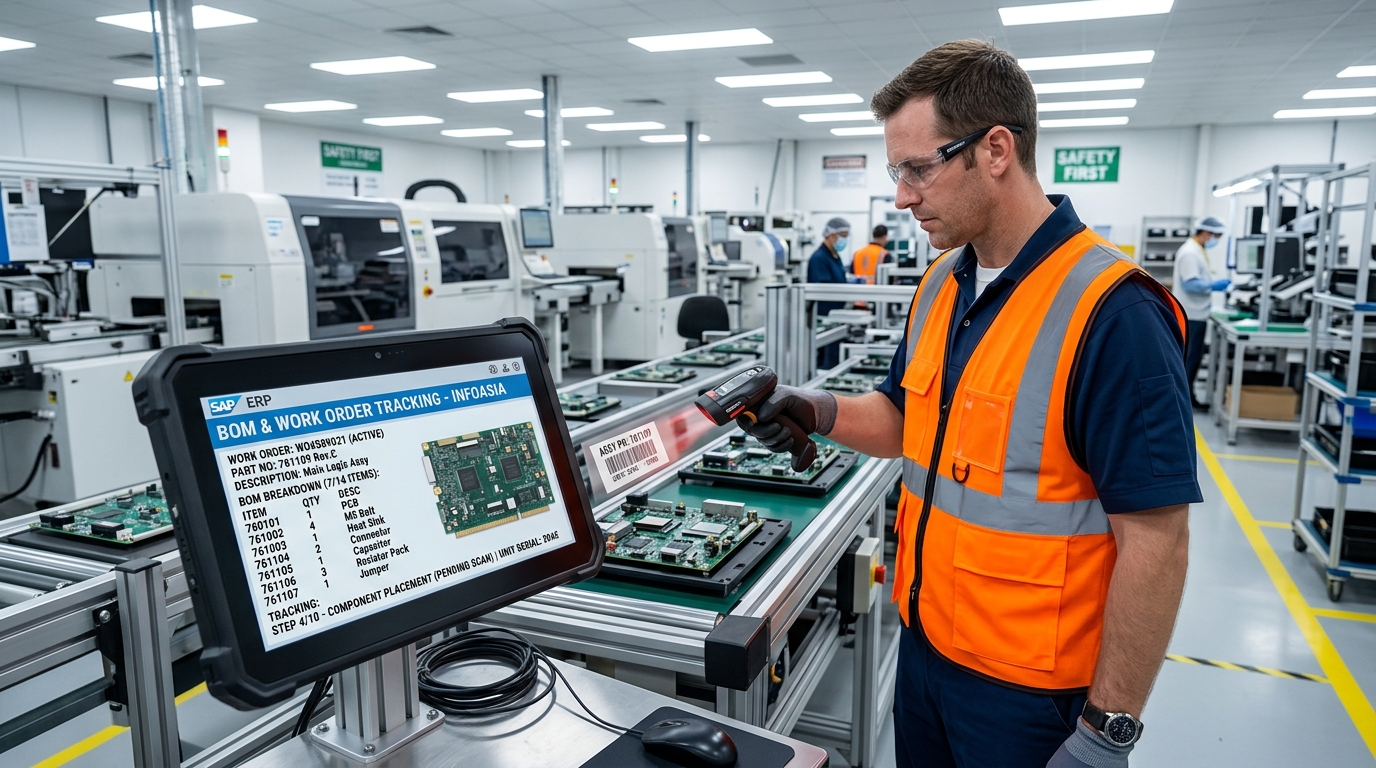
- Clean Master Data: The single biggest bottleneck, accounting for 40% of project delays. Clean data upfront guarantees rapid Go-Live.
- Executive Sponsorship & Key User Dedication: Leadership commitment to protect Key Users’ project time is critical for keeping milestones on track.
- “Best Practices First” Mindset: Adopting proven SAP standard workflows rather than over-customizing prevents costly development cycles.
- Implementation Partner Expertise: Experienced consultants foresee industry-specific edge cases and resolve them proactively.
5. Expert Quote
“The most common pitfall for manufacturers is attempting to digitize every microscopic process simultaneously from Day 1. The key to rapid, high-impact SAP ERP deployment is a Phased Approach: tackle the primary pain points first (MRP, electronic Work Orders, inventory control, actual costing) to achieve Go-Live within 12 to 16 weeks, then expand advanced modules as the organization matures.”
— Principal Manufacturing Solutions Architect, Infoasia

InfoAsia Việt Nam trở thành nhà cung cấp dịch vụ phần mềm số hóa nhà máy sản xuất cho thương hiệu giày hàng đầu thế giới NEW BALANCE
Công ty TNHH Mây Tre Hà Linh
SAP ERP MES and IOT Project for FVIV Factor
Buwon Industry Co, Ltd
KANGLONGDA VIETNAM PROTECTION TECHNOLOGY COMPANY LIMITED
Shini Group
TA TING PLASTIC (HAI DUONG ) CO., LTD
CÔNG TY TNHH MTV BIÊN HOA SCM