



In the era of global manufacturing shifts and supply chain realignment, factory directors and business leaders are constantly confronting a painful paradox: “Why are our production lines running around the clock with non-stop overtime, and customer orders flowing in steadily, yet our net profit margins at year-end remain razor-thin?”
The core bottleneck rarely lies in worker diligence or machinery speed on the shop floor. Instead, it stems from data fragmentation and operational disconnects across the entire organization. At month-end, a familiar scene unfolds across traditional factories: Accounting and Warehouse teams clash over massive inventory discrepancies; Production Planners spend days wrestling with dozens of chaotic Excel spreadsheets; while Executive Directors are forced to make high-stakes strategic decisions based on outdated paper reports with a 3 to 5-day lag.
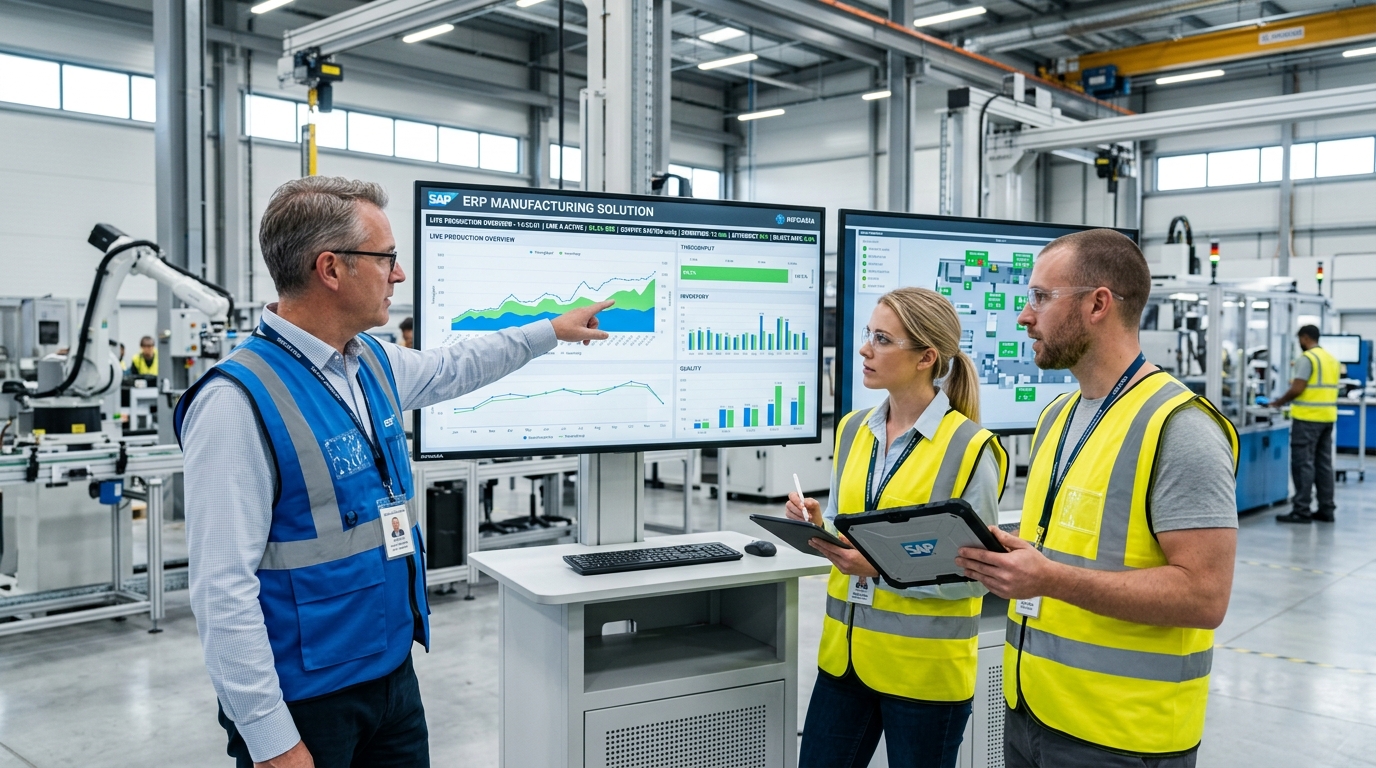
This is the precise moment when legacy systems hit their ceiling and the factory demands a robust digital backbone. This article explores the true essence of ERP Software in Manufacturing, pinpoints the 5 critical red-flag signs that make upgrading to SAP ERP imperative, and delivers a realistic Return on Investment (ROI) roadmap for modern enterprises.
1. What is ERP Software in a Real Manufacturing Context?
ERP (Enterprise Resource Planning) is frequently misunderstood as merely an “extended accounting software” or a centralized document repository.
For a modern manufacturing enterprise, however, ERP acts as the central nervous system that seamlessly connects and synchronizes four critical organizational flows:
- Material Flow: Tracking raw material procurement, warehouse intake, issuance to Work Orders, multi-stage Work-In-Progress (WIP) routing, finished goods warehousing, and final customer dispatch.
- Data & Planning Flow: Real-time synchronization between Sales Orders, factory machine capacity, and Material Requirements Planning (MRP).
- Cost & Financial Flow: Automated capturing and allocation of direct labor, utilities, depreciation, and material scrap into real-time Actual Costing.
- Human Resource Flow: Managing shop floor shift scheduling, worker efficiency, and machine station productivity.
The Staggering Cost of Invisible Inefficiencies
Without an integrated ERP ecosystem, manufacturing plants bleed significant financial and operational resources every day:
- 68% of middle managers’ time (Plant Supervisors, Planning Leads, Warehouse Managers) is wasted on phone calls, paperwork verification, and manual cross-department reconciliation.
- Safety Stock inflates by 20% to 35%, locking up billions in working capital due to an inability to forecast exact material arrival and lead times.
- Scrap rates and rework account for 3% to 8% of total order value due to engineering drawing (BOM) version mismatches between R&D and production lines.
2. 5 Critical Red Flags: When Upgrading to SAP ERP Becomes Urgent
Not every startup factory requires immediate SAP deployment. However, if your plant exhibits 2 or more of the following 5 red flags, delaying an ERP upgrade actively destroys your competitive edge:
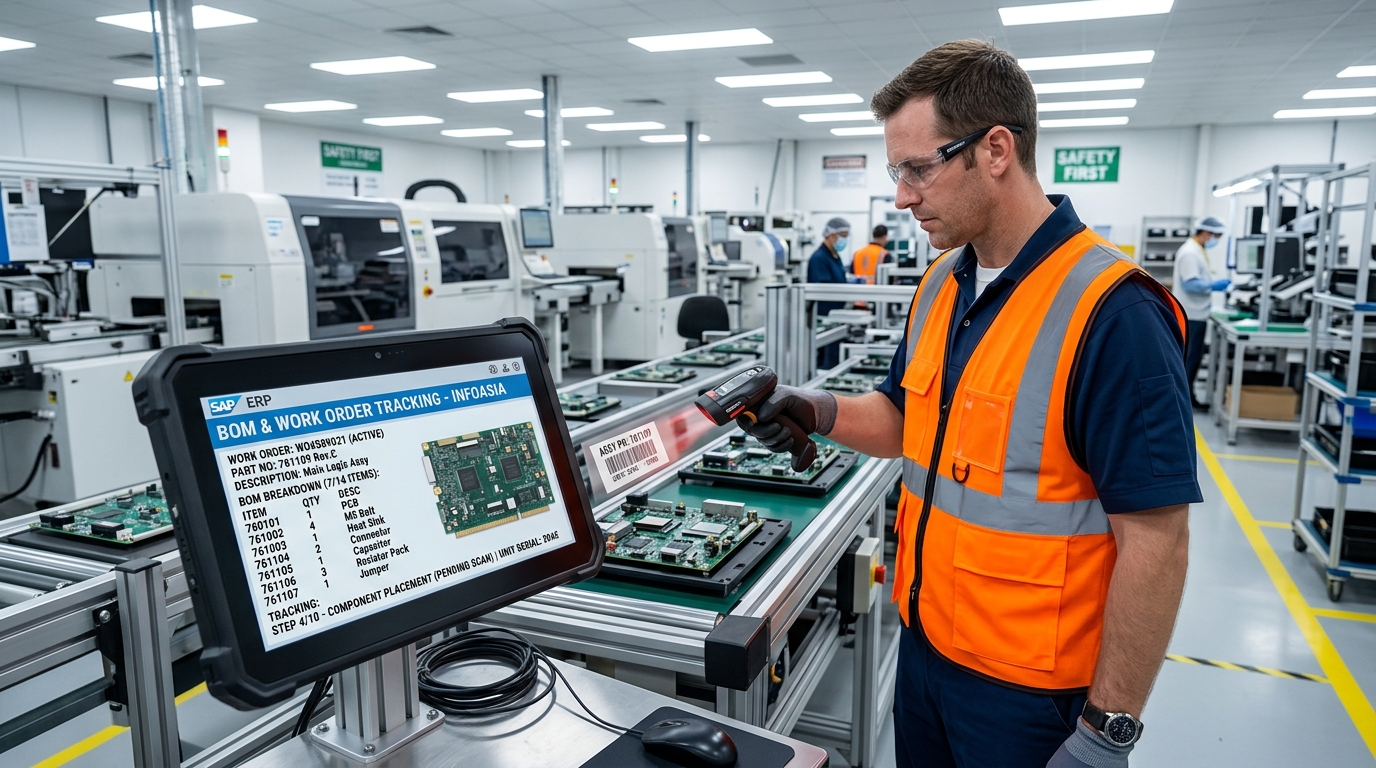
1. Severe Disconnect Between Front Office and Shop Floor
Sales promises rush delivery deadlines without real-time visibility into machine availability or raw material inventory. As a result, lines grind to a halt waiting for materials, or the factory incurs expensive overtime costs while still missing delivery commitments.
2. Multi-Level Bill of Materials (BOM) Chaos and Engineering Changes
In precision machining, electronics, plastics, and furniture industries, finished goods comprise hundreds of sub-components and multi-tiered routings. Managing BOMs via Excel turns Engineering Change Orders (ECO) into disasters, leading to expensive scrap produced from obsolete drawings.
3. Inability to Determine Actual Production Costs (Actual Costing)
Costing is calculated via crude weighted averages weeks after month-end. Management cannot answer vital questions: Which customer order yielded real profit? Which workstation is burning excessive overhead? Which machine operator has the highest defect rate?
4. Growth Bottlenecks When Expanding to Multi-Site Operations
Basic accounting packages collapse when scaling beyond a single facility. When expanding to 2 or 3 plants with hundreds of employees, data turns into isolated silos, destroying executive visibility and centralized control.
5. Failing Global Supply Chain and FDI Audit Standards
Global brand partners (Samsung, LG, US/EU OEMs) mandate verifiable Lot/Batch traceability, integrated MES (Manufacturing Execution Systems), and international ERP compliance to qualify for multi-million-dollar supply contracts.
3. Comprehensive Comparison: Accounting/Custom Software vs. SAP ERP Ecosystem
| Evaluation Criteria | Extended Accounting Software | Custom-Built ERP (In-House) | SAP ERP Ecosystem (Infoasia) |
|---|---|---|---|
| Scope of Integration | Restricted to general ledger, invoicing, and tax filing. | Fragmented modules built ad-hoc to meet immediate requests. | End-to-end integration: Sales, MRP, Purchasing, Production, Warehouse, Finance. |
| MRP & Production Scheduling | None or basic manual subtraction formulas. | Frequently fails when calculating complex multi-level BOMs. | Automated real-time Material Requirements Planning based on Work Orders & Lead Times. |
| Actual Costing Precision | Periodic calculation delayed by 15-30 days post month-end. | Rough theoretical estimation; fails on complex work-in-progress. | Granular allocation of direct/indirect costs and machine depreciation per Work Order and Lot. |
| System Scalability | Extremely low; severe lag when transactions exceed 100k rows. | High key-person dependency; catastrophic risk if lead developer leaves. | Unlimited scalability; native support for multi-branch, multi-currency, and SAP Cloud ERP. |
| Shop Floor & IoT Hardware | No native integration. | Limited, fragile synchronization with PLC, CNC, and barcode scanners. | Deep native integration with industrial terminals, RFID/Barcode, and SAP MES systems. |
| Global Brand Recognition | Unrecognized by foreign audit and procurement teams. | Low credibility during multinational supply chain audits. | Globally recognized standard; dramatically increases bidding credibility with FDI clients. |
4. Expert Perspective: The Strategic ROI of Upgrading to SAP ERP
Many plant executives ask: “Isn’t SAP ERP too expensive and cumbersome for medium-sized manufacturing plants in Vietnam?”
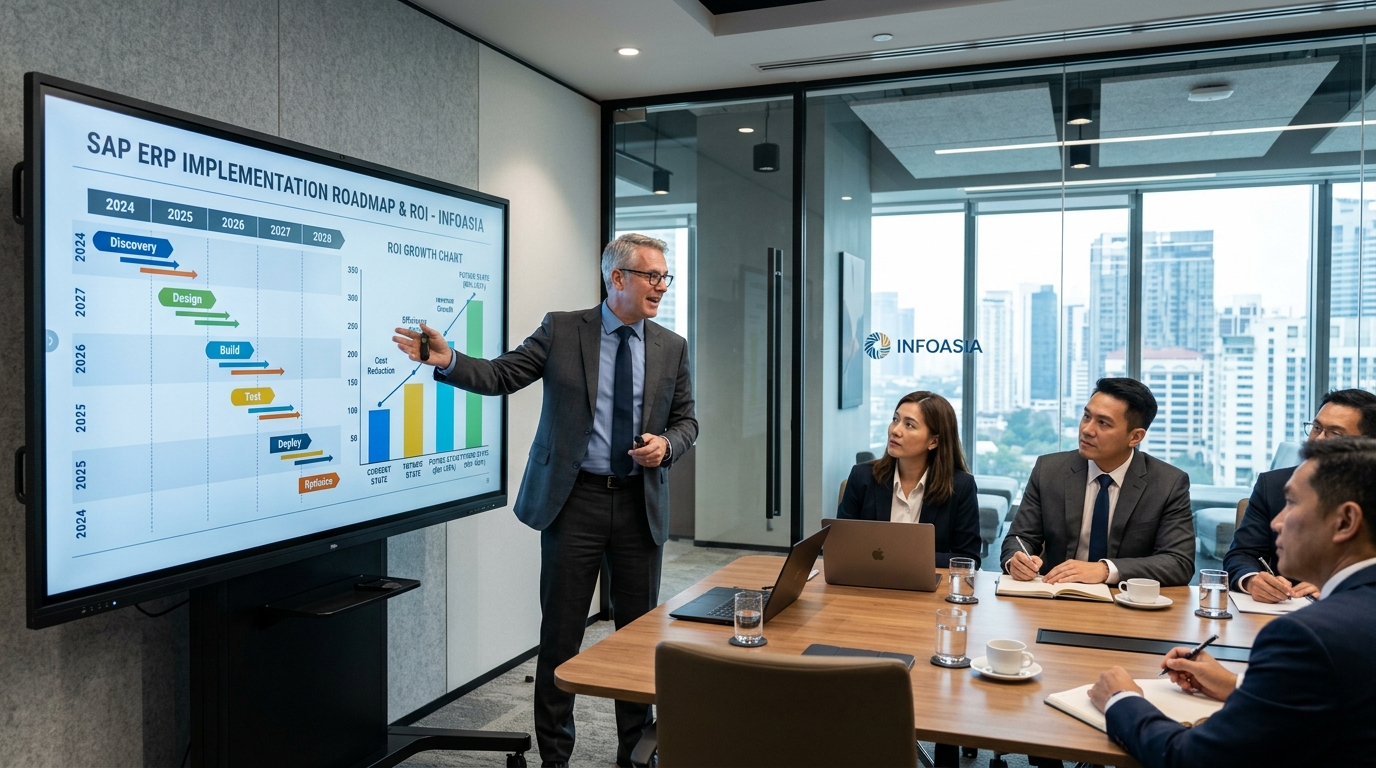
“Many manufacturing business owners hesitate at the initial investment in SAP ERP. In reality, the cost of ERP implementation is dwarfed by the ‘invisible hidden costs’ bleeding the factory every single day: billions in dead inventory, hundreds of idle machine hours waiting for materials, and the forfeit of multi-million-dollar FDI contracts due to failed digital audits. SAP ERP is not an expense—it is a strategic, high-yielding investment that frees executive leadership from operational firefighting.”
— Enterprise Solutions Director, Infoasia
Measurable Financial Return (ROI) for Manufacturing Plants
Deploying an Infoasia-tailored SAP ERP solution delivers tangible financial returns within 6 to 12 months of Go-Live:
- 15% to 25% reduction in inventory holding costs through dynamic MRP calculations tied to real customer demand.
- 40% to 60% reduction in month-end financial closing time, delivering instantaneous P&L and cash flow statements to the Board.
- 15% to 20% increase in machine and labor utilization through standardized electronic Work Order dispatching and minimized changeover times.
- Average ROI Payback Period: Achieved within 12 to 18 months, providing the scalable foundation to double or triple factory capacity without increasing administrative overhead. (Explore our customer success stories).
5. Frequently Asked Questions (FAQs)
Q1: Can Small and Medium Enterprises (SMEs) successfully implement SAP ERP?
Answer: Absolutely. SAP offers tailored packages for growing businesses (such as SAP Business One combined with Infoasia’s localized manufacturing modules), engineered for lean budgets, rapid deployment, and maximum agility.
Q2: What data and personnel preparation is required before starting an ERP project?
Answer: Three fundamental pillars: (1) Clean master data (Item Codes, multi-level BOMs, Routings, Warehouse layouts); (2) A dedicated cross-functional Key User team (Accounting, Production, Planning, Warehouse, Purchasing); (3) Strong executive sponsorship and change management commitment from top leadership.
Q3: What is the typical deployment timeline for a manufacturing plant?
Answer: Deployment typically ranges from 3 to 6 months. Leveraging Infoasia’s pre-packaged industry templates and proven implementation methodology significantly accelerates time-to-value.

InfoAsia Việt Nam trở thành nhà cung cấp dịch vụ phần mềm số hóa nhà máy sản xuất cho thương hiệu giày hàng đầu thế giới NEW BALANCE
Công ty TNHH Mây Tre Hà Linh
SAP ERP MES and IOT Project for FVIV Factor
Buwon Industry Co, Ltd
KANGLONGDA VIETNAM PROTECTION TECHNOLOGY COMPANY LIMITED
Shini Group
TA TING PLASTIC (HAI DUONG ) CO., LTD
CÔNG TY TNHH MTV BIÊN HOA SCM