




Implementing international standard manufacturing management erp software is the key to solving the paradox in many Vietnamese factories today: Machines run at full capacity, workers work continuous overtime, yet profit margins drop significantly. The core reason does not lie in labor skills, but in the “information gap” between the shop floor and the finance department.
This article will break down the structural layers of a modern factory management system, helping businesses accurately measure every penny of costs and establish an effective digital transformation roadmap.
This image serves as an illustration for the article to help readers understand better
1. Information breakdown: When the “Shop Floor” and “Office” do not speak the same language
Without implementing ERP software, factories often operate in a fragmented manner. Foremen run the shop floor based on experience, storekeepers manage with paper stock cards, and accountants sit in the office waiting for documents to be submitted.
This breakdown creates 3 profit-swallowing “black holes”:
- Over-purchasing materials, lack of synchronization: Purchasing plans calculated manually in Excel often ignore in-transit goods or phantom inventory. The result is an excess of group A materials, but a shortage of group B materials, causing the entire production line to stop and wait.
- Invisible Work in Progress (WIP) costs: Semi-finished products are scattered across 5-7 processing stages but are not recorded in a timely manner. Accountants cannot know exactly at which stage the cash flow is stuck.
- Capacity illusion: Human planning often assumes machines run continuously 24/7. When machines break down or lack raw materials, the entire delivery schedule shatters.
This image serves as an illustration for the article to help readers understand better
2. The 3-tier architecture of manufacturing management erp software
To solve the root cause of the problem, manufacturing management erp software approaches the production problem through a Top-Down pyramid structure, from the data foundation to the final financial results.
Bottom tier: Setting up the product’s “Genome” (Master Data)
The system cannot automate if it doesn’t understand how the product is made.
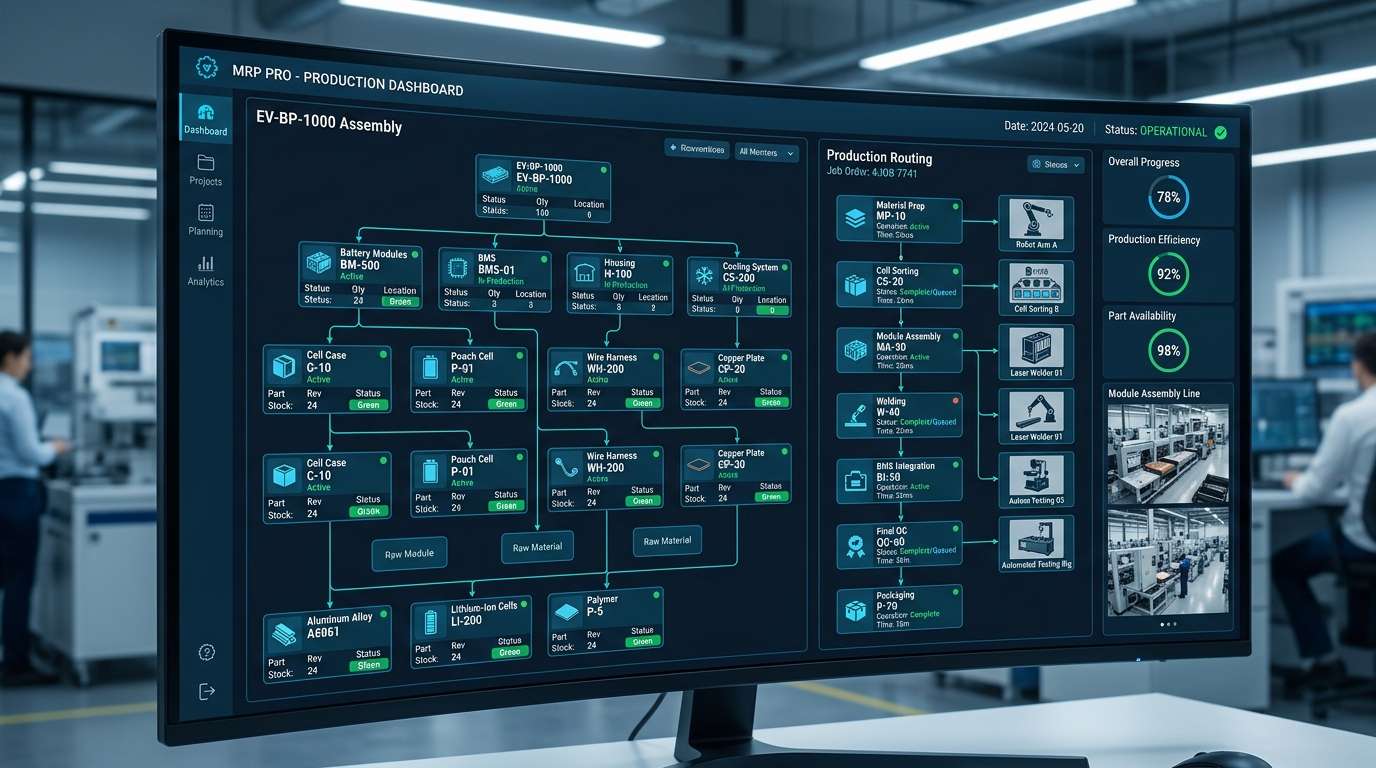
- BOM (Bill of Materials): Bill of materials data is precisely defined in a multi-level structure. For example: To make a table, the system specifies exactly 1 wooden top, 4 iron legs, 16 screws, and an allowable wood waste rate of 2%.
- Routing (Process routing): Declaring the sequence of processing steps, machine setup time, and machine run time as a basis for calculating labor and electricity costs.
Middle tier: Coordinating the factory’s heartbeat (Execution & Scheduling)
This is where algorithms exert their power to completely replace manual Excel spreadsheets.
- MRP algorithm (Material Requirements Planning): Based on the incoming order volume, the system automatically calculates backwards in time and subtracts the current inventory to issue accurate “Purchase Requisition Orders” down to the day.
- Finite capacity scheduling (APS): ERP will arrange Production Orders into the available time slots of machines, ensuring no machine is overloaded or idling.
Top tier: Cost accounting (Cost Roll-up)
The ultimate goal of manufacturing is profit. As soon as a batch is completed, the system immediately rolls up costs from the bottom up:
- Accumulating actual material issue costs.
- Allocating manufacturing overhead costs based on actual machine running hours.
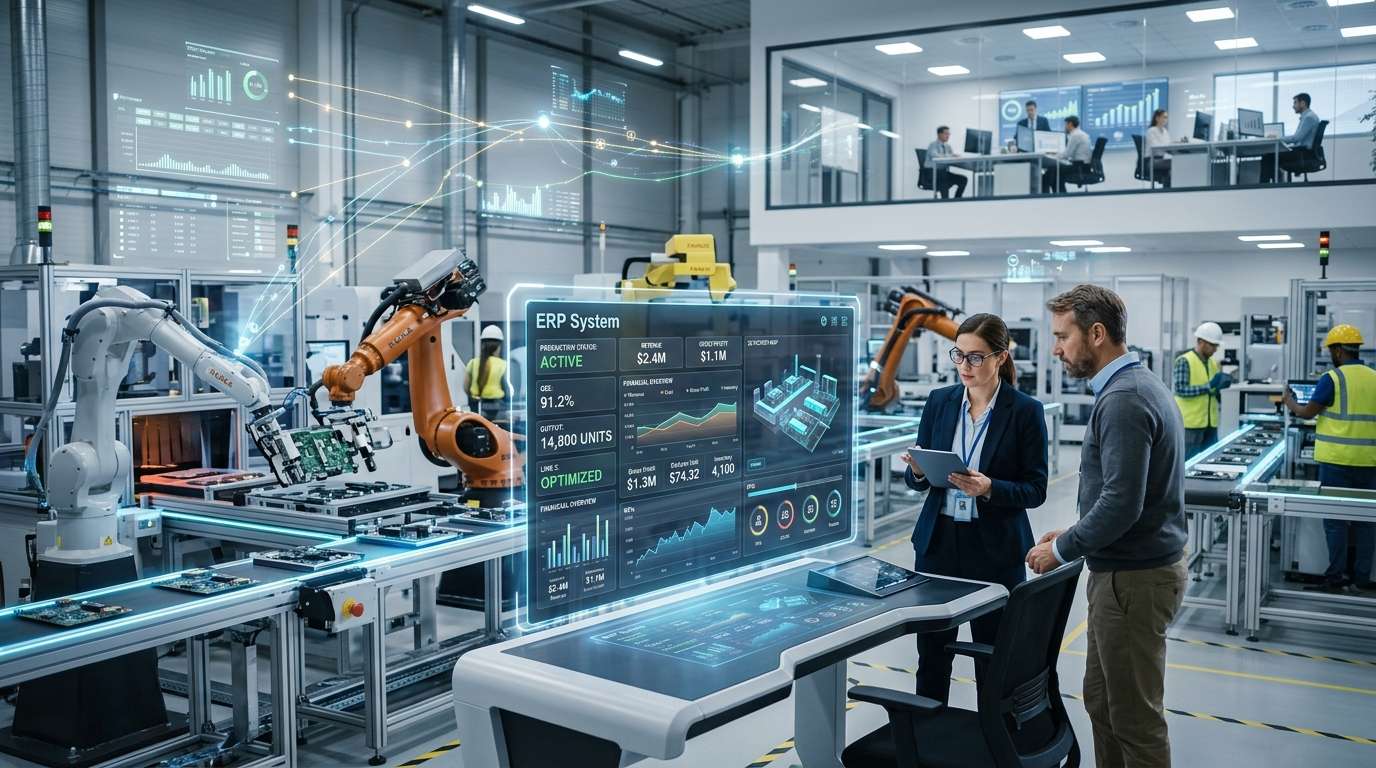
- Providing Actual Costing to compare with Standard Costing, helping the Board of Directors instantly know whether this batch is profitable or not, instead of waiting until the month-end closing period.
3. When should businesses “push the button” to upgrade their systems?
Trying to keep disjointed management software only adds “technical debt” to the organization. Businesses need to start upgrading their manufacturing management system when facing the following signals:
- Synthesizing inventory data and production progress takes too many days and depends on 1-2 key individuals.
- Frequently having to pay for overtime or high-cost air freight to compensate for plan deviations.
- High scrap rates without the ability to trace the root cause back to a specific work shift or material batch.
This image serves as an illustration for the article to help readers understand better
4. InfoAsia: Redefining the approach to manufacturing management projects
The market is not short of software, but it lacks consultants who truly understand industrial engineering and accounting cash flows. At InfoAsia, the project implementation methodology for factories is established based on discipline and system optimization.
- Data planning first, installation later: Failed projects are often due to “cramming” garbage data into new software. The InfoAsia team intensely focuses on standardizing the BOM and Routing structures for clients, ensuring sharp input data before launching the core SAP software Business One system.
- Expanding power through niche expertise: InfoAsia does not attempt to customize basic software to serve complex manufacturing. For large-scale factories, we directly apply the Beas Manufacturing solution – the world’s leading manufacturing management standard – to neatly handle capacity scheduling and multi-level costing algorithms.
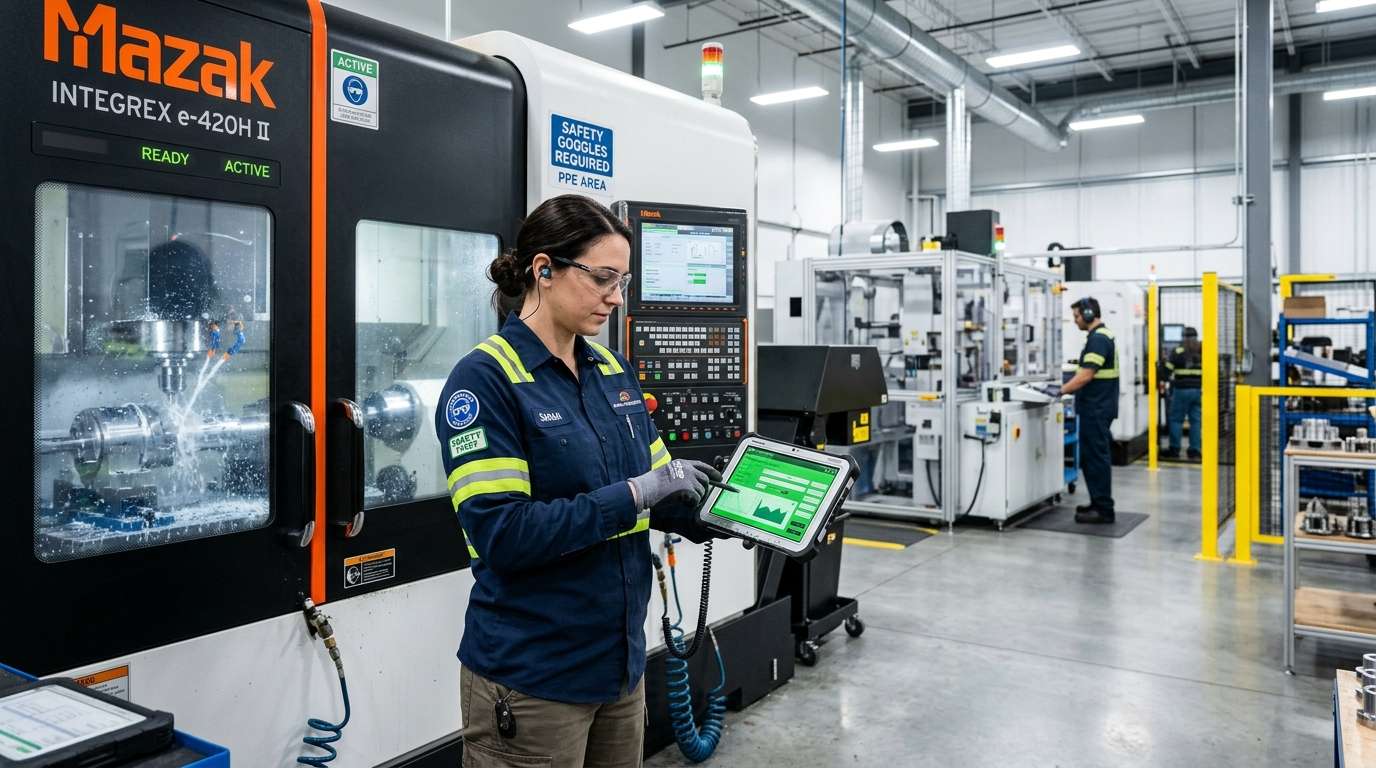
- Unblocking bottlenecks on the shop floor (Shop-floor Control): The biggest barrier is forcing workers to do complex data entry. With our mastery of integration techniques, InfoAsia provides communication portals (Terminal/Barcode Scanner) right at the assembly line. Workers simply scan codes to report stage completion, and the data automatically flows into the ERP core, optimizing both licensing budgets and operational time.
5. Frequently Asked Questions (FAQs)
Is manufacturing management erp software suitable for small-scale workshops?
Yes. Today, modern ERP systems are designed in modular forms. Small and medium-sized enterprises can start with core features like BOM and warehouse management, then expand further as they scale up without having to invest too large of an amount upfront.
Can shop-floor workers use this software?
InfoAsia’s solution focuses on the shop-floor experience. Instead of having to operate on desktop computers, workers only need to use barcode scanners or touch screens to quickly record stage progress.
How much time does implementation take?
Typically, a standard manufacturing ERP implementation project will take between 3 to 6 months, depending on the complexity of the manufacturing processes and the quality of the business’s current Master Data.
In conclusion, an effective manufacturing management erp software is a tool, and how it generates profit depends on the architect who designs it. Choosing an implementation partner with standard thinking and practical expertise like InfoAsia is the safest investment for businesses to establish a leading position in the global supply chain.

InfoAsia Việt Nam trở thành nhà cung cấp dịch vụ phần mềm số hóa nhà máy sản xuất cho thương hiệu giày hàng đầu thế giới NEW BALANCE
Công ty TNHH Mây Tre Hà Linh
SAP ERP MES and IOT Project for FVIV Factor
Buwon Industry Co, Ltd
KANGLONGDA VIETNAM PROTECTION TECHNOLOGY COMPANY LIMITED
Shini Group
TA TING PLASTIC (HAI DUONG ) CO., LTD
CÔNG TY TNHH MTV BIÊN HOA SCM