




When searching for a Vietnam manufacturing management software company, most businesses approach the task through the lens of their IT department: finding a tool that allows workers to easily input data, count quantities, and track progress. However, this mindset often leads to significant budget waste and fails to address the core challenges.
This article will completely shift that perspective by adopting a “Top-Down” approach: diving straight into a comprehensive architectural solution from a reputable implementation partner, and then dissecting the nature of manufacturing through the lens of Management Accounting (Cash Flow and Standard Costing). This helps the Board of Directors accurately measure the Return on Investment (ROI) when investing in software.
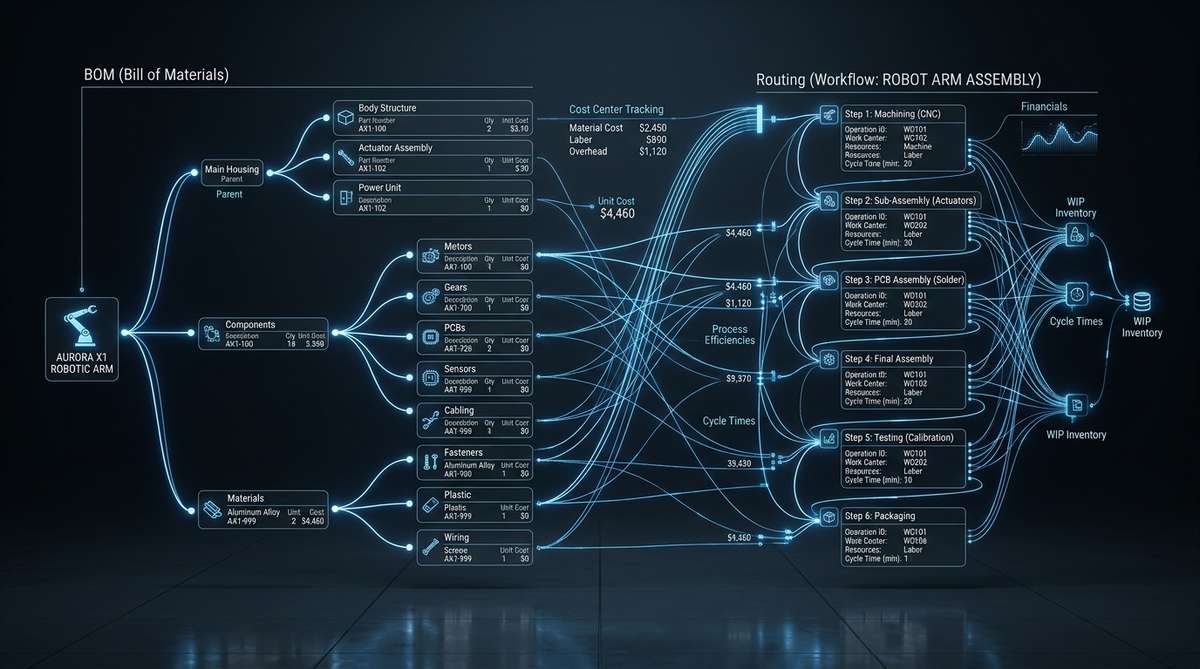
1. InfoAsia – Redefining Manufacturing Management Software from a Financial Viewpoint
Rather than just selling software for recording factory data, InfoAsia positions itself as an architect to restructure the financial and operational flow for enterprises. We tackle manufacturing challenges starting from the ultimate goal: Controlling Work in Progress (WIP) costs and calculating precise Standard Costing.
InfoAsia’s solution ecosystem is built on 4 practical pillars:
- Core Strength from SAP Business One & Beas Manufacturing: InfoAsia does not develop fragmented internal software. We implement the specialized Beas Manufacturing module running directly on the global financial platform, SAP ERP. This architecture flawlessly handles multi-level Bill of Materials (BOM) challenges and automatically accounts for production costs as soon as physical transactions occur.
- Database Mastery: A factory generates a massive amount of Big Data every minute. InfoAsia’s team of experts applies advanced SQL Server programming skills and performance tuning for Stored Procedures. Consequently, cost analysis and material waste reports are always retrieved instantly, avoiding system bottlenecks.
- Physical Infrastructure Integration (RFID/Barcode): To eliminate human errors, InfoAsia sets up an automated data collection ecosystem. Barcode scanners and RFID gates are directly integrated into the system, automatically triggering material issue commands (Backflush) when semi-finished goods pass through control stations.
- Digitalizing Approval Workflows with InfoAsia e-Office: All Production Orders, Inventory Issue Requests, or Procurement Proposals are synchronized from the core system to the InfoAsia e-Office digital workplace. The Board of Directors can monitor and approve budgets online via mobile devices, creating a seamless, zero-latency workflow.
2. The Nature of Manufacturing: The Circulation of Cash Flow (First-Principles)
To understand why a rigorous architecture like InfoAsia’s is necessary, we must view manufacturing from its first-principles. Manufacturing is not simply transforming the physical state of raw material A into product B. Inherently, it is a process of transferring financial value.
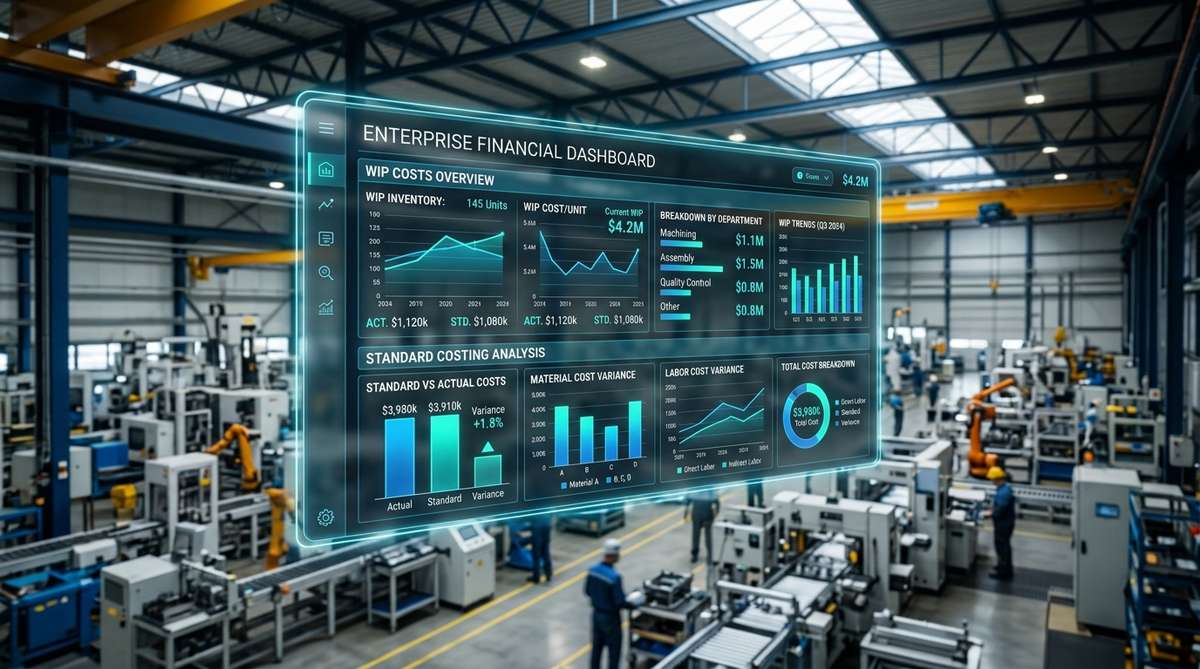
The Principle of Conversion: When a steel plate is cut, it’s not just a dimensional change. On the general ledger, the value of that steel plate (Direct Material Cost) plus the cutter’s wages (Direct Labor Cost) and the cutting machine’s electricity (Manufacturing Overhead Cost) must be aggregated to form the Work in Progress (WIP) Value.
Data Consistency: Any scrap generated on the assembly line means the enterprise has just lost a corresponding amount of cash. The manufacturing management software must act as an “automated accountant,” immediately recording this financial depreciation rather than waiting for the month-end closing cycle.

3. Three “Cracks” Draining Profits When Choosing the Wrong Software
Many factories are using cheap, fragmented enterprise management software that lacks financial integration. This disconnect creates invisible “cracks” that swallow profit margins:
- Crack 1: Cost Averaging and Costing Illusions: If the software cannot record actual machine running times for each production order, accountants are forced to allocate overheads (electricity, water, depreciation) evenly. Consequently, product A (which actually takes less machining time) ends up bearing the cost for product B (which takes more time). The business might be selling product B at a loss without even realizing it.
- Crack 2: The WIP Blackhole: Lacking the capability to break down the Routing structure through each workstation, the software won’t know which stage the goods are currently in. Billions of dong in cash flow turn into an invisible “black hole” on the assembly line, causing working capital congestion.
- Crack 3: Waste due to Capacity Delusions: Poor planning software schedules based on infinite capacity (assuming machines run 24/7). When a machine actually breaks down or materials run out, the factory is forced to put workers on Overtime at 1.5x salary to meet delivery deadlines, collapsing the entire profit structure of that order. Automating procurement and Material Requirements Planning (MRP) is mandatory to avoid this scenario.
4. The Anatomical Architecture of Profitable Software
A truly capable Vietnam manufacturing management software company must provide a technological architecture capable of patching these “cracks.” By implementing advanced platforms such as an in-depth MES system, this architecture involves 3 logical tiers:
- Master Data Definition: Building the DNA of the product.
- BOM (Bill of Materials): Precisely declaring every screw, millimeter of electrical wire, and allowable Scrap rate.
- Routing: Declaring standard Run time and Setup time for each operation.
- Finite Capacity Scheduling: Applying mathematical algorithms to sequence production orders. The software automatically fills machine schedule gaps based on order priority, ensuring no machine is overloaded or left idling.
- Real-time Costing Control: Directly linking production orders to the chart of accounts. When the shop floor reports completion, the system immediately executes journal entries to deduct materials and record the Actual Costing.
5. Partner Evaluation Criteria for the Board of Directors
Investing in manufacturing software is not an operational expense for purchasing tools, but a Capital Expenditure (CAPEX) to protect cash flow. The Board of Directors should pose 2 core questions to evaluate the implementation company’s capabilities:
- “Can you explain how the system allocates Manufacturing Overhead costs into Work in Progress (WIP) values?”
- Evaluation Criteria: The consulting team must possess hybrid knowledge. They must not only be IT engineers but also experts in Manufacturing Accounting and Industrial Systems Engineering.
- “When my factory has 1 million production orders in the database, how long does it take to load the material waste analysis report?”
- Evaluation Criteria: Database mastery. The partner must demonstrate their ability to write and optimize SQL Server query commands (Stored Procedures) to ensure the system consistently extracts data at high speeds.
The difference between a factory struggling with stagnant capital and one boasting high profit margins lies in the accuracy of information. Choosing the right Vietnam manufacturing management software company that possesses sharp financial acumen, mastery of global software platforms, and deep data architecture like InfoAsia is the strategic move for businesses to master the rules of the game in the digital era.
6. Frequently Asked Questions (FAQs)
Why shouldn’t the IT department be the primary decision-maker when choosing manufacturing software?
Because manufacturing software directly impacts cash flow and product costing. IT can evaluate system stability, but the Board of Directors and Chief Accountant are the ones who truly understand cost allocation, WIP management, and profit margin optimization.
Does the business need to replace its entire existing accounting system?
It depends on your digital transformation strategy. However, to synchronize manufacturing and financial systems in real-time (Real-time Costing), implementing a comprehensive ERP solution like SAP Business One from InfoAsia eliminates latency and data fragmentation compared to using multiple disparate software programs.
How long does it take to implement an in-depth manufacturing management system?
Implementation time depends on the scale and complexity of Routings in the factory. Typically, a professional implementation project by InfoAsia takes 4 to 6 months, starting from Master Data standardization to full system Go-live.

InfoAsia Việt Nam trở thành nhà cung cấp dịch vụ phần mềm số hóa nhà máy sản xuất cho thương hiệu giày hàng đầu thế giới NEW BALANCE
Công ty TNHH Mây Tre Hà Linh
SAP ERP MES and IOT Project for FVIV Factor
Buwon Industry Co, Ltd
KANGLONGDA VIETNAM PROTECTION TECHNOLOGY COMPANY LIMITED
Shini Group
TA TING PLASTIC (HAI DUONG ) CO., LTD
CÔNG TY TNHH MTV BIÊN HOA SCM