




warehouse automation is a vital step, but it often hits a dead end when the hardware systems on the factory floor cannot communicate with the high-level management software. At a large-scale precision mechanical factory, the supply chain director once faced a critical dilemma: the AGV robots transporting steel billets operated smoothly 24/7, but the inventory data on the system was delayed by half a day compared to reality. As a result, the purchasing department constantly ordered excess materials, while the assembly line had to halt due to a lack of synchronized parts. The problem did not stem from human error or machine failure, but from the lack of an industry-standard data connection bridge. Establishing the right communication protocols between peripheral devices and the management system is the only key to eliminating “data silos” and ensuring absolute transparency in material flow.
Key Takeaways:
- Identify the vital role of Middleware in translating raw electronic signals from sensors and robots into readable production scheduling commands and financial reports.
- Understand the technical characteristics of the three most popular connection protocols today: OData RESTful API, BAPI, and IDoc, thereby choosing the most suitable method for the factory’s current network infrastructure.
- Recognize fatal security vulnerabilities when opening internal local area network (LAN) communication ports to the internet environment, and equip yourself with knowledge about transmission encryption to protect corporate digital assets.
- Draw profound lessons from real-world digital transformation projects, proving that real-time data synchronization can cut down redundant warehousing costs by up to 40 percent.
- Provide criteria for evaluating hardware and software capabilities, supporting the board of directors in making accurate investment decisions and avoiding wasting resources on incompatible technologies.
1. The foundational architecture of industrial data transmission networks
Connecting data between the factory floor and the central management software is not simply a matter of plugging in a physical network cable. Hardware systems, including conveyor belts, robotic arms, and barcode scanners, often use low-level programming languages, emitting thousands of binary signals per second. Meanwhile, the management software operates on complex relational database structures, requiring information to be packaged into business fields (such as material codes, batch numbers, and production dates).
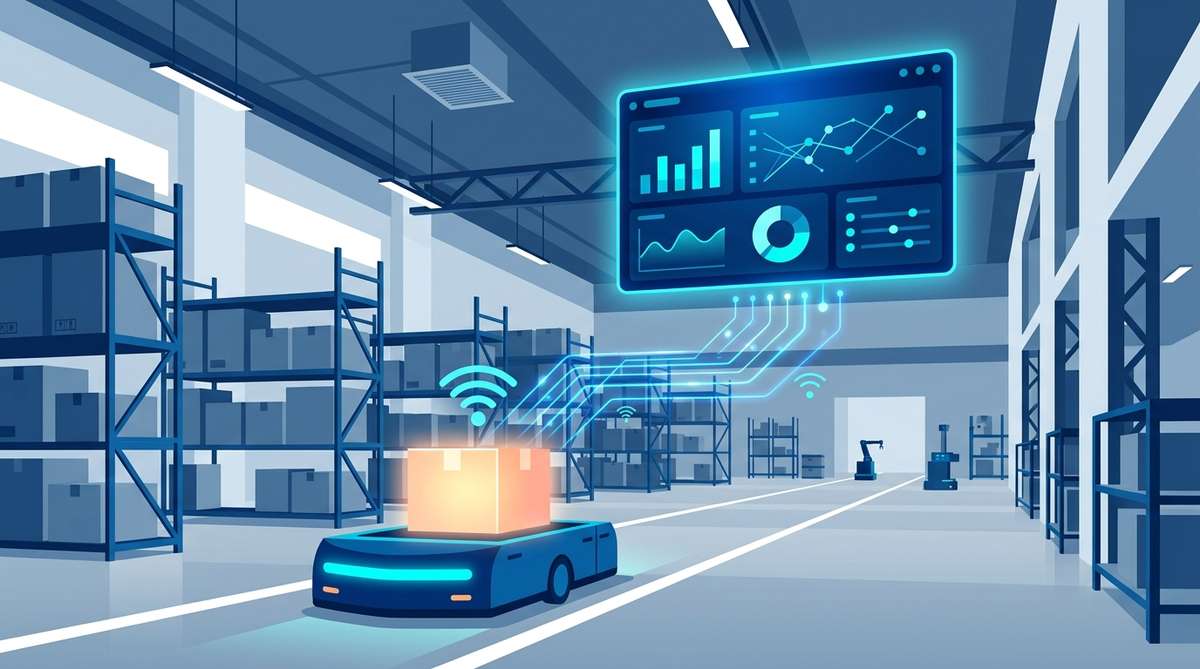
To resolve this discrepancy, system engineers must deploy a Middleware layer acting as a bilingual interpreter. This intermediate layer is responsible for collecting all raw data from the physical layer, filtering out noise signals, standardizing formats, and pushing them directly to the server system via the internal network. In this way, every physical movement on the floor, no matter how small, is immediately digitized and recorded, creating a comprehensive picture that is accurate to the second.
2. Classification of popular warehouse automation connection protocols
In the world of industrial information technology, there is no single protocol that is absolutely perfect for every model. Chief Information Officers (CIOs) must base their decisions on the frequency of data updates, the volume of information to be transmitted, and the processing capacity of the server to choose the appropriate method. Choosing the wrong protocol not only causes internal network bottlenecks but also crashes the entire operating system when transaction volumes surge.
Below is a detailed comparison table of the three most popular data connection methods widely used in large-scale factories:
| Evaluation Criteria | OData RESTful API | BAPI (Business Application Programming Interface) | IDoc (Intermediate Document) |
|---|---|---|---|
| Technical characteristics | Communicates via HTTP/HTTPS, lightweight JSON format | Direct Remote Function Calls (RFC), tight coupling | Asynchronous data exchange, large block formats |
| Response speed | Real-time, latency under 100ms | Very fast, requires absolute network stability | Slower, batch processing oriented |
| Bandwidth requirement | Very low, suitable for mobile devices and IoT sensors | High, requires an extremely robust internal network infrastructure | Medium, does not require continuous connection |
| Practical application | Scanning barcodes on tablets, instant inventory queries | Initiating production orders, large-scale material issues | Sending end-of-shift reports, multi-branch data synchronization |
| Security level | Easy to set up SSL/TLS encryption, OAuth2 authentication | High security as it resides deep within the internal network | Requires strict file system authorization management |
Successfully implementing a project requires the deployment team to have deep expertise in software architecture, high customization capabilities, and a thorough understanding of production business processes. This is why consulting international standard MES software solutions for factories has become more urgent than ever, to ensure the system can scale infinitely in the future.
3. Proven success from supply chain digitalization projects
The difference between a loosely connected system and a deep integration network is clearly demonstrated through incident handling scenarios. Let’s review real-world cases that have proven the value of mastering data transmission protocols.
Case Study 1: Eliminating phantom negative inventory at a textile factory
An export garment enterprise once struggled because the automatic product counting system on the conveyor belt did not synchronize in time with the management software. When the export department created an order to pack the container, the software reported a shortage (phantom negative inventory), forcing them to buy more from external suppliers at an exorbitant price. By switching from a file-push protocol (IDoc) to direct function calls (BAPI), the data update time was reduced from 30 minutes to 1 second. The phantom negative inventory situation completely disappeared, saving the enterprise billions of dong in emergency purchasing costs every month.
Case Study 2: Preventing network congestion at a cold storage warehouse
With thousands of temperature and humidity sensors continuously sending signals back to the server, a seafood factory experienced bandwidth overload, crashing the internal operating network. The engineering team decided to restructure the data flow, switching to OData RESTful API with JSON compression mechanisms. As a result, the volume of transmitted data was reduced by 80 percent, freeing up network bandwidth while still ensuring temperature alerts were recorded instantly, protecting tens of millions of dollars worth of assets.
Case Study 3: Synchronizing the operational flow of AGV robots
Integrating dozens of AGV robots running randomly in a mechanical workshop requires an extremely intelligent communication method. Instead of letting each robot send data directly back to the server, the factory set up an Edge Computing station. This station continuously collects the robots’ movement data via industrial Wi-Fi, then packages and sends it to the management software via the BAPI protocol. This approach helped minimize the number of direct queries to the database server by 90 percent, ensuring the system always operates smoothly even during peak shipping hours.
The smoothness of material flow cannot be separated from an accurate production scheduling plan. If you are facing delays due to unannounced material shortages, exploring the mechanism of automated purchasing and freeing up inventory capital (MRP) will open new directions to optimize the entire supply chain.
To ensure your warehouse automation project stays on track and avoids costly technical traps, contact the expert team at INFOASIA today. We are ready to provide the most intuitive Demo, sketching a specialized data connection roadmap tailored to your factory’s specific characteristics.
4. FAQs
Is using industrial Wi-Fi to transmit data safe against cyberattack threats?
Every wireless connection protocol comes with risks; however, if properly set up with WPA3-Enterprise encryption layers, combined with digital certificates (SSL/TLS) and two-factor authentication (OAuth2), your data will be extremely well-protected. Network segmentation (VLAN) separating the production area from the office is also a mandatory checkpoint.
If the internal network connection drops midway, will barcode scanning data on the floor be lost?
Modern industrial barcode readers or specialized tablets are equipped with local cache memory (Local Storage). When the connection is interrupted, the data will be temporarily stored on the device. As soon as the network is restored, the system will automatically synchronize (Sync) back to the central software, ensuring not a single transaction is missed.
What is the average time to fully deploy a data connection architecture between hardware and software?
Depending on the scale and complexity of the peripheral devices, a project to configure Middleware and set up protocols usually lasts from 3 to 6 months. This time is primarily spent load testing and troubleshooting data flow disruptions in a simulated environment before going into actual operation.
Do small businesses necessarily have to invest in a private server to process data connections?
Not at all. With the development of cloud computing, small and medium enterprises can leverage Cloud network infrastructure to process data via OData RESTful API gateways. This significantly reduces initial hardware investment and server room maintenance costs, while still ensuring stable connection performance.

InfoAsia Việt Nam trở thành nhà cung cấp dịch vụ phần mềm số hóa nhà máy sản xuất cho thương hiệu giày hàng đầu thế giới NEW BALANCE
Công ty TNHH Mây Tre Hà Linh
SAP ERP MES and IOT Project for FVIV Factor
Buwon Industry Co, Ltd
KANGLONGDA VIETNAM PROTECTION TECHNOLOGY COMPANY LIMITED
Shini Group
TA TING PLASTIC (HAI DUONG ) CO., LTD
CÔNG TY TNHH MTV BIÊN HOA SCM