




In modern manufacturing, there is always a data “blind spot” between the ideal plans in the boardroom (ERP) and the actual machinery operations on the shop floor. To eliminate this disconnect, managers turn to MES (Manufacturing Execution System)—an execution system acting as the factory’s “nervous system.”
So, what is the essence of MES? What does its architecture look like, and how does it impact a company’s bottom line? This comprehensive article from InfoAsia will help you decode everything.
1. What is MES?
1.1 Definition of MES (Manufacturing Execution System)
MES (Manufacturing Execution System) is a specialized manufacturing execution and management software designed to connect, monitor, and control all shop-floor operations in real time.
Unlike static accounting or warehousing software, MES operates as a “dynamic control center.” The system continuously acquires signals from machine sensors, PLCs, and operator inputs to issue instant instructions and alerts, ensuring the transformation from raw materials to finished goods occurs precisely according to the routing and bill of materials.
1.2 Meaning in Vietnamese and Origin of the Term
In professional terminology in Vietnam, MES is often referred to as “Hệ thống Thực thi Sản xuất” (Manufacturing Execution System) or “Phần mềm Điều hành Nhà máy” (Factory Management Software).
The word “Execution” is the key to this term. The MES concept emerged in the 1990s when the industrial sector realized that while ERP software excelled at “planning” (finances, materials), it was entirely blind to how the shop floor “executed” those plans. MES was created to bridge this gap, translating paper plans into detailed control actions for machinery.
1.3 The Role of MES in Modern Manufacturing Systems
Within the architecture of a Smart Factory, MES acts as a central processing brain.
- Seamless Coordination: Upon receiving production orders from the ERP, the MES automatically assesses current machine capacities, breaks down the orders, and allocates materials to the right production lines and shifts.
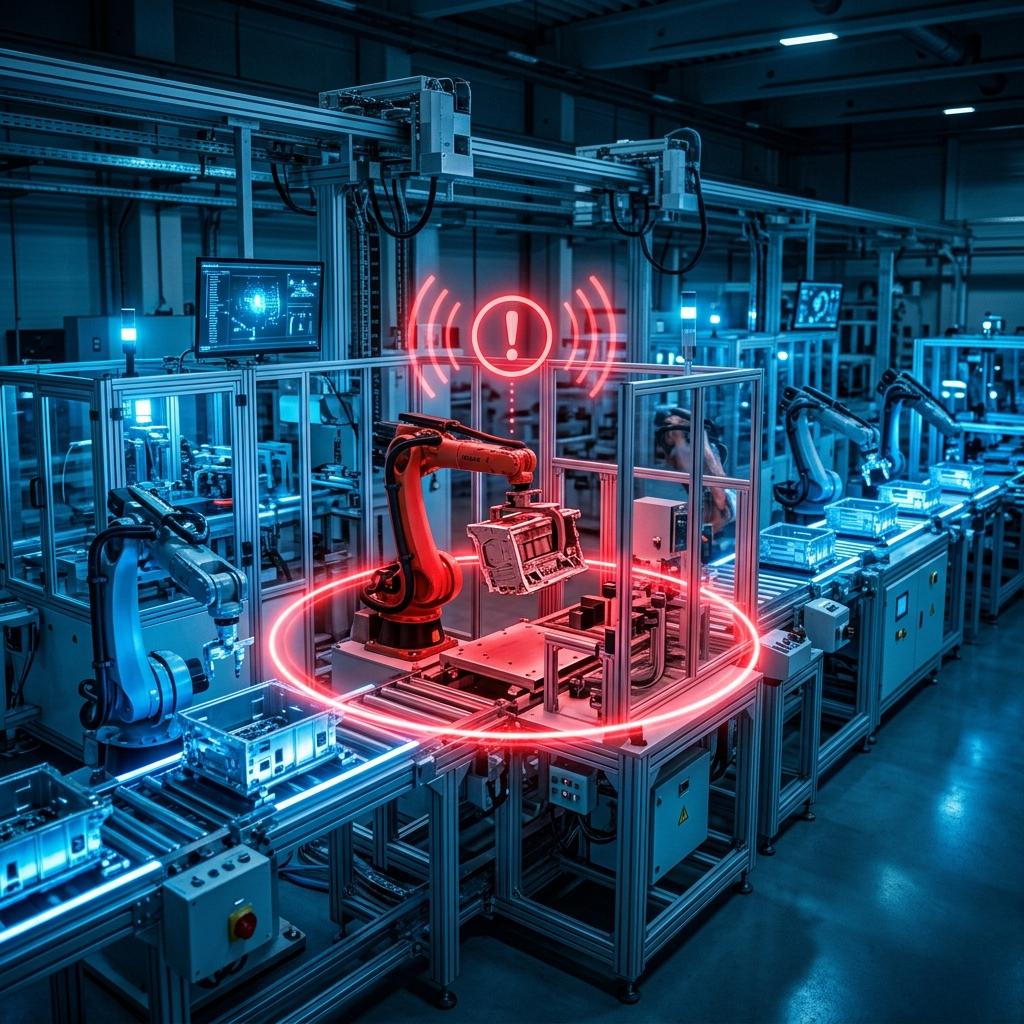
- Agility: If a workstation reports an error or input materials fall short, the MES instantly flashes a red alert and automatically proposes backup workflows to prevent production line disruption.
- FDI Quality Assurance: Particularly in Vietnam, satellite factories in the electronics, pharmaceutical, and food industries must have an MES in place to meet the strict traceability standards of global corporations.
2. Core Functions and Architecture of an MES
2.1 Core Functions of MES
The power of a standard MES is defined by the following 5 functional pillars:
- Scheduling and Production Order Management: Breaking down master orders into operational routings and scheduling machine runs to optimize capacity and setup time.
- Real-time Data Acquisition: Automatically gathering data from processing machines (temperature, RPM, cycle times) to visually reflect shop-floor status via instant dashboards.
- Quality Control (QC/QA) & Traceability: Recording all measurement parameters at every inspection checkpoint. If a defective product (scrap) is detected, the MES immediately locks the batch and logs the material codes to trace the root cause.
- Labor & Equipment Management: Logging actual working hours of line operators and counting down machine operating times to issue preventive maintenance orders, avoiding sudden breakdowns.
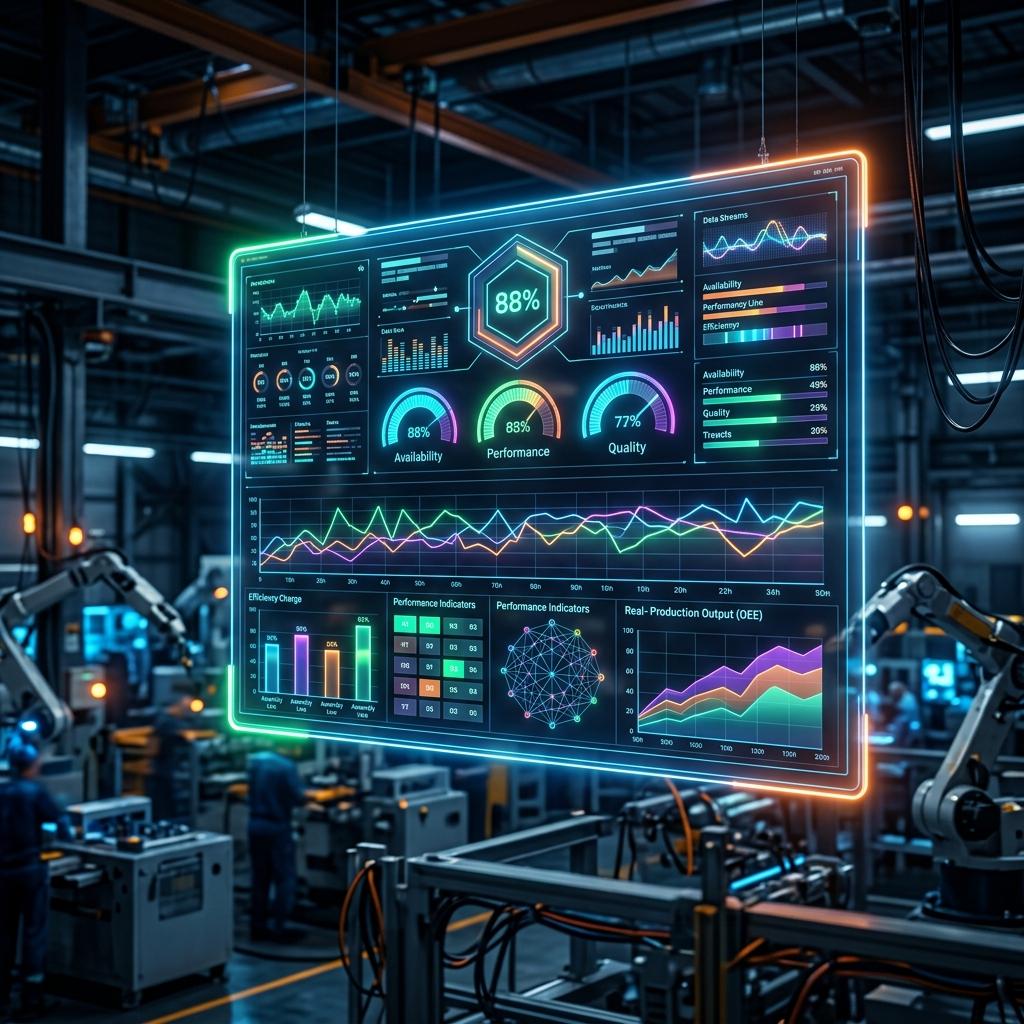
- Overall Equipment Effectiveness (OEE) Measurement: Automatically calculating OEE metrics based on 3 factors: Availability x Performance x Quality.
2.2 Components of MES Architecture and How It Operates
A standard MES is designed following a 3-Tier Architecture:
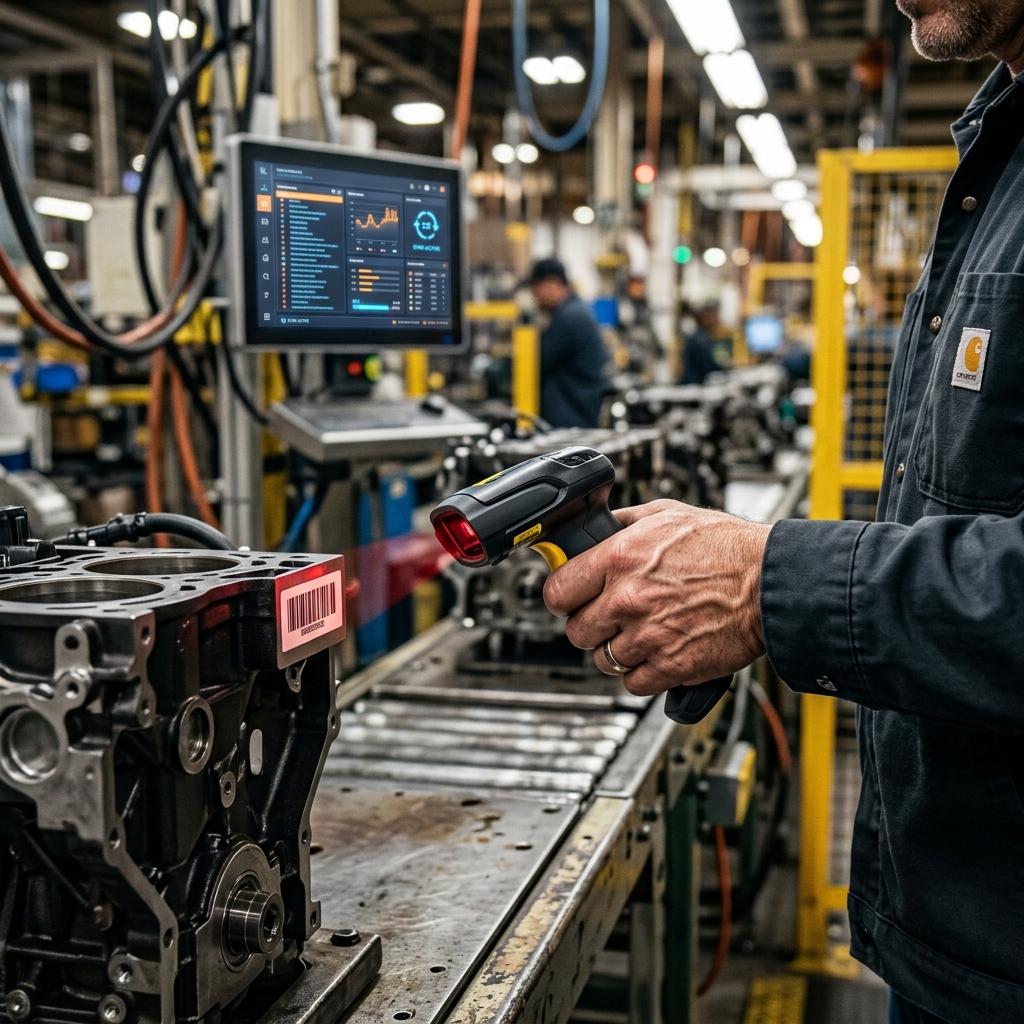
- Edge/Device Layer: Comprises IoT sensors, barcode/QR scanners, and PLC/SCADA controllers attached directly to the production line. This layer is responsible for “listening, seeing,” and digitizing physical movements.
- Middleware/Server Layer: Where the MES server receives millions of raw data points, filters them, calculates, and cross-references them with predefined technical standards to make decisions.
- UI/Dashboard Layer: Visualizing data into comprehensive dashboards. Interfaces are customizable: Operator screens (showing assembly instructions), Supervisor screens (showing shift progress), and Director screens (displaying plant-wide OEE).
2.3 Integrating MES with Other Systems: ERP, SCADA, IoT
An MES never operates in a vacuum. Its true power is unleashed when integrated:
- MES & ERP: MES receives Production Orders and Bills of Materials (BOM) from the ERP; it then sends back finished production reports and actual material consumption for accurate Cost of Goods Sold (COGS) accounting in the ERP.
- MES & SCADA/PLC: While SCADA controls valve openings/closings or conveyor speeds, MES retrieves this data to analyze whether production cycles are running ahead or behind schedule.
- MES & IoT: Industrial Internet of Things sensors allow MES to extend its reach into every corner of the factory, monitoring cold storage temperatures and power consumption, thereby delivering absolute accuracy.
3. Practical Benefits of Implementing MES
3.1 Increasing Efficiency and Optimizing Production Processes
MES eliminates invisible “downtime.” By accurately tracking progress at each workstation, the system coordinates material delivery precisely when the machine needs it (Just-in-Time), eliminating piled-up Work-In-Progress (WIP) inventory. When urgent orders are inserted, MES algorithms recalculate the entire production schedule in seconds—a task that would take humans hours using Excel.
3.2 Data Transparency and Rapid Decision Support
With an MES, the factory is no longer a “black box.” Large-screen dashboards clearly display which lines are running and which machines are stopped due to errors. Supervisors can intervene immediately when production speeds drop, rather than waiting for paper reports at the end of the shift to discover that daily targets were missed.
3.3 Reducing Waste and Defects, Enhancing Quality Control
The system enforces compliance with Standard Operating Procedures (SOPs). If an operator scans the wrong material code, the machine will refuse to start. Detecting errors right at the processing stage (In-line QC) prevents defective products from slipping into subsequent operations, safeguarding brand reputation and saving millions in material losses annually.
3.4 Meeting Compliance and Product Traceability Requirements
In Food & Beverage (FDA, HACCP) or Pharmaceuticals (GMP), if a batch is recalled, MES enables companies to trace the entire “genealogy” of that product with a single click. You will know exactly what day the raw materials were purchased, which machine it ran on, which operator was in charge, and what the oven temperature was at that exact moment.
4. Comparing MES with Other Manufacturing Management Systems
4.1 MES vs. ERP
- Perspective: ERP focuses on finance and cash flow (Macro); MES focuses on machinery and speed (Micro).
- Timeframe: ERP accounts by day, week, or month; MES pulses continuously by the second and minute.
- Users: ERP is for the back-office (Accounting, Procurement); MES is for the shop floor (Engineers, Shift Leaders, Operators).
- In Summary: ERP tells you “What needs to be produced to make a profit,” while MES ensures “Producing it fastest, cheapest, and to standard.”
4.2 MES vs. SCADA and PLC
- PLC is the hardware device that commands a motor to spin or stop.
- SCADA is the software that allows engineers sitting in air-conditioned control rooms to press buttons controlling PLCs.
- MES takes data from SCADA to generate management reports: How many times did the machine stop today? What were the downtime reasons? What was the OEE score?
4.3 The Role of MES in a Smart Factory
In the ISA-95 pyramid (the standard for system integration), MES is the intersection point (Layer 3) connecting Information Technology (IT) and Operational Technology (OT). Without MES, a factory cannot truly be called smart, because machine data (OT) will forever be trapped on the shop floor without ever translating into business strategy (IT).
5. Practical Applications and MES Implementation Process in Vietnamese Enterprises
5.1 Steps to Implement MES in a Factory
For a successful MES deployment, companies must undergo a rigorous roadmap:
- Bottleneck Analysis: Mapping the actual current processes (As-Is) to identify the most wasteful stages.
- Solution Selection: Seeking MES software with an open architecture that easily interfaces with existing CNC/PLC machines and the current ERP system.
- Design & Customization: Standardizing material codes, Work Center structures, and OEE measurement rules.
- Pilot Run: Trialing the system on a simple production line to let operators acclimatize and to debug industrial network connections.
- Go-live & Training: Rolling out plant-wide, completely eliminating paper logbooks, and requiring the workforce to interact 100% through HMI screens.
5.2 Practical Examples Across Industries: Electronics, Pharmaceuticals, Food, Automotive
- Electronics Industry (Bac Ninh): MES manages the Serial/MAC Addresses of millions of circuit boards, ensuring clients like Apple or Samsung can trace component origins down to Tier-3 suppliers.
- Pharmaceutical Industry (Hanoi): MES establishes “Electronic Batch Records” (eBR) to automatically record chemical weights, eliminating handwriting errors and breezing through GMP inspections.
- Plastics & Packaging: MES strictly monitors injection molding temperatures and accurately calculates scrap plastic for recycling, optimizing cost structures.
5.3 Common Challenges and MES Implementation Experience
- Workforce Resistance: Older operators are often intimidated by touch screens and believe that scanning badges or entering data slows down progress. Solution: The MES interface must be highly intuitive, featuring large buttons and clear color-coding (Green/Red).
- Broken Device Connectivity: Legacy machines lack data export ports (Ethernet/RS485). Solution: Utilize external IoT Gateways to capture indirect signals (such as current draw or vibrations).
- Lack of ERP Synchronization: Inconsistent Units of Measure (ERP using Tons, MES using Kg). Solution: Engage a consulting partner proficient in both ERP and MES to establish an accurate data mapping table.
6. Future Trends of MES and Smart Factories
6.1 MES and the Digital Transformation Trend
MES is no longer a heavy, on-premise hardware server sitting on the shop floor. The Cloud MES trend allows businesses to pay a monthly subscription fee (SaaS) while enjoying a powerful system, enabling them to monitor their factory via an iPad anytime, anywhere.
6.2 MES Integrated with AI, IoT, Big Data, and Manufacturing Automation
Once MES has collected enough Big Data, Artificial Intelligence (AI) steps in. Machine Learning algorithms will analyze machine vibrations to predict: “Press Machine No. 4 will have a bearing failure in the next 72 hours.” This creates the concept of Predictive Maintenance, saving millions of dollars in repair costs.
6.3 The Future of MES in Smart Manufacturing Strategy and Industry 4.0
Advancing into Industry 4.0, MES will integrate with Digital Twins. Managers can create a 3D “virtual factory” on their computers. They can run scenario simulations: If capacity is increased by 20%, which machine will overload? All risks are tested in the digital realm before being applied to the real world.
7. Connecting MES with the Enterprise’s Overall Management Ecosystem
To awaken its maximum potential, MES cannot stand alone. It must be a core module deeply embedded within the overall ERP Management Ecosystem.
At InfoAsia, we understand that the best solution is a “seamless” system. That is why we provide Beas Manufacturing (MES/Advanced Manufacturing) — a solution natively integrated into SAP Business One (ERP).
This combination delivers a perfect closed-loop value chain:
- Finance Linked with the Shop Floor: The amount of plastic consumed logged in the MES immediately translates into Cost of Goods Sold (COGS) in SAP B1 accounting software.
- Accurate Logistics: The WMS warehouse system receives signals from the MES, automatically issuing materials just before the machine runs out.
- Seamless Quality Control: The QC department detects defects on the floor, and the data automatically flows to the Procurement department via the ERP to evaluate and deduct credit scores from the material supplier.
When implementing InfoAsia’s ERP-integrated MES solution, businesses are not just buying software; they are investing in a roadmap to elevate their manufacturing capabilities to international standards.
8. Conclusion
Implementing MES software is not a passing trend but a prerequisite for manufacturing enterprises to survive and avoid being marginalized from global supply chains. From calculating OEE and controlling quality to tracing defects within a minute, MES has proven the power of a true “execution” system.
If your business is struggling with high scrap rates, delayed deliveries, or unexplained machine downtime, it is time to put an MES into operation. Let your shop-floor data speak, and turn every machine movement into tangible profits!
9. Frequently Asked Questions (FAQs)
Q1: Is this system required to run in parallel with an ERP?
A1: It can run independently, but it will create a “Data Silo.” When you directly integrate it with comprehensive management software, all shop-floor fluctuations (from material shrinkage to labor hours) instantly flow back to the company’s financial ledger. You buy software for synchronization, not to create more manual data entry work for accountants.
Q2: Can older operators with poor eyesight use the software?
A2: The shop-floor Terminal interface is unlike an office computer screen. It is designed with a touch-first mindset, featuring oversized buttons and clear warning colors. Operators only need to hold a barcode scanner and tap the “Start” button—no keyboard typing required. Just 1-2 hours of training is enough for them to master the operations.
Q3: Will the cost to implement this smart MES solution equal our entire revenue?
A3: If you weigh the costs of buying paper and ink, the salaries for three manual Excel data entry clerks each month, and especially the massive amounts lost due to scrap not being intercepted in time, the cost of MES software is negligible. Today’s SME solutions come in pre-packaged versions, with implementation times measured in months and extremely rapid Return on Investment (ROI).
Q4: How does the system know if a machine is stopped due to an electrical fault or out-of-material error?
A4: Through IoT connectivity, sensors notify the software that the press machine has been idle for more than 3 minutes. At this point, the workstation screen flashes red, compelling the operator to select a downtime reason (Power Outage, Broken Blade, Out of Blanks, etc.) from a pre-defined list. This data is a “gold mine” for the maintenance team to analyze and plan preventive repairs in the future.

InfoAsia Việt Nam trở thành nhà cung cấp dịch vụ phần mềm số hóa nhà máy sản xuất cho thương hiệu giày hàng đầu thế giới NEW BALANCE
Công ty TNHH Mây Tre Hà Linh
SAP ERP MES and IOT Project for FVIV Factor
Buwon Industry Co, Ltd
KANGLONGDA VIETNAM PROTECTION TECHNOLOGY COMPANY LIMITED
Shini Group
TA TING PLASTIC (HAI DUONG ) CO., LTD
CÔNG TY TNHH MTV BIÊN HOA SCM