




Factory managers often face a paradox: Accounting or ERP systems report that raw materials are available, but when workers run the machines, they run short. At the end of the month, heated arguments erupt between Accounting and the Shop Floor because inventory numbers mismatch by thousands of dollars, productivity drops, and no one knows where the fault lies. This is when the ERP system reveals its limitations on the shop floor, and why you need an MES System.
In this article, we’ll break down exactly what an MES System is, and why integrating ERP and MES has become the “golden key” for manufacturing enterprises to fundamentally eliminate waste and boost productivity.
1. What is an MES System? Why do large factories rely on it?
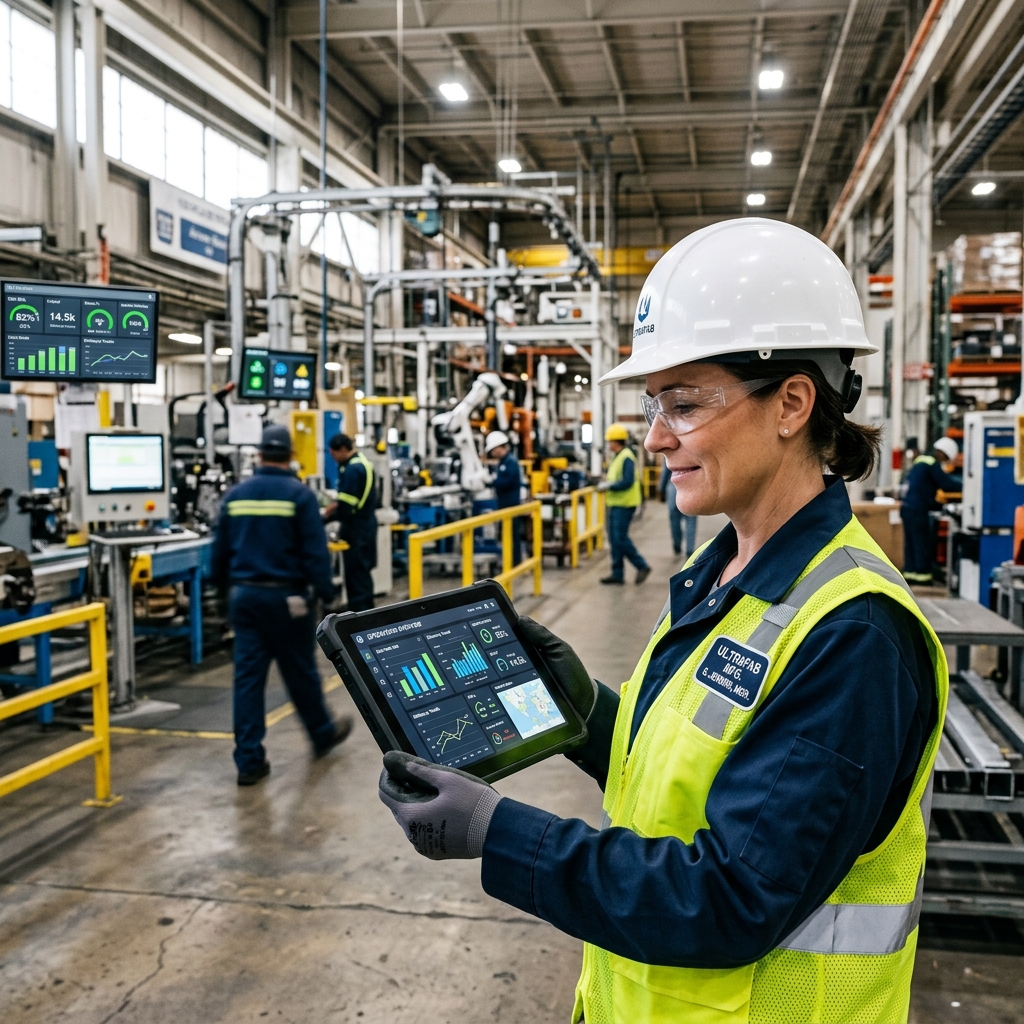
MES System (Manufacturing Execution System) is a specialized software solution designed to track, control, and document the transformation of raw materials into finished goods on the shop floor in real-time.
Imagine this: If ERP is the “Brain” of the company, handling broad issues like procurement, sales, HR, and finance, then MES is the “Nervous System” connecting the brain down to the fingertips (machines, workers on the assembly line).
MES doesn’t care about tax invoices; MES cares about:
– What product code is Injection Molding Machine #3 running?
– Worker A just scrapped 5 defective parts at the cutting station.
– CNC Machine #5 has been down for 45 minutes due to a jammed workpiece.
The numbers speak for themselves:
Numerous case studies show that after implementing MES, factories typically reduce cycle time by 15% – 20%, cut scrap rates by 10% – 15%, and eliminate up to 40% of manual paper-based data entry. For a factory with millions in revenue, a 2% reduction in material waste equates to massive annual savings.
2. ERP and MES: Why ERP alone is not enough?
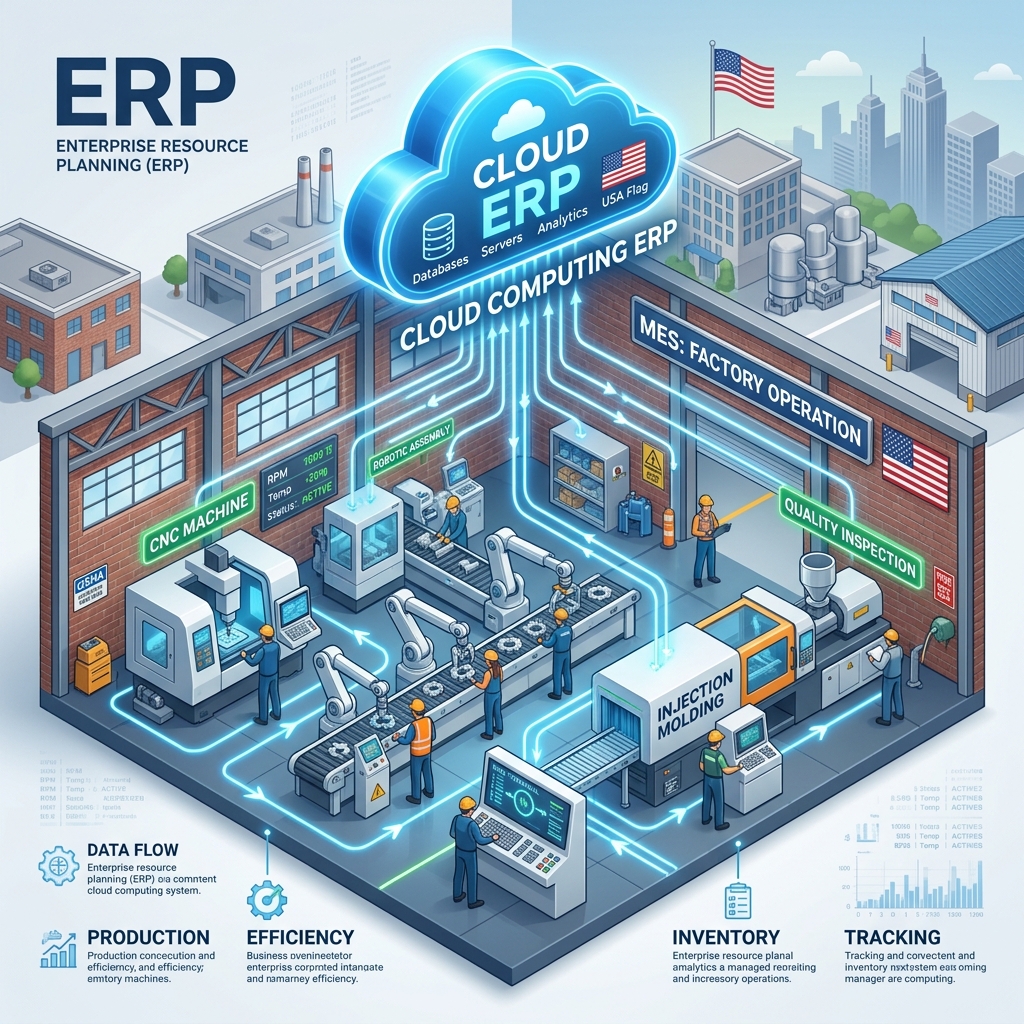
Many companies have invested tens of thousands of dollars in ERP software only to find that shop floor operations remain a “black box.” Why?
Because ERP was built to manage the Business Flow, updating data daily or per shift. Meanwhile, on the production floor, things change by the second.
When a Work Order is issued from the ERP to the floor, the ERP assumes it’s being executed. It doesn’t know how long it takes a worker to change a mold, if a machine loses power, or if damp materials need re-drying. Consequently, the data the ERP receives is often “post-mortem”—meaning the damage is already done (defective goods, delayed orders).
This is the fatal blind spot. Without MES, Management is essentially managing based on faith and paper reports from shift supervisors.
3. What is ERP MES? The breakthrough benefits of combining the “Brain” and the “Nervous System”
ERP MES is the seamless integration between Enterprise Resource Planning (ERP) and Manufacturing Execution Systems (MES). This combination creates a continuous Data Flow from the Office down to the Machine Level, and back up again.
A real-world example addressing factory pain points:
At month-end, Accounting needs to calculate product costs. Without MES, Accounting simply takes total raw material costs divided by total finished goods entered into inventory. This is an estimated cost.
But with an ERP MES system, it accurately records: Batch A consumed exactly how many kilos of plastic, used how much electricity (via IoT sensors), ran for exactly how many minutes, and produced what exact scrap rate. You now have a product cost accurate to the penny.
“The difference between a traditional machine shop and a modern factory isn’t about who has the more expensive machines, but who can capture shop floor information faster. ERP MES shifts management from ‘damage control’ to ‘proactive prevention’ on every second of production.”
— Infoasia Expert
Comparison Table: Standalone ERP vs. Integrated ERP MES
| Evaluation Criteria | Standalone ERP Only | Integrated ERP MES System |
|---|---|---|
| Real-time Capability | Updates per shift/day (High latency). | Updates every minute/second on the shop floor. |
| Inventory Accuracy | Discrepancies between theoretical and actual stock. | 100% matched inventory with automated backflushing. |
| Machine & OEE Tracking | Cannot track detailed machine performance. | Closely monitors OEE, alerts immediately on machine stops. |
| Traceability (Lot/Batch) | Slow, reliant on manual logbooks. | Traces entire process, workers, and machines in seconds. |
| Product Costing | Estimated, averaged using standard BOM. | Accurately calculated based on actual material and machine time. |
4. Why Manufacturing Enterprises Need to Migrate to an ERP MES System
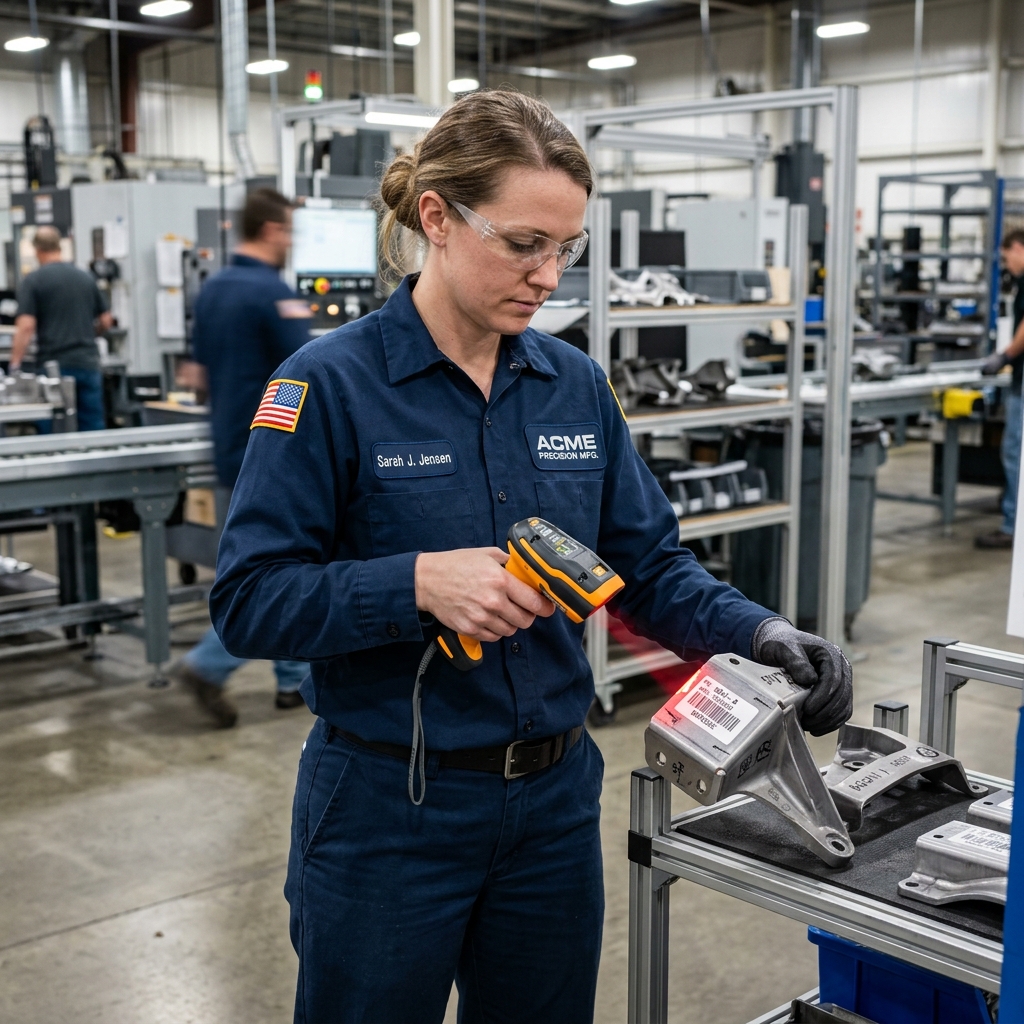
The era of competing on cheap labor is over. As standards from global partners become increasingly stringent, failing to prove your production process or trace the origin of a defect (Traceability) means losing the contract.
Combining ERP and MES helps you:
1. Eliminate “dark zones” in production: Every action, from receiving and mixing to machining and packaging, is digitized via Terminals or Barcodes.
2. Transparent accountability: Whoever makes the mistake owns it. No more shifting blame between shifts.
3. Rapid response to changes: For rush orders, MES and APS (Advanced Planning and Scheduling) instantly propose the optimal machine scheduling without disrupting other orders.
5. Frequently Asked Questions (FAQs) About MES Systems
Can an MES System connect to older machines on the shop floor?
Yes. Modern MES systems (like Infoasia’s solutions) typically use supplementary hardware like PLCs and IoT data collectors to pull signals (run/stop/count) from both mechanical machines and older CNCs without needing deep circuit board intervention.
Does implementing an MES system take a lot of time and money?
It depends on the scale and level of automation you desire. However, instead of replacing entire machines, deploying MES yields immediate results at a much lower cost than hardware investments. ROI is often achieved within the first 1-2 years due to material savings and increased capacity.
Is production data secure when using MES?
Absolutely. Especially when using international standard platforms, your data is strictly permission-based. Only authorized personnel can view or edit productivity reports, ensuring the secrecy of your company’s technology and manufacturing formulas.
Conclusion: If your business is experiencing symptoms like mismatched inventory, delayed deliveries, or inaccurate costing, it is time to seriously consider combining ERP and MES into a comprehensive ERP MES system.

InfoAsia Việt Nam trở thành nhà cung cấp dịch vụ phần mềm số hóa nhà máy sản xuất cho thương hiệu giày hàng đầu thế giới NEW BALANCE
Công ty TNHH Mây Tre Hà Linh
SAP ERP MES and IOT Project for FVIV Factor
Buwon Industry Co, Ltd
KANGLONGDA VIETNAM PROTECTION TECHNOLOGY COMPANY LIMITED
Shini Group
TA TING PLASTIC (HAI DUONG ) CO., LTD
CÔNG TY TNHH MTV BIÊN HOA SCM