




An ERP MES integration represents a strategic turning point that transforms a traditional factory into a Smart Factory. When the financial planning brain is seamlessly connected to the shop-floor execution system, businesses eliminate data blind spots, optimize production costs, and control progress in real time.
Below is a detailed analysis of the architecture, operational value, and deployment roadmap for manufacturing enterprises stepping into comprehensive digitalization.
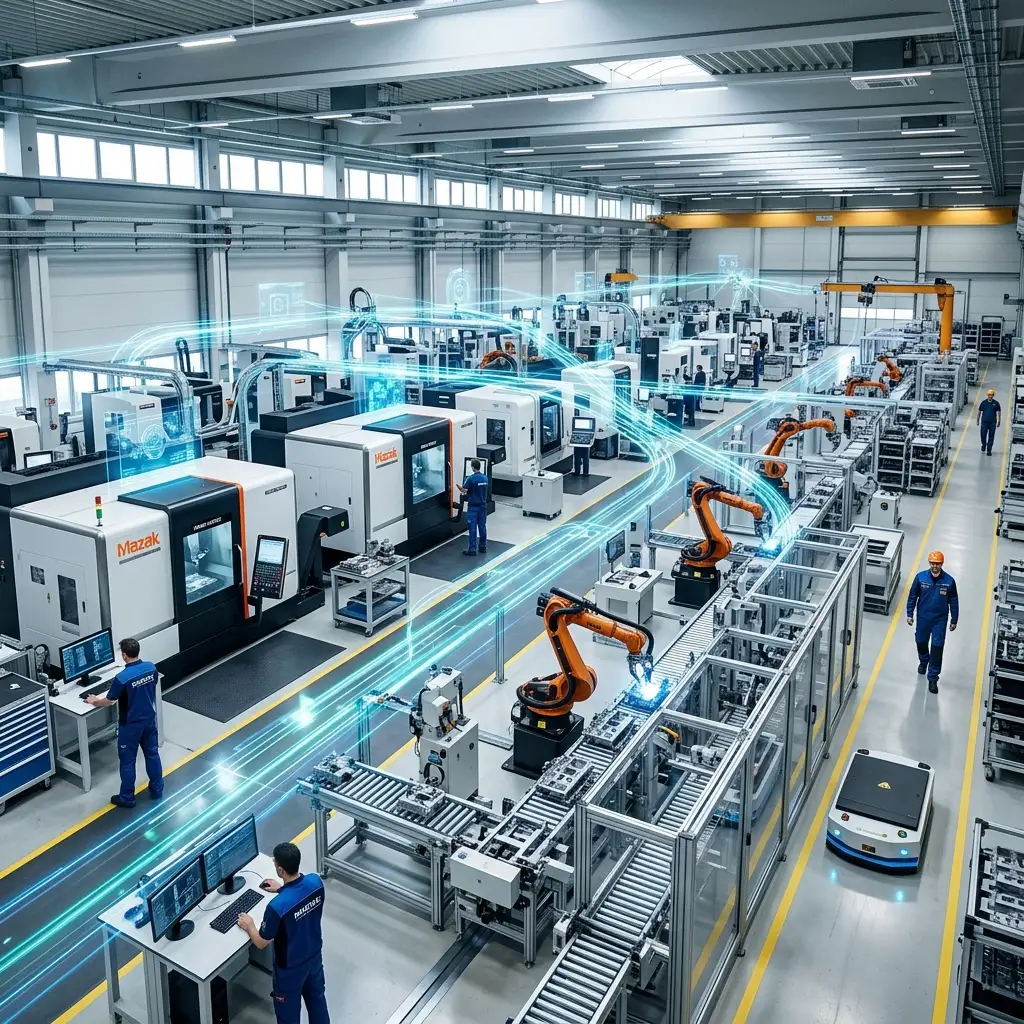
1. Technical Nature: What Does an ERP MES Do?
For successful integration, administrators must view the system structure through a layered principle: ERP manages the macro-flow (Top-Floor), while the shop-floor software controls the micro-flow.
1.1. ERP – The Strategic Planning “Brain”
It plays the central role in total resource management, responsible for financial efficiency and mid-to-long-term planning. Calculates Material Requirements Planning (MRP) and issues production orders specifying quantities and standard cost allocations. However, it is not designed to “see” second-by-second fluctuations on the factory floor.
1.2. Execution Layer – The Shop-Floor “Nervous System”
This is the specialized software layer, sitting between management and automated control systems (SCADA/PLC). It receives overall production orders, breaks them down, and allocates them to individual Work Centers. It calculates Overall Equipment Effectiveness (OEE) and records product defects on the spot (in-line QC).
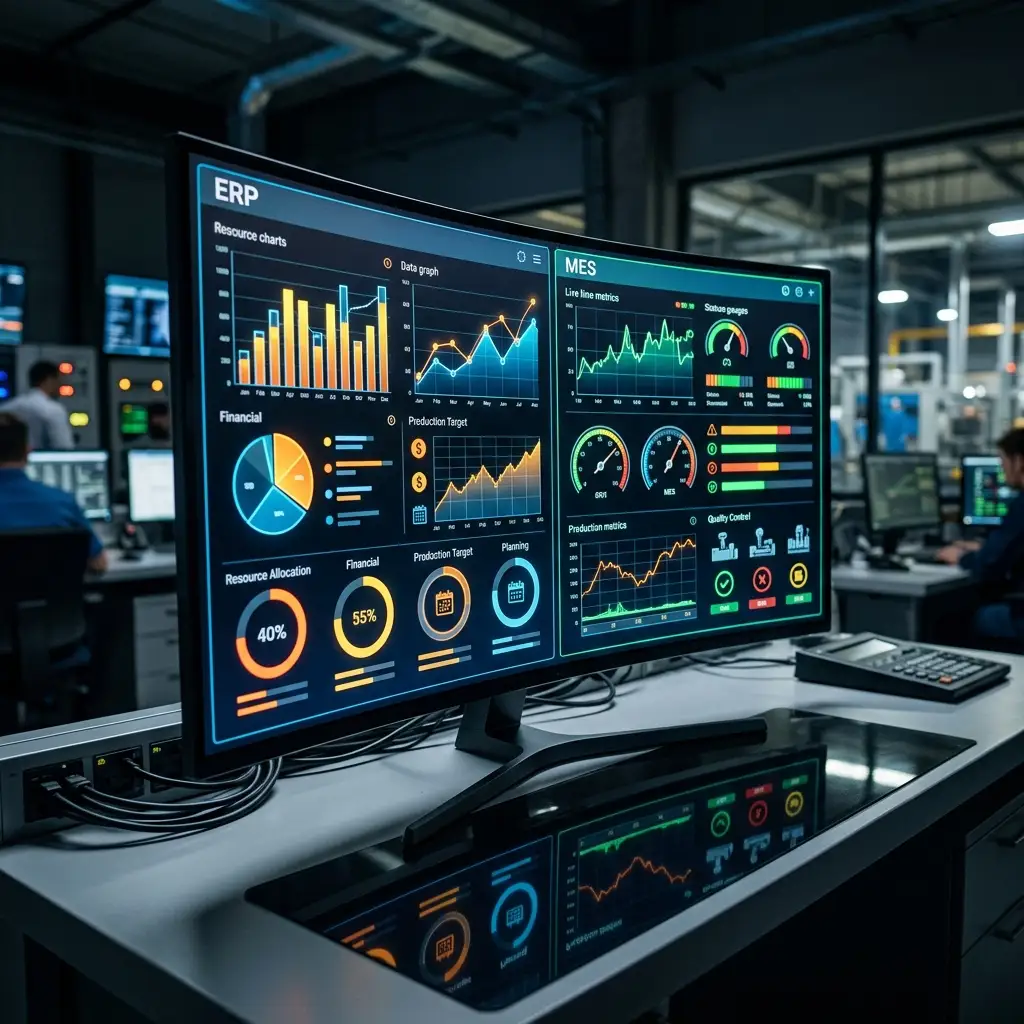
2. Why Does Separating The Systems Cause Losses?
Many factories today still operate in “Data Silos”: the back office runs disconnectedly from the shop floor. The lack of a synchronized ERP MES solution generates 3 hidden losses:
- Discrepancy between “Standard Costing” and “Actual Costing”: Without receiving actual material consumption data, accountants must allocate costs according to standard metrics and pool wastage at the end of the month.
- Bloated Work In Progress (WIP) inventory: Without a real-time connection, planners are unaware of which machine center is bottlenecked, causing semi-finished products to pile up.
- Delays in incident response: A technical issue delays a line by 12 hours, but sales only learns about it the next morning, leading to late deliveries.
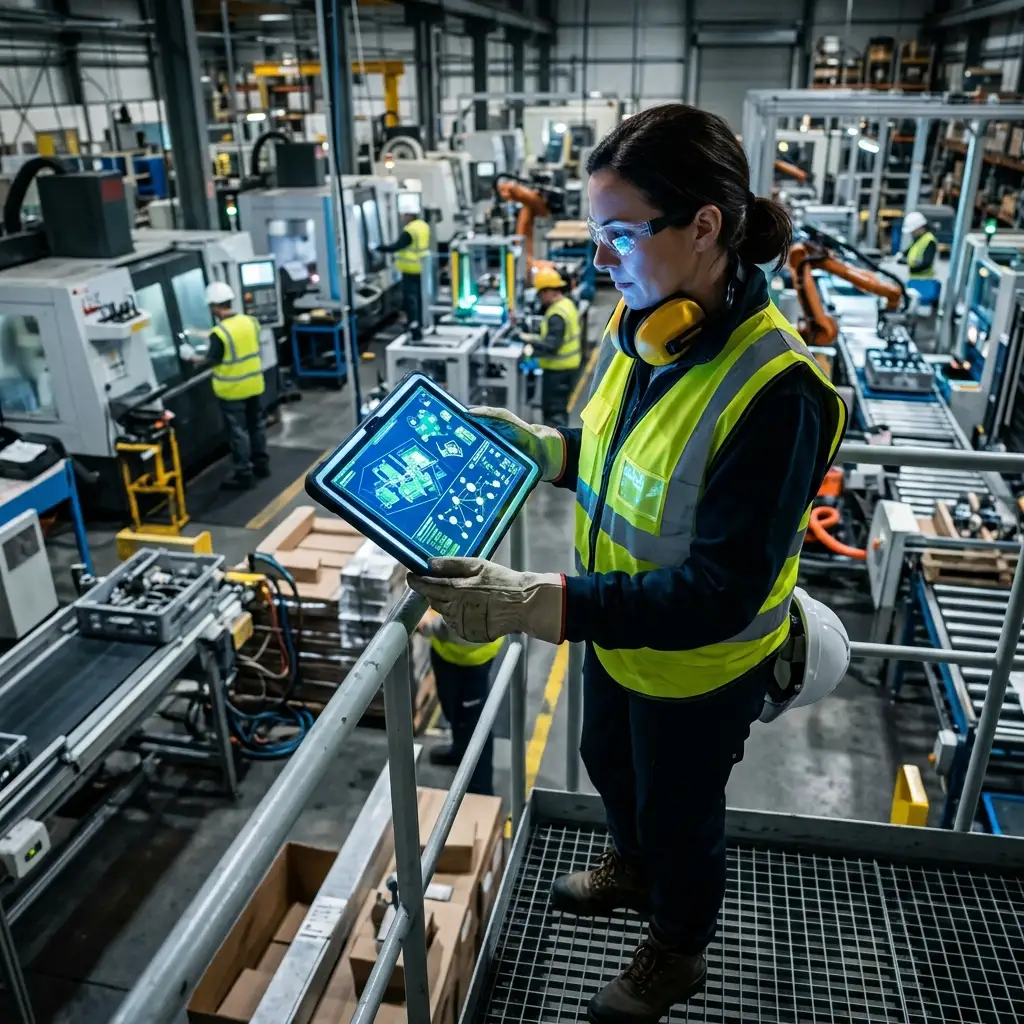
3. 5 Outstanding Values When Synchronizing Data
When applying a bi-directional ERP MES synchronization model, the factory transforms from a reactive operational model to smart control.
3.1. Establishing a “Single Source of Truth”
Automated top-down synchronization: Production orders are pushed directly to the shop floor. Instant bottom-up feedback: Finished goods yield and machine running hours are updated back the moment a shift ends.
3.2. Absolutely Accurate Actual Costing
For example, an order standardly consumes 1,000 kg of plastic, but actually takes 1,050 kg due to purging. The shop-floor software records the exact 1,050 kg and sends it to the system to calculate the true actual cost.
3.3. Shortening Lead Time
When a machine cluster is detected running below capacity, the signal immediately reflects on the ERP MES scheduling board. Planners can redirect orders to another line with available capacity.
3.4. Strict Control of Work In Progress (WIP)
Integration allows monitoring the volume of semi-finished goods moving between stages. If stage B slows down, the system automatically alerts to pause feeding materials into stage A.
3.5. Comprehensive Traceability and Genealogy
When a defective product is complained about, supplier history combined with shift history helps trace the exact root cause in just a few minutes.
4. Standardization Roadmap for Enterprise Deployment
Integrating two platforms with different architectures is a complex challenge. Enterprises must adhere to a systematic ERP MES integration roadmap:
- Process Survey and Master Data Governance.
- Data Mapping and Unit of Measure (UoM) Conversion.
- Selecting integration architecture via API or Middleware. Read more about technical architectures at SAP Official Website.
- Real-world Scenario Integration Testing (SIT & UAT).
- Go-Live Operations and establishing a data monitoring center.
Frequently Asked Questions (FAQs)
Q1: Will production data be lost if the ERP MES network connection drops unexpectedly?
A1: Absolutely not. The execution layer is designed with a local caching mechanism at each terminal. If the internal network goes down, data is still recorded offline and will automatically cross-sync to the management system as soon as the connection is restored, ensuring zero data loss.
Q2: Our shop-floor workers are older and not tech-savvy. Can they operate the system?
A2: The worker interface is highly simplified, utilizing touch screens or barcode scanners. Operators only need to press “Start” or “Pause”, or simply scan a barcode, and the data is automatically updated without requiring any complex keyboard typing.
Q3: Does this integration require us to replace all our legacy machinery?
A3: Not at all. Modern execution systems connect to legacy machines using IoT gateways or external PLC adapters. These devices extract operational signals (like cycle counts or fault codes) and translate them into digital data, eliminating the need to overhaul expensive equipment.
Q4: How does the system handle sudden priority orders (rush jobs) that interrupt running lines?
A4: On the Scheduling Board, planners can simply drag and drop the priority order. The system immediately sends an alert to the specific Work Center screens, allowing workers to smoothly pause current tasks and switch to the rush order seamlessly.
Q5: Does actual costing account for the value of scrap or by-products sold at the end of the month?
A5: Yes, the system is configured to track finished goods, scrap, and by-products separately. The recovered value from scrap is automatically offset against the total material cost of that production order, calculating the most accurate final actual cost.
Advice for Factory Leaders
Integration is not about “buying two softwares and putting them together”, but a strategic data restructuring project. The Board of Directors must standardize Master Data and choose knowledgeable consulting partners. Register to experience a customized ERP MES solution for your factory workflow at INFOASIA.

InfoAsia Việt Nam trở thành nhà cung cấp dịch vụ phần mềm số hóa nhà máy sản xuất cho thương hiệu giày hàng đầu thế giới NEW BALANCE
Công ty TNHH Mây Tre Hà Linh
SAP ERP MES and IOT Project for FVIV Factor
Buwon Industry Co, Ltd
KANGLONGDA VIETNAM PROTECTION TECHNOLOGY COMPANY LIMITED
Shini Group
TA TING PLASTIC (HAI DUONG ) CO., LTD
CÔNG TY TNHH MTV BIÊN HOA SCM