




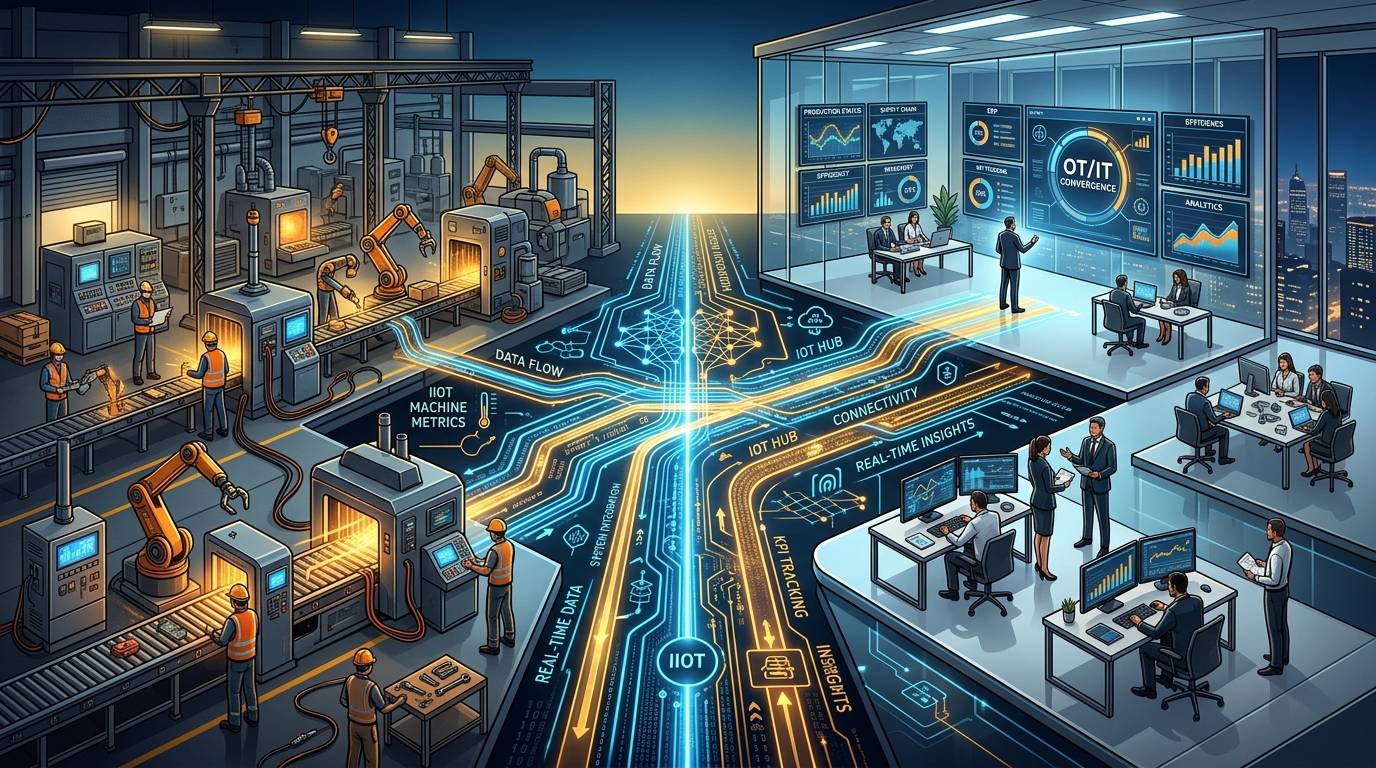
In the landscape of industrial management, there exists an “invisible wall” separating two worlds: the physical world on the shop floor (OT – Operational Technology) and the financial world in the back office (IT – Information Technology). Machines run continuously, and materials are consumed every second, but the enterprise resource planning software only receives delayed, aggregated numbers at the end of the day, or even the end of the month.
Breaking down this wall so that the data flow occurs in real-time is not merely a matter of pulling a network cable. It is a complex architectural undertaking.
Below is an in-depth blueprint on thedata integrationroadmap, the core technical layers, and how businesses can upgrade their operational systems to the highest level.
Illustration
1. Locating Your “Digital Coordinates”: What Level is Your Factory?
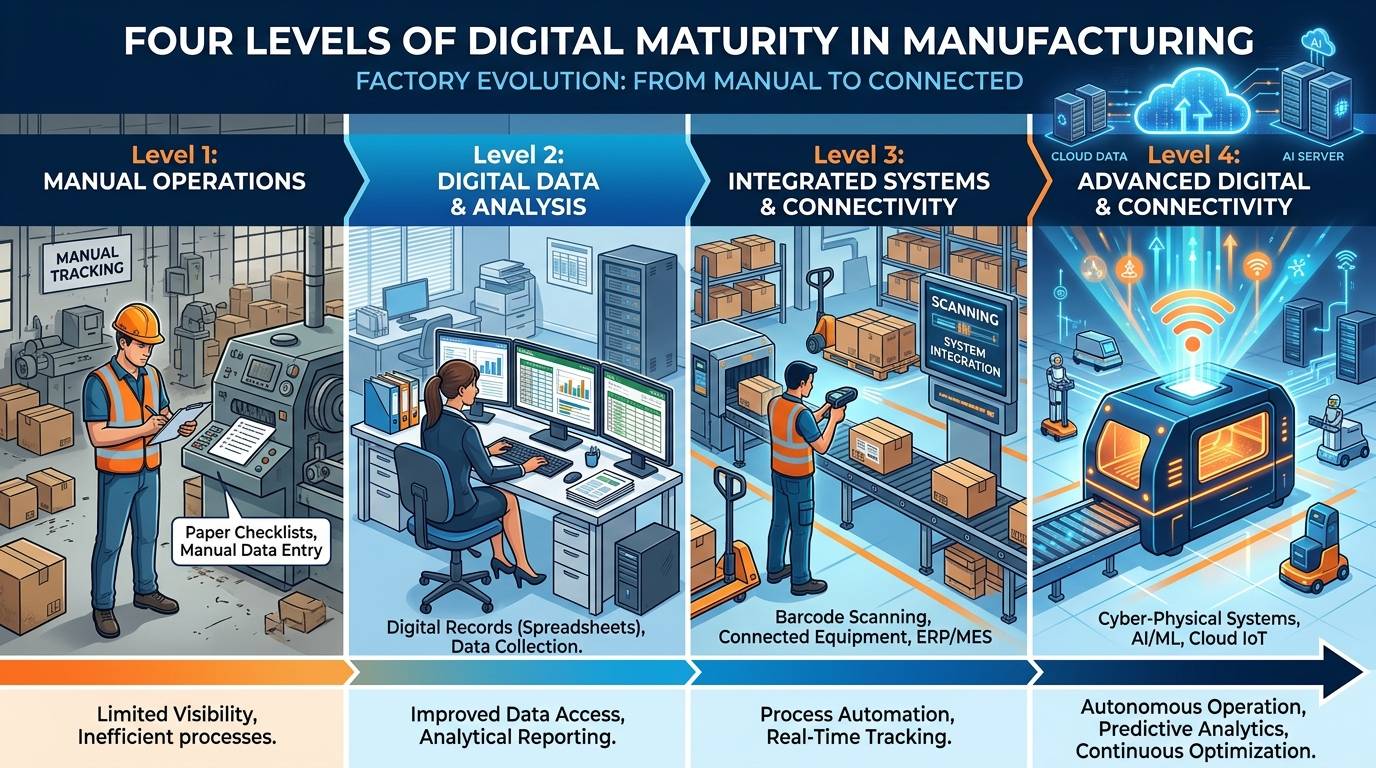
Before seeking a way to connect data, the Board of Directors needs to self-diagnose the state of their enterprise’s “data wall” using the 4-Level Digital Maturity Model:
–Level 1 – Physical Blackbox:Everything relies on notebooks and memory. Workers count quantities manually and submit paper slips to the supervisor. Data is contradictory, lost, and accountants always have to re-enter it from scratch into the software.
–Level 2 – Digital Silos:There is internal software or Excel to track production, but it stands completely independent from Accounting/ERP software. Data still has to be exported, edited, and imported/exported manually.
–Level 3 – Semi-integrated:The shop floor has a Barcode scanning system, and data is pushed to the central management system. However, it still depends on the human act of “pulling the trigger” on the scanner. If a worker forgets to scan, the data is broken.
–Level 4 – Real-time Sync:Machines and sensor systems (RFID/PLC) automatically “talk” directly to the core system via middleware. Wherever goods move, Work-in-Progress (WIP) costs are updated accordingly without human intervention.
The goal of a system integration project is to propel the factory straight to Level 4.
Illustration
2. Anatomy of the 3-Tier Architecture: How OT and IT Communicate
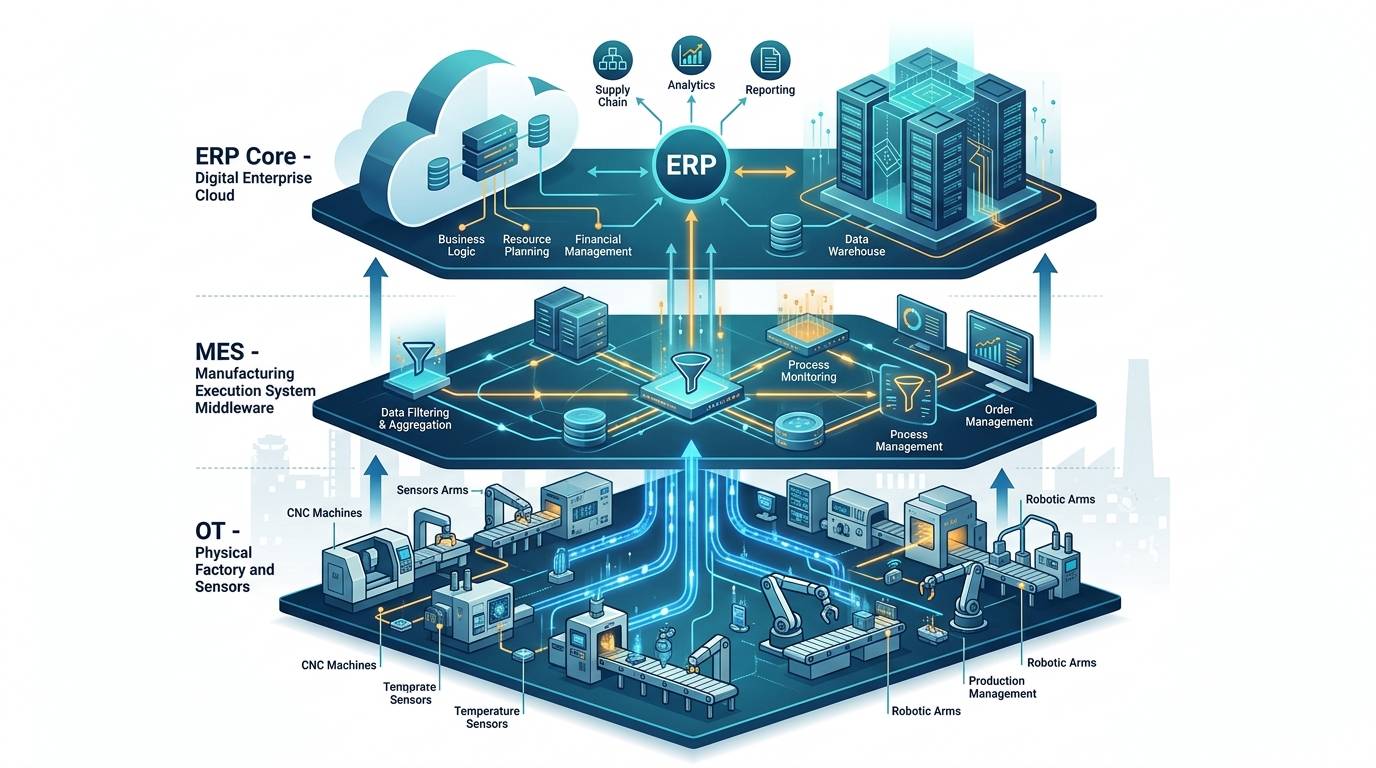
To connect mechanical machines with financial software, we cannot push raw data directly into the central system. The reason is that financial software is designed to process Transactional Data, while machines emit Time-series Data at a frequency of thousands of times per second. Pushing directly would crash the server immediately.
Standard data integration architecture must pass through 3 buffering layers:
–Tier 1 – Physical Collection (Edge/Sensors):These are the “senses.” It could be an RFID portal identifying a passing batch, an automatic barcode scanner on a conveyor belt, or extracting signals directly from a CNC machine’s PLC (Programmable Logic Controller) to know if the machine is running or stopped.
–Tier 2 – Middleware Wrapper (MES):Raw data from Tier 1 pours into the MES (Manufacturing Execution System). Here, MES acts as a “filter.” It gathers thousands of stamping machine pulses into a meaningful message: “Production order #102 completed 500 products, 2 defects, running time 60 minutes.”
–Tier 3 – Accounting Core (ERP Core):The system receives the “clean message” from Tier 2 via communication ports (APIs). At this point, the system automatically triggers financial logic: Deducting raw material inventory by Bill of Materials (Backflush), calculating labor costs, and accumulating the value in the Work-in-Progress (WIP) account.
Illustration
3. Overcoming the Two Toughest Technical Barriers in Connectivity
Many digital transformation projects fail at the data integration stage because they stumble upon two critical technical barriers:
–Protocol Mismatch:Industrial machines communicate using classic languages like Modbus, OPC UA, or Profinet. Meanwhile, management software communicates using RESTful API or OData. The implementation team must be able to program Gateways to “translate” back and forth between these two languages seamlessly and with absolute security.
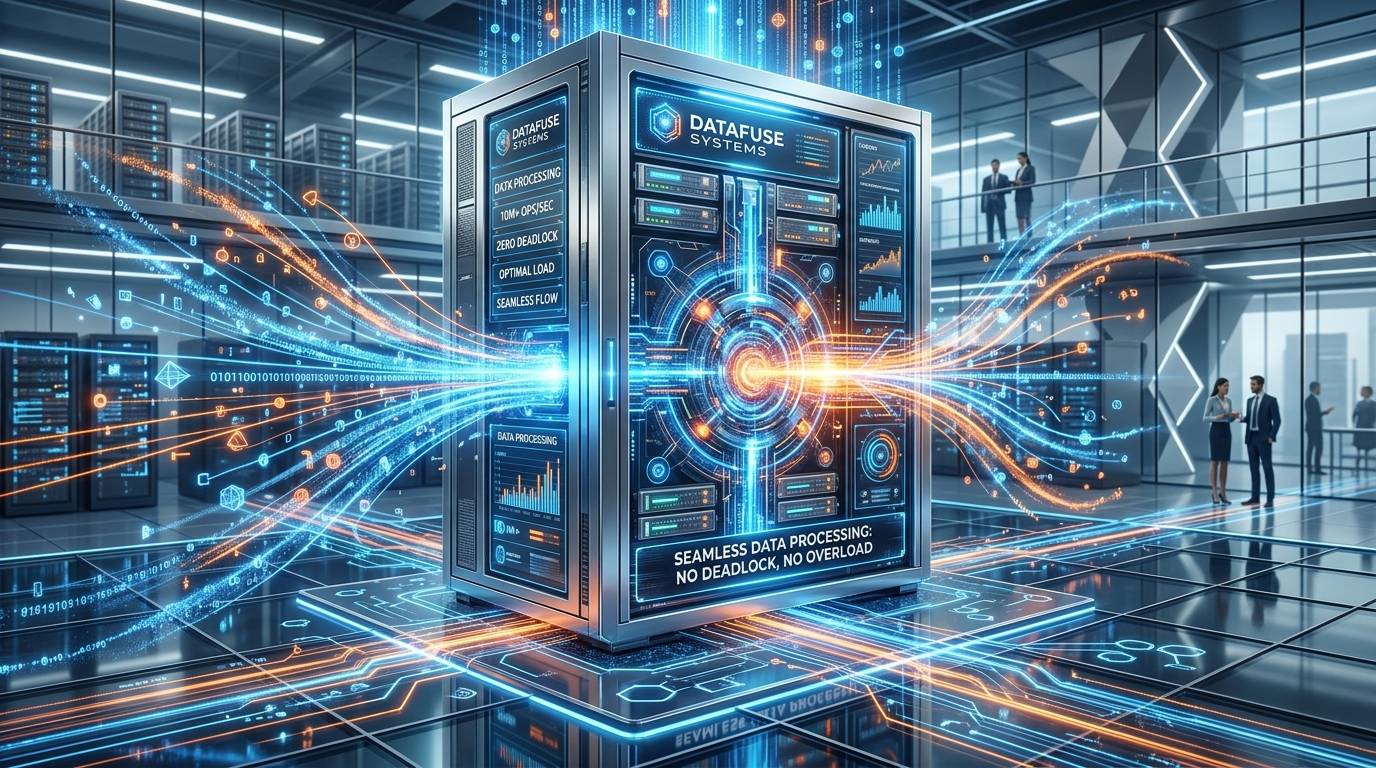
–Database Deadlock:When a factory has 50 machines continuously sending data, the database endures massive write-pressure. If SQL Queries are not optimized, data tables will be locked (Deadlock), causing the entire system (including accounting or sales departments) to freeze.
Illustration
4. Return on Investment (ROI): What Does the Board Get from This Connection?
Investing in shop floor and office data integration is not an IT Spend, but a spearhead for profit optimization:
–Eliminating the WIP “Dark Zone” (WIP Visibility):The company’s cash flow is no longer trapped in the form of incomplete batches of unknown value. The CFO always knows the exact Actual Cost on a daily basis.
–Instant Supply Chain Reaction:As soon as the shop floor reports a damaged batch of raw materials via the system, an MRP algorithm is automatically triggered to issue a supplementary Purchase Request, preventing a catastrophic line stoppage.
–True OEE Optimization:Machine downtime data is recorded objectively by sensors, helping the Board know exactly which machine and which stage the “bottleneck” is at for precise expansion investment strategies.
5. InfoAsia – The Architect of a Seamless Data Ecosystem
Integrating data from the shop floor to the central management system requires an implementation unit that converges 3 elements: Deep understanding of electromechanics (OT), proficiency in data analytics programming (IT), and deep knowledge of management accounting. In the Vietnamese market, InfoAsia asserts its position as the “chief architect,” specializing in designing and deploying world-class smart factory ecosystems.
The technical strength that shapes InfoAsia’s capabilities:
–The Management Brain from SAP Business One & Beas Manufacturing:InfoAsia uses the financial platform SAP ERP combined with the Beas Manufacturing module as the central processing core. With flexible integration capabilities, the system is ready to “absorb” data from any source on the shop floor. As soon as data pours in, the system automatically cross-checks the BOM and posts production entries without any manual intervention.
–Mastering SQL Server Technology (Data Optimization):To solve the “performance crisis” (mentioned in Section 3), InfoAsia takes pride in its team of senior Database experts. We intervene, write from scratch, and perform Performance Tuning on complex Stored Procedures. Thanks to this, the central machine always runs smoothly, processing millions of records from machines with almost zero latency.
–Deploying Smart Warehouse and Factory Infrastructure (RFID Ecosystem):InfoAsia provides a comprehensive solution from hardware to software. We directly design and install automatic identification systems (RFID portals, industrial barcode readers), ensuring physical data is digitized 100% automatically right at Tier 1.
–Interconnecting the Approval Chain with InfoAsia e-Office:Production data often accompanies administrative tasks (e.g., Machine reports error -> Need approval for a budget to buy replacement parts). InfoAsia seamlessly interconnects alerts from the management system to the InfoAsia e-Office digital workplace platform. All proposals and submissions will immediately appear on the Board of Directors’ phones for signature, creating a perfectly closed operating machine.
For a factory not to fall behind in the digital era, data integration is a mandatory path. Partnering with someone who masters the language of machines, the power of high-speed databases, and global financial accounting standards like InfoAsia is the strategic move to unleash your business’s operational power.
6. FAQs (Frequently Asked Questions)
Q: My factory’s machines are quite old and don’t have network ports to export data, can they still be connected?
A: Yes. For older machines that do not support direct network connection, we will install additional peripheral IoT sensors or auxiliary PLC devices to collect On/Off status and pulse counts without interfering deeply with the machine’s motherboard.
Q: When the internal network connection on the shop floor breaks down, is data lost?
A: The Gateway system in Tier 2 (Middleware) has a Store and Forward function. When the network is disconnected, data is retained on the local server. As soon as the network connection is restored, all data will automatically sync to the central system without any loss.
Q: Is it expensive to deploy a real-time data integration system?
A: The cost depends entirely on the factory’s current digital maturity level and the system’s scale. However, instead of spreading investments thin, InfoAsia always advises clients to deploy in a Phased Approach. You can start with the most critical “bottleneck” machines to immediately see the Return on Investment (ROI) before scaling up to the entire shop floor.

InfoAsia Việt Nam trở thành nhà cung cấp dịch vụ phần mềm số hóa nhà máy sản xuất cho thương hiệu giày hàng đầu thế giới NEW BALANCE
Công ty TNHH Mây Tre Hà Linh
SAP ERP MES and IOT Project for FVIV Factor
Buwon Industry Co, Ltd
KANGLONGDA VIETNAM PROTECTION TECHNOLOGY COMPANY LIMITED
Shini Group
TA TING PLASTIC (HAI DUONG ) CO., LTD
CÔNG TY TNHH MTV BIÊN HOA SCM