




In the context of strong digital transformation, the top question raised by business leaders when considering investment in management technology is about the “erp implementation time“. According to market research reports from Gartner and Panorama Consulting, up to 55% to 75% of ERP projects fail to meet their initial goals or experience timeline overruns. Accurately estimating the schedule not only helps organizations proactively allocate resources but also ensures optimization of investment costs. This article will analyze in detail all phases, determining factors, along with real-world data, while introducing practical solutions from InfoAsia.
1. ERP Implementation Phases
To put an enterprise resource planning system into smooth operation, the project must go through a sequential series of steps arranged according to technical logic:
- ERP project planning: Establish overall objectives, define module scope, set budgets, and allocate initial resources.
- System design: Survey the actual process current state (As-Is) to build a future configuration plan (To-Be) suitable for business characteristics.
- ERP software configuration: Customize the modules on the system according to the agreed solution design.
- Data migration: Clean, format, and transfer old data from legacy software systems or fragmented Excel files to a new centralized database.
- System testing: Conduct pilot runs (Integration Testing and UAT) for about 4 to 6 weeks to check for business logic errors.
- User training: Create instructional materials and organize practical training sessions, helping end-users operate the new system proficiently.
- Official launch (Go-live): Put the system into official operation across the entire enterprise.
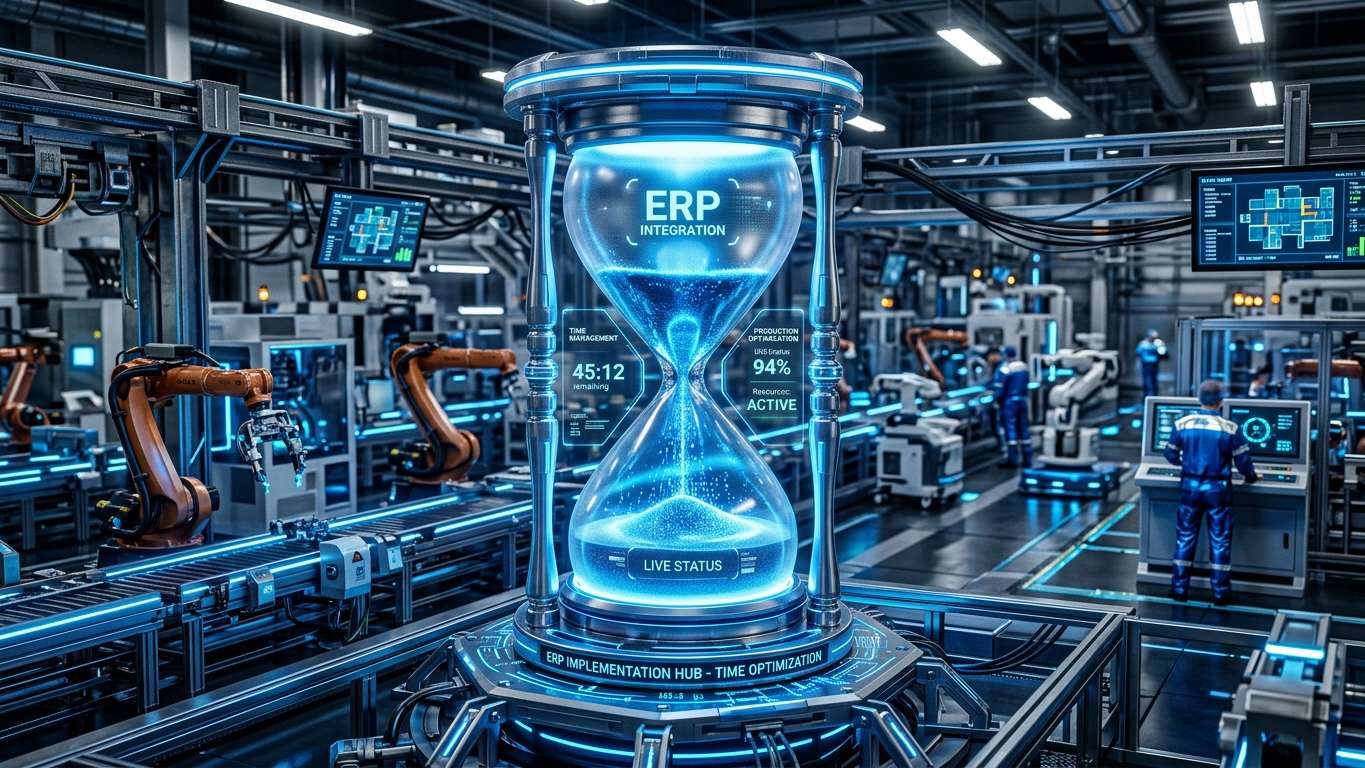
2. How long does a real ERP project implementation take? Influencing factors
Operational reality shows that there is no fixed time formula for every organization. According to statistics from technology research organizations, the global average time for an ERP project lasts about 15.5 months.
Real-world examples of cost and time overruns: Many manufacturing enterprises entering the implementation phase often face budget overruns or schedule delays due to internal technical barriers. For instance, projects with excessive custom structures typically increase testing time by an additional 30% to 50% compared to the initial plan.
3. Average implementation time by business size
Based on actual data from hundreds of implementation projects, the reference timeframe for each organizational model is clearly defined in the following table:
| Project size and characteristics | Actual reference timeframe |
|---|---|
| Small businesses, implementing few modules | 3 – 6 months |
| Medium businesses | 6 – 9 months |
| Manufacturing businesses with many processes | 9 – 12 months |
| Corporations or multi-factory enterprises | 12 – 24 months or longer |
To clearly see the detailed time allocation, an estimated timeframe comparison table for a medium-scale project is shown through the execution steps:
| Medium-scale project phase | Specific reference time | Work focus |
|---|---|---|
| Survey and write URD document | About 2 – 4 weeks | Assess the current status of processes and infrastructure. |
| Solution design & internal testing | About 1.5 – 3 months | Customize modules and perform technical testing. |
| Data migration & integration | About 1 – 2 months | Cleanse, migrate data, and synchronize APIs. |
| Installation, training, and UAT | About 4 – 6 weeks | Conduct pilot runs and train users. |
| Go-live and acceptance | About 1 – 2 months | Official operation and ad-hoc support. |

4. Why is there no fixed ERP implementation timeline?
The project completion time is directly affected by 6 core groups of factors:
- Business size and industry characteristics: Mechanical and electronic manufacturing businesses must handle the multi-level Bill of Materials (BOM) problem and complex MRP planning, making the configuration time usually 30% to 50% longer than pure trading companies.
- Implementation scope and number of modules: A project integrating finance, warehousing, production, and human resources simultaneously will take significantly longer than just running the financial – accounting module separately.
- Human readiness level: According to analyses from Prosci, projects with decisive participation and strong commitment from the strategic level achieve a much higher success rate, while the lack of consensus among departments slows down progress by up to 40%.
- Data quality and technology infrastructure: About 41% of projects running behind schedule stem from data being scattered, stored fragmented across multiple Excel files, and not cleaned from the source.
- Level of customization: Abusing custom coding instead of applying standard processes (Best Practices) skyrockets maintenance costs and time.
- Capacity of the provider: Statistics indicate that partnering with an experienced consulting firm helps raise the project’s success rate up to 85%.
5. How to shorten the ERP implementation time?
To optimize progress and quickly put the system into operation, businesses can apply these focal strategies:
- Clearly define the number of users: Provide an exact number to effectively plan end-user training.
- Narrow down the ERP project scope: Prioritize implementing core modules first, limiting the inclusion of too many complex functions in the initial phase.
- Phased implementation: Break the project into easily manageable parts, reducing the pressure on the internal team.
- Prioritize configuration over customization: Make the most of the software’s standard processes.
- Strengthen resources: Establish a dedicated project team and clearly assign responsibilities.
- Carefully select a consulting partner: Collaborate with a reputable contractor that has clear time commitments.
- Choose the right timing: Avoid implementing during peak business seasons or at the end of the financial year.
- Limit unnecessary integrations: Carefully weigh the benefits before connecting with inefficient legacy applications.

6. Success factors for ERP implementation
To ensure the project lands on schedule and maximizes its effectiveness, businesses need to focus on the following key factors:
- Executive Sponsorship: Directors and CEOs must not only approve budgets but also directly participate in directing, inspiring, and completely resolving conflicts of interest between departments during the digital transformation process.
- Detailed project planning: Clear allocation of specific milestones is needed for each category, from surveying and system design to data cleansing, to closely monitor and adjust promptly.
- Establish a dedicated internal deployment team (Core Team): Gather personnel with deep understanding of actual business processes, who have a voice and decision-making authority, ready to dedicate up to 50% of their working time to follow the project closely.
- Master Data Management: Before moving to the new system, all data regarding item catalogs, partners, and material norms must be unified, deduplicated, and thoroughly cleaned to prevent the “Garbage in, Garbage out” situation.
- Change Management strategy: Continuously organize practical training sessions and internal communications so end-users clearly understand the system’s benefits, thereby minimizing resistance when switching work habits from Excel to ERP.
- Maintain open communication channels: Organize weekly periodic progress review meetings between the internal project team and the consulting unit to quickly handle any technical risks that arise on-site.
7. Issues causing delays in ERP project implementation
- Lack of communication: Leaders do not regularly communicate with project managers about progress, leading to a loss of control.
- Isolating the IT department: Letting the IT department shoulder the project alone without decisive participation from business department leaders.
- Unclean data: The existence of multiple duplicates and erroneous data causes the migration process to be congested, consuming many processing resources.
- Lack of resources: Personnel holding multiple roles concurrently, lacking focused time for testing.
- Poor change management: Users protest because they have not been thoroughly trained on the new system.
8. Professional ERP software implementation provider: InfoAsia
Choosing a reputable companion is the key determining the time and success of the entire digital transformation strategy.
- Solid foundation and extensive experience: Established in 2016, InfoAsia is a member company of Cadmen Taiwan – a technology corporation with a development history since 1980 that firmly holds the position of an exclusive Gold Partner of SAP. InfoAsia possesses a team of deeply experienced experts in consulting, configuring, and seamlessly integrating SAP ERP, MES systems, and smart manufacturing solutions.
- Practical track record across global-scale projects: InfoAsia has affirmed its capabilities by successfully implementing factory management systems and integrating closed-loop supply chains for many key industrial zones as well as multinational corporations (typically the factory digitization project for the global footwear brand New Balance, FVIV factory, Buwon Industry, Shini Group, etc.).
- Commitment to accompany and exceed schedule: InfoAsia applies strict project management methodologies, helping businesses accurately determine feasible timelines, optimize the implementation scope, and ensure the system goes into operation as promised, maximizing the Return on Investment (ROI).

9. Frequently Asked Questions (FAQs)
Q1: Can businesses shorten the ERP implementation time to less than 2 months?
Answer: It is nearly impossible for a standard ERP system. Forcing too short a schedule will lead to skipping important testing steps and incomplete data cleansing, causing major risks when the system goes live.
Q2: What is the most common reason for ERP projects falling behind schedule?
Answer: The leading cause comes from “dirty data” (accounting for about 41% of delay reasons), the lack of internal resources participating in testing, and continuous requirement changes from the business side during execution.
Q3: Can the internal IT department implement an ERP on its own without a consulting unit?
Answer: It’s very difficult. A deeply integrated ERP system requires multi-disciplinary expertise ranging from finance, accounting, supply chain to production scheduling, exceeding the capability limits of a regular IT team.
Q4: How to control incurred costs when the ERP project duration is extended?
Answer: Businesses need to sign clear contracts regarding the scope of work, establish a joint project management board with the contractor to closely follow milestones, and strictly control any arising customization requests.
Q5: How does InfoAsia support customers to ensure the system is completed on the committed timeline?
Answer: InfoAsia provides a dedicated consulting team, conducts thorough current state surveys to create a detailed weekly roadmap, and closely accompanies from data standardization and personnel training to 24/7 technical support after Go-live.
Conclusion
The ERP implementation time can range from 3 months to over 2 years depending on the size of the organization, but it is entirely controllable and shortenable if the business builds a systematic roadmap, standardizes data from the root, and chooses the right reputable companion partner. When deployed on schedule under the guidance of practically experienced experts like InfoAsia, the management system will become a solid launchpad helping businesses optimize operations and break through strongly in the digital era.

InfoAsia Việt Nam trở thành nhà cung cấp dịch vụ phần mềm số hóa nhà máy sản xuất cho thương hiệu giày hàng đầu thế giới NEW BALANCE
Công ty TNHH Mây Tre Hà Linh
SAP ERP MES and IOT Project for FVIV Factor
Buwon Industry Co, Ltd
KANGLONGDA VIETNAM PROTECTION TECHNOLOGY COMPANY LIMITED
Shini Group
TA TING PLASTIC (HAI DUONG ) CO., LTD
CÔNG TY TNHH MTV BIÊN HOA SCM