




In the modern industrial manufacturing environment, the boundary between a high-profit margin factory and one struggling to cover losses is often determined by the speed of information flow. An organization cannot operate optimally if the Accounting Department uses standalone software, the Planning Department uses Excel spreadsheets, and the production floor records data in notebooks.
To achieve Operational Excellence and control costs down to every penny, businesses need a closed ecosystem comprising 4 technology pillars: ERP, MES, APS, and MRP.
However, piecing together these 4 massive system blocks is an extremely complex technical and financial problem. The success or failure of the entire digital transformation comprehensively depends on the capability of an ERP MES APS MRP implementation company that deeply understands data architecture and management practices.
Below is an in-depth analytical picture of the nature of this 4-pillar ecosystem, the disruptions that destroy profits in reality, and the criteria for identifying an implementation partner of sufficient stature.
1. The Interconnected Nature of the 4 Technology Pillars (First-Principles Thinking)
To understand why a factory must necessarily integrate all 4 systems, we need to dissect production operations from the most basic principles (first-principles). Any factory, whether large or small, must manage 4 dimensions of space: Cash Flow, Materials, Time Capacity, and Physical Action.
Each system in this quartet is born to thoroughly solve one dimension, and they must speak a common “language”:
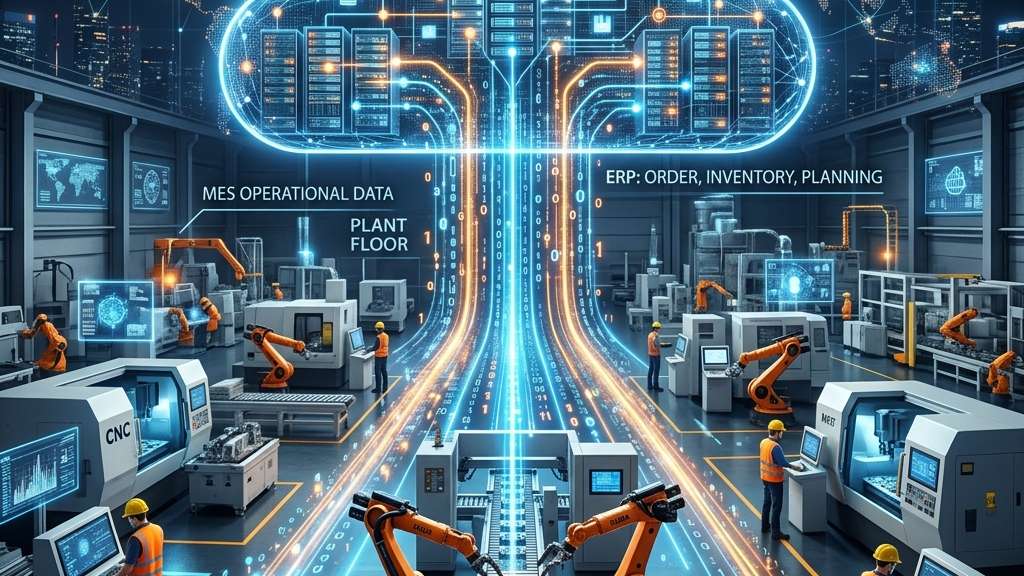
- ERP (Enterprise Resource Planning): Solves the problem of “Cash Flow & Overall Management”. This is the “brain” of the enterprise. It records Sales Orders, tracks payables/receivables, manages cash flows, and the ultimate destination is financial accounting and calculating product costing.
- MRP (Material Requirements Planning): Solves the problem of “Materials”. MRP is a mathematical calculation machine. Based on the Bill of Materials (BOM) and current inventory data, it accurately answers 3 questions: What components to buy? How many to buy? And when must the goods arrive so as not to halt the production line?
- APS (Advanced Planning and Scheduling): Solves the problem of “Time Capacity”. Unlike MRP which only cares about materials, APS cares about machines and humans. It plans based on Finite Capacity. APS knows exactly that CNC machine number 1 is under maintenance today, the night shift is short of 2 workers, thereby arranging the order of manufacturing orders (Routing) to be most optimal, minimizing Setup time.
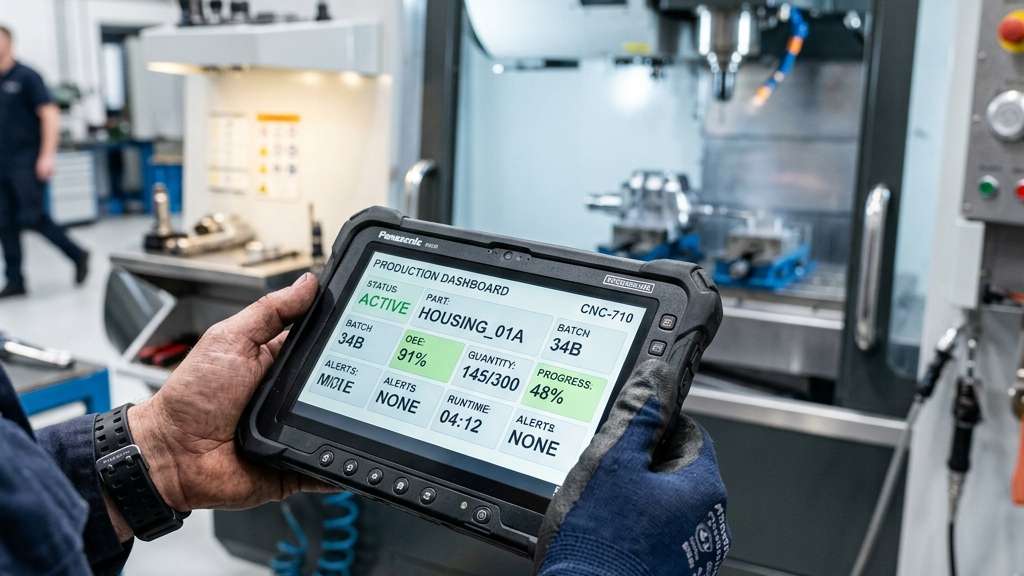
- MES (Manufacturing Execution System): Solves the problem of “Physical Action”. MES is the “nervous system” placed directly on the factory floor. It collects data in Real-time: counting the number of finished products, recording the scrap rate, reporting machine running/downtime.
The actual chain reaction: A customer places an order for 10,000 products. (1) ERP records the expected revenue. (2) MRP immediately breaks down the multi-level BOM structure and issues a purchase order for the remaining 2,000 components. (3) APS puts this order into the running schedule of the injection molding machine for next Monday morning. (4) MES records every stroke of the molding machine completed, pushing data back to ERP to automatically deduct raw materials from inventory and allocate directly to work in process (WIP) costs.
This image is for illustrative purposes to make the article easier to understand
2. The “Disruption Points” Destroying Profits When Systems Are Fragmented
Many enterprises are willing to spend billions buying software but let them operate disjointedly like “islands”. This lack of synchronization creates direct “pains” that erode gross profit:
- Phantom Capacity when lacking APS integration: Planning on Excel is often based on the assumption that machines run at 100% capacity. This phantom plan leads Sales to promise inaccurate delivery dates, causing delayed progress (low OTIF), contract penalties, and the need to compensate with Overtime at 1.5 times the labor cost.
- WIP Blackhole due to lacking MES: If the data on the shop floor is not pushed up automatically, Accounting cannot know exactly on the 15th, how much material value is stuck on the production line. Absorption Costing at the end of the period becomes an “estimation” or flat allocation. The Board of Directors is completely in the dark about whether the recently shipped batch is actually making a profit or loss.
- Bullwhip Effect due to MRP – ERP disruption: When inventory data on ERP does not match the calculation figures of MRP, the purchasing department falls into a panic. They tend to order excess materials (Just-in-case) to prevent risks. Swollen inventory depletes working capital and increases the risk of expired goods.
This image is for illustrative purposes to make the article easier to understand
3. Standard Integrated Architecture: The Roadmap from a Professional Implementation Company
To connect these 4 massive systems, a professional ERP MES APS MRP implementation company will not focus on software installation, but on data architecture and processes:
- Master Data Engineering Discipline: This is a prerequisite condition. The implementation partner will directly accompany the factory to standardize material codes, restructure multi-level BOMs, and redefine routing steps. If the BOM structure is wrong, MRP will issue the wrong purchase orders, and APS will schedule machine runs incorrectly.
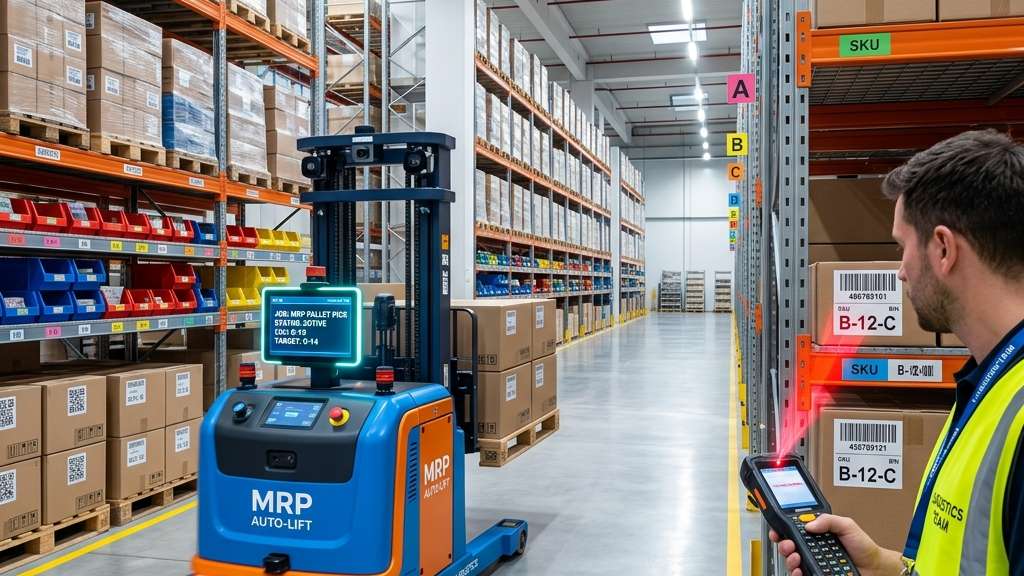
- Backflushing Mechanism Automation: Set up the database so that when MES records a worker completing 100 products, the system automatically triggers a command to the raw material warehouse to deduct the corresponding materials according to the BOM standard. Accounting does not need to manually type any goods issue slip.
- What-If Scenarios Simulation: Bring all operations onto a central dashboard. The factory manager can use the APS module to test scenarios: “If the cutting machine breaks down for 2 days, how long will the progress of the orders be pushed back?” The system will recalculate all resources in just a few seconds without damaging the original data.
This image is for illustrative purposes to make the article easier to understand
4. Core Criteria for Positioning an Implementation Company of Sufficient Stature
Simultaneously implementing 4 technology pillars is a project that requires an extremely high intellectual content. The Board of Directors needs to use these 3 strict filters to appraise partners:
- Possessing Financial & Operational Expertise (Hybrid Knowledge): The consulting team cannot just be IT engineers writing code. They must necessarily deeply understand Manufacturing Accounting (to set up accounting accounts, calculate standard costing) AND Industrial System Engineering (to understand bottlenecks, waiting time, equipment changeover time).
- Database Mastery Capability: 4 parallel running systems will generate tens of millions of data records (Big Data). The partner must have extremely deep expertise in writing, optimizing, and Performance Tuning for SQL Server scripts (Stored Procedures, Views). Without this capability, when running the MRP algorithm or exporting costing reports, the server will hang or take hours to process.
- Ability to Connect Physical Hardware Infrastructure: The partner must have the capability to bring the software out of the computer screen. They must know how to plan peripheral data collection systems such as barcode scanners, RFID card technology, or read PLC signals from machines directly pushed into MES.
5. InfoAsia – The Architect Establishing the Comprehensive Digital Manufacturing Era
In the enterprise management technology market in Vietnam, InfoAsia asserts its position as an in-depth ERP MES APS MRP implementation company. We do not provide disjointed software, but bring a complete “central nervous system”, custom-designed for complex factories (Electronics, Mechanical Manufacturing, Plastics, Textiles).
The core power creating InfoAsia’s absolute difference:
- Synergistic Power from SAP Business One & Beas Manufacturing: InfoAsia comprehensively solves the 4-pillar problem through the international standard financial platform SAP software ERP, combined with the high-level manufacturing solution suite Beas Manufacturing. This architecture has built-in extremely sophisticated multi-level MRP calculation and finite capacity planning APS modules. All execution data from the shop floor (MES) is instantly communicated to SAP’s accounting ledger, ensuring product costing is accurately accounted to every penny.
- Peak Data Processing with SQL Server: InfoAsia’s difference lies in its team of data experts. With the ability to write and set up storage scripts (SQL Stored Procedures) and Complex Views, InfoAsia breaks all speed limits. Your MRP or APS algorithm will scan through millions of records and deliver optimal results in the blink of an eye without causing system bottlenecks.
- Smart Infrastructure Transformation (RFID Ecosystem): InfoAsia has experience designing physical data collection architecture through RFID technology. Instead of making workers type on the MES screen, magnetic gates will automatically identify batches moving through, triggering goods issue/receipt commands and recording production progress completely Touchless.
- Comprehensive Digitalization with InfoAsia e-Office: Purchase requests (from MRP) or maintenance budget approval requests (from MES) will never get bottlenecked at the paper document stage. The data flow is directly communicated by InfoAsia to the digital office solution InfoAsia e-Office. The Board of Directors can review and electronically sign all operations right on their mobile phones anytime, anywhere.
Successfully unifying ERP, MES, APS, and MRP is a major surgery on processes, marking the maturity of a factory. Partnering with a company converging enough financial capability, understanding the physical principles on the shop floor, and possessing in-depth database techniques like InfoAsia is a strategic step, helping businesses optimize cash flow and establish a leading position in the Industry 4.0 era.
6. Frequently Asked Questions (FAQs)
How much time does an ERP MES APS MRP implementation company need to complete a project?
The implementation time depends greatly on the scale and current data status of the factory. Typically, a comprehensive implementation project for all 4 systems takes 6 to 9 months to ensure the data structure is cleaned, the system operates stably, and the personnel get used to the new processes.
Can I implement each system one by one or do I have to do all 4 at once?
You can completely implement in phases. Most implementation companies advise businesses to set up ERP and MRP first to stabilize financial and purchasing processes, then integrate MES and APS to optimize production scheduling on the shop floor.
How much does the implementation cost for this 4-pillar technology ecosystem usually be?
The cost depends on the chosen software solution (e.g., SAP, Beas Manufacturing) and the number of users. An in-depth implementation project requires a worthy investment for both software licenses and the intellectual property of the consulting firm, but the return on investment (ROI) brought by cutting inventory and management costs is extremely clear.
Do small and medium-sized factories really need to look for an ERP MES APS MRP implementation company?
Even at a small and medium scale, data fragmentation causes serious waste. You may not yet need an overly massive APS system, but a standard connection between ERP and basic MRP/MES is a vital foundation for the business to scale up without operational breakdown.

InfoAsia Việt Nam trở thành nhà cung cấp dịch vụ phần mềm số hóa nhà máy sản xuất cho thương hiệu giày hàng đầu thế giới NEW BALANCE
Công ty TNHH Mây Tre Hà Linh
SAP ERP MES and IOT Project for FVIV Factor
Buwon Industry Co, Ltd
KANGLONGDA VIETNAM PROTECTION TECHNOLOGY COMPANY LIMITED
Shini Group
TA TING PLASTIC (HAI DUONG ) CO., LTD
CÔNG TY TNHH MTV BIÊN HOA SCM