




In the increasingly complex context of industrial manufacturing, choosing the right technology platform is a vital factor in maintaining profit margins and competitiveness. Faced with the digitalization challenge, many management boards often find themselves hesitating between two core platforms: MES and ERP systems.
Instead of delving into theoretical concepts, this article from InfoAsia will directly analyze the functional boundaries, provide practical comparisons, and offer specific criteria to help businesses accurately determine which software is the missing puzzle piece in their organization.
Key Takeaways:
- Clear functional boundaries: ERP provides macro-level management across the entire enterprise (Finance, Procurement, HR), while MES provides micro-level monitoring of all direct activities on the shop floor in real-time.
- When to prioritize ERP: Multi-facility enterprises that need centralized data, suffer from cross-departmental information silos, and lack a comprehensive picture of costs/profits.
- When to choose MES: Factories with high-speed production, strict traceability requirements (Lot/Serial), and a need to monitor Overall Equipment Effectiveness (OEE) to eliminate waste.
- Integration is the ultimate goal: Combining both systems helps achieve an accurate “Actual Costing,” ensuring the supply chain plan synchronizes perfectly with actual manufacturing capacity.
1. In-Depth Comparison Table: Functional Boundaries Between MES and ERP Systems
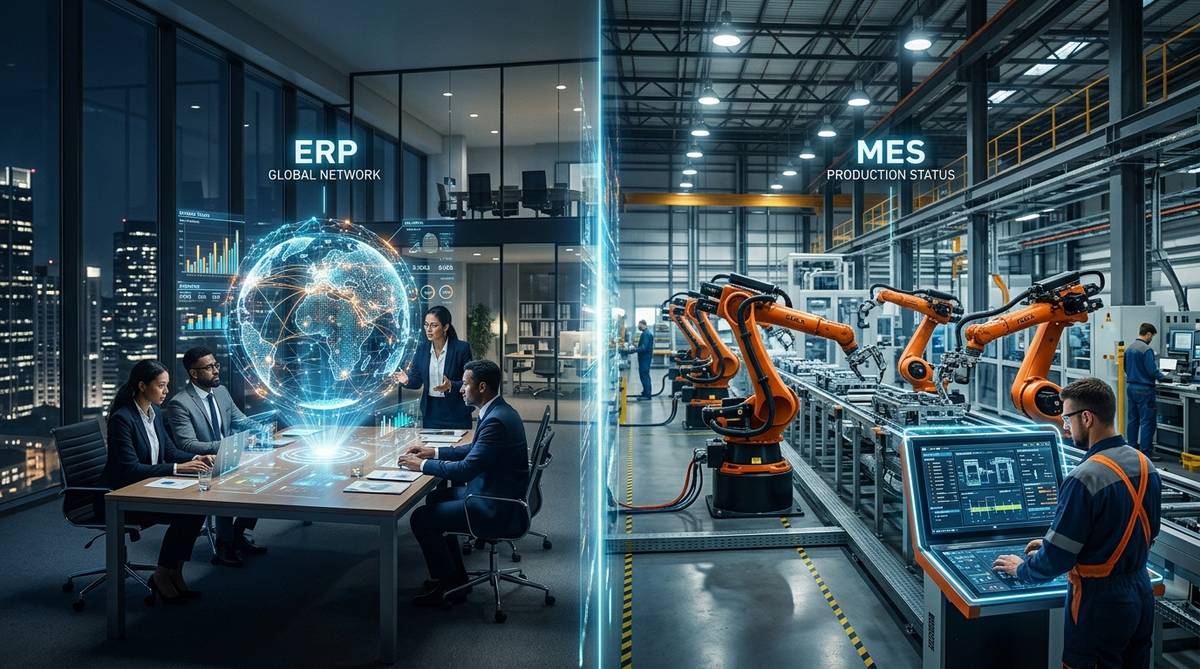
To make an accurate decision, managers need to view MES and ERP systems through the lens of management levels and data granularity. Below is a direct comparison table:
| Criteria | ERP System | MES System |
|---|---|---|
| Core Objective | Comprehensive management of the financial health and commercial activities of the entire enterprise. | Direct control, monitoring, and optimization of every physical movement on the production line. |
| Scope of Impact | Cross-departmental: Finance – Accounting, HR, Procurement, General Warehousing, Sales, and Supply Chain Management. | Localized to the shop floor: Workstations, assembly line workers, quality control (QC) areas. |
| Data Granularity | Macro-level, aggregated periodically (daily, weekly, monthly). Example: Total material cost last week. | Micro-level, continuously updated in real-time (seconds, minutes). Example: Running speed of stamping machine #3 right now. |
| Core Functions | Material Requirements Planning (MRP), debt tracking, budget management, cost accounting, and overall business reporting. | Detailed shift scheduling, OEE (Overall Equipment Effectiveness) measurement, on-the-spot error alerts, batch traceability. |
| Strengths | Provides a Bird’s-eye view, helping CEOs/CFOs make strategic decisions and coordinate capital flows. | Optimizes Cycle time, reduces Scrap rate, and eliminates operational waste on the shop floor. |
| Limitations | High investment cost, unable to closely monitor the interruption status of individual machines on the shop floor in real-time. | Only solves manufacturing problems, cannot replace ERP in managing finance, cash flow, or customer care. |
Illustration
2. When Should an Enterprise Prioritize Implementing an ERP System?
ERP is a backbone management platform. An enterprise cannot scale sustainably without this system. You should prioritize your budget and resources to implement ERP software in the following cases:
- Expanding organization size, multi-facility operations: When a business owns multiple factories, numerous commercial branches, or scattered warehouses. ERP helps standardize processes, centralize data, and prevent the “each place does it differently” situation.
- Loss of control over cross-departmental information flow: Accounting does not know the actual inventory figures, the procurement department cannot match data with the production plan. ERP breaks down these barriers, helping finance, sales, and HR synchronize smoothly.
- Crisis in strategic decision-making: The Board of Directors frequently has to make decisions based on “gut feeling” or delayed, inaccurate Excel reports. ERP provides a transparent reporting system (Dashboard), instantly reflecting the profit/loss picture and operating costs.
- High hidden costs and administrative waste: The enterprise spends too much time and manpower on manual data entry and paper reconciliation. ERP automates repetitive processes, reducing internal operating costs.
(Practical example: A furniture manufacturing company has a factory in Binh Duong, an office in HCMC, and a nationwide showroom system. They need ERP to ensure that when an order is closed at a showroom, the factory immediately receives a command to plan materials, and accounting automatically records the expected revenue).
3. When Should a Factory Focus on Investing in an MES System?
If ERP solves the problem of “What to do and how much does it cost?”, then MES solves the problem of “How to do it fastest and with the fewest errors?”. MES is a mandatory choice when your factory faces the following situations:
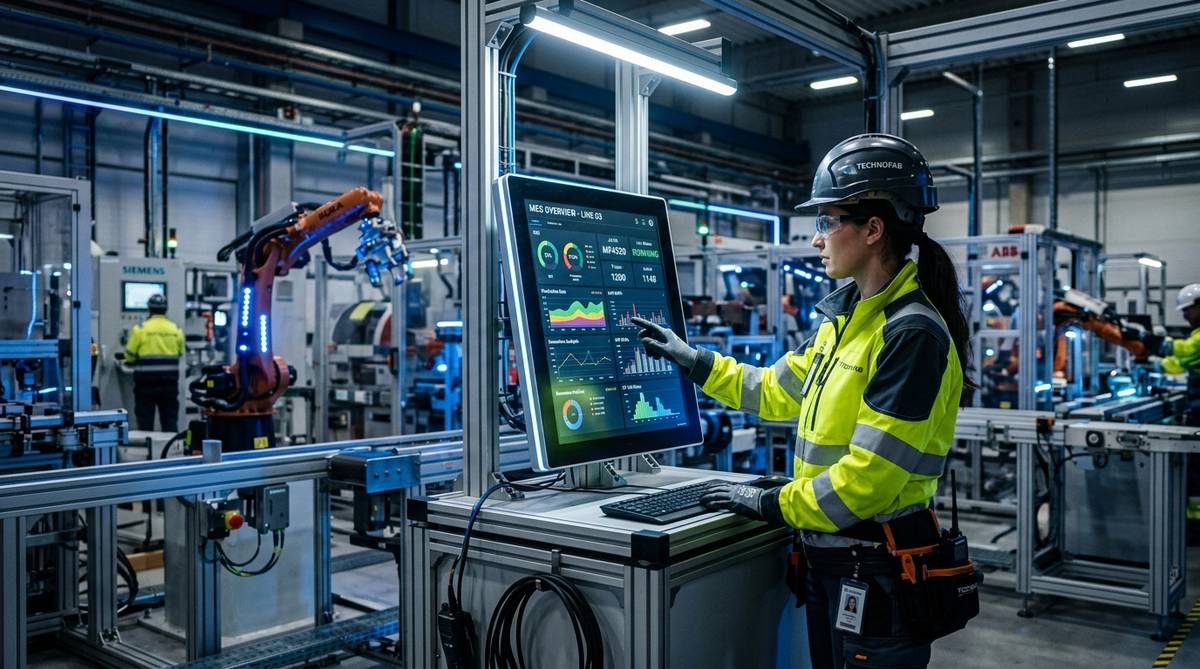
- Characteristics of mass production, high speed, or complex processing: The manufacturing process goes through dozens of stages requiring absolute precision. MES helps allocate production routing to each machine, optimizes line capacity, and eliminates bottlenecks.
- Strict traceability requirements: For the Pharmaceutical, Food, or Electronic Component industries, partners require strict origin control of every input material through to the final product. MES records all parameters (temperature, material lot, operator) at every touchpoint for recall or inspection purposes.
- Lack of transparency in equipment status (OEE): Businesses need to closely monitor machine conditions (running, stopped, error, maintenance) to apply Preventive Maintenance, avoiding sudden machine breakdowns that paralyze the line.
- Inconsistent shop floor processes: Each workshop or shift has a different habit of handling incidents. MES digitizes and enforces adherence to standard operating procedures (SOPs) right on the touchscreens on the shop floor.
(Practical example: A plastic injection molding factory consistently experienced material loss beyond the norm but couldn’t find the cause. By applying MES, they discovered that materials were being wasted because workstation #2 frequently had to restart multiple times during the night shift).
Illustration
4. Integration Between MES and ERP Systems: The Strategy to Optimize Manufacturing Operations
Practice has proven that no single system can completely solve the problems of a manufacturing company. Choosing which system depends on the current “pain points” of the business, but the ultimate goal is always the integration of both.
- Complementary principle: ERP holds the Bill of Materials (BOM), unit prices, and delivery schedules. MES receives this information to operate the shop floor, then measures actual waste (machine time, material consumption, scrap rate) and feeds the data back to the ERP.
- Integration efficiency: This combination brings absolute accuracy in “Actual Costing”. The management board no longer has to calculate costs based on theoretical norms. Every incident on the shop floor (MES) is instantly reflected in the supply chain plan (ERP), helping the business react quickly, minimize waste, and maximize labor productivity.

Illustration
5. Digital Transformation Consulting and Implementation Services from InfoAsia
In the era of Industry 4.0, digitalizing management systems is a mandatory condition for businesses to break through. Understanding the complex characteristics of the manufacturing industry, InfoAsia provides a comprehensive digital transformation consulting and implementation roadmap, precisely “tailor-made” to the scale and resources of the organization.
The technology ecosystem at InfoAsia does not stop at core systems but creates a tightly linked value chain:
- Core System Implementation: Providing international standard enterprise management software solutions and in-depth MES systems for factories.
- Platform Integration: Connecting multi-tier data with DMS (Distribution Management System), CRM (Customer Relationship Management), and smart reporting systems (BI).
- Hardware & Automation Development: Integrating IT infrastructure and IoT sensor solutions to directly collect machine data.
With a problem-solving methodology based on First-principles, the team of experts at InfoAsia commits to accompanying businesses from analyzing “bottlenecks”, choosing the right software, until the system operates smoothly — building a solid foundation for sustainable development goals.
FAQs – Frequently Asked Questions About MES and ERP Systems
Q1: Should a small-scale enterprise implement both an MES and an ERP system at the same time?
A1: For small businesses, implementing both systems at once can put significant pressure on finances and human resources. The recommendation is to prioritize implementing ERP software to standardize accounting, procurement, and inventory processes first. When the factory scale expands and requires more detailed control, you should then integrate MES.
Q2: Does linking data between an ERP and MES system take a lot of time and easily cause errors?
A2: If you choose two disjointed platforms without API support, this process will be very complex. However, if you use management software solutions with built-in standard connectors (like the solutions provided by InfoAsia), data synchronization happens almost in real-time and is extremely stable.
Q3: Can I use the manufacturing features in ERP instead of buying a separate MES?
A3: The manufacturing module of an ERP typically only stops at high-level planning, issuing orders, and receiving periodic reports. If your factory needs to monitor machine status instantly, alert errors right on the line, or strictly trace Lot/Serial origins, the basic features of an ERP will not suffice, and the support of an MES is mandatory at that point.

InfoAsia Việt Nam trở thành nhà cung cấp dịch vụ phần mềm số hóa nhà máy sản xuất cho thương hiệu giày hàng đầu thế giới NEW BALANCE
Công ty TNHH Mây Tre Hà Linh
SAP ERP MES and IOT Project for FVIV Factor
Buwon Industry Co, Ltd
KANGLONGDA VIETNAM PROTECTION TECHNOLOGY COMPANY LIMITED
Shini Group
TA TING PLASTIC (HAI DUONG ) CO., LTD
CÔNG TY TNHH MTV BIÊN HOA SCM