




aps deployment is becoming a decisive weapon for the competitiveness of complex manufacturing plants. When supply chains break down and urgent orders constantly interrupt, manual Excel spreadsheets or traditional material requirements planning systems expose their weaknesses. At this point, an Advanced Planning and Scheduling (APS) system is the only solution to save the factory from chaos.
Key Takeaways:
– APS does not operate on the assumption of infinite capacity like older software, but calculates based on the actual capacity of machinery and manpower.
– Applying APS helps factories minimize Work-in-Progress (WIP) inventory and eliminate downtime caused by waiting for materials.
– A successful aps deployment requires the consulting partner to have extensive knowledge in Industrial Engineering.
– Seamless data integration between finance, production, and planning departments is a mandatory requirement for the scheduling algorithm to work.
1. The core nature of the APS system: The boundary between “Virtual” and “Real”
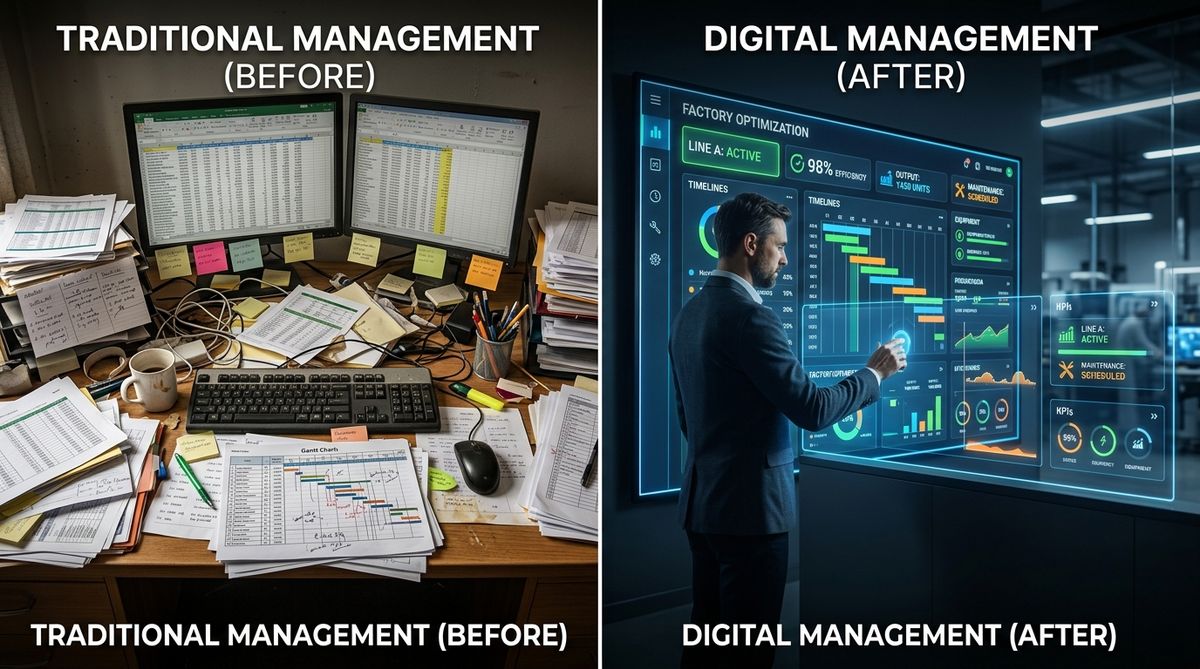
Image illustrating the APS system
To truly evaluate the value of a planning algorithm, we must start from first principles. Most legacy ERP systems use the MRP module for scheduling. The fatal flaw of this method is operating on “Infinite Capacity”. The software merely counts backward from the delivery date to assign a production date, completely ignoring whether the machine is broken or if the factory workers are fully present. This results in an unrealistic and impossible production schedule.
The APS system was created to bring the plan back to the physical reality of the factory:
- Finite Capacity Planning: The system is loaded with actual limits. For example, in a textile factory, the software knows the workshop only has 10 overlock machines, 2 shifts, and 15 level-4 skilled workers. When an export order for 50,000 shirts is pushed in, the algorithm simultaneously reviews constraints on: machine limits, labor productivity, thread inventory, and accompanying jigs.
- Optimization Algorithms and Smart Batching: The software applies mathematical models to solve the cost problem. Specifically in a plastic packaging factory, switching from white to black film takes 10 minutes, but from black to white takes 2 hours to wash the screw. APS will automatically group light-colored production orders to run first and dark ones later, saving hundreds of hours of machine downtime each month.
2. The pain of factories lacking a standard aps deployment strategy
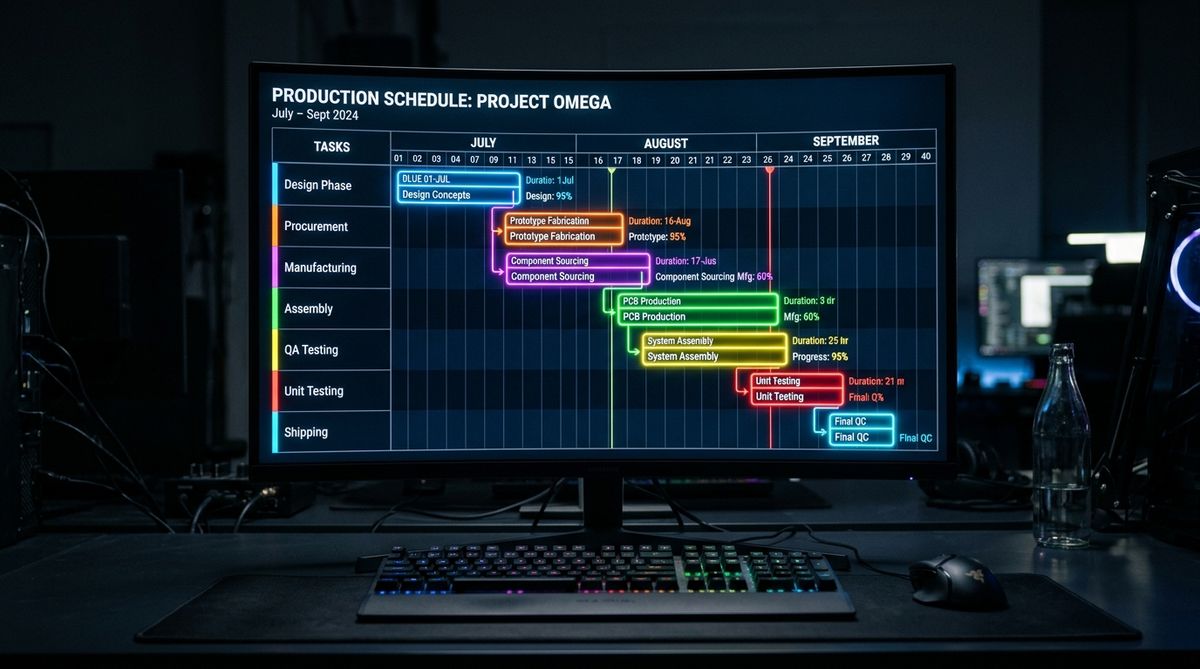
Image illustrating the APS system
Without a capable aps deployment provider to establish scheduling rules, mechanical machining, plastic injection, or packaging factories are constantly caught in a spiral of troubleshooting:
- The collapse of the fragile “Excel Empire”: The Planning department exhausts 80% of their daily working time just copying data between Excel files. When a minor variable occurs (a CNC milling machine breaks a tool, a VIP order jumps the queue), the entire chain of Excel formulas is displaced. The planner has to spend hours rescheduling manually, leading to a situation where “planning chases production.”
- Bloated WIP inventory swallowing cash flow: Without a tool to identify bottlenecks, the supervisor just lets early stages (like cutting, stamping) run at full speed. A massive amount of semi-finished products pours into the subsequent stages (like welding, assembly) which are already overloaded. Consequently, the factory floor runs out of space, working capital is buried in WIP, while final products are still unavailable for delivery.
- Emotional delivery promises and rock-bottom OTIF rates: With no database to simulate future capacity, the Sales department blindly promises delivery dates to partners. When delayed, the factory has to bite the bullet and compensate the contract, or pay for expensive air freight—which is 10 times more costly than sea freight—just to salvage their reputation.
3. The power of APS: Changing physical operations with Data
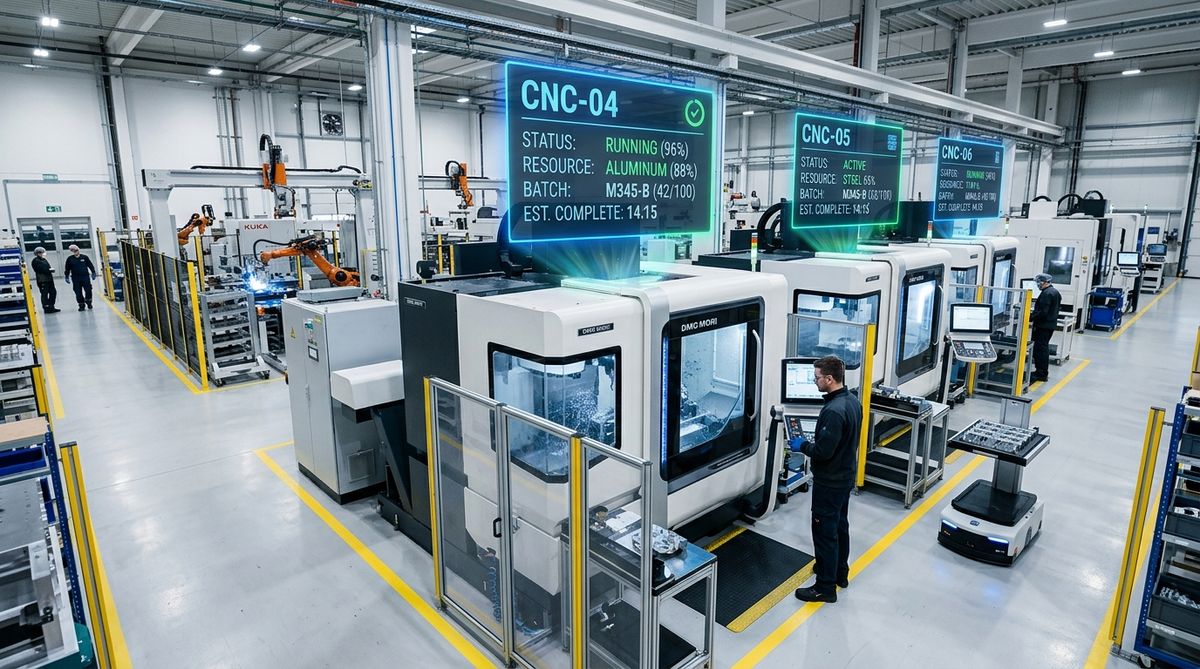
Image illustrating the APS system
A project put into practice will completely transform operations, turning the factory into a dynamic engine capable of self-recovering from shocks:
- Visualization via dynamic interactive Gantt charts: All production orders, machines, and shifts are vividly digitized on a central dashboard. Planners simply drag and drop a production order to another machine cluster. Instantly, the algorithm automatically pushes back the timelines of a series of subsequent orders and warns of schedule drops in a split second.
- Risk-free What-If Analysis: Before finalizing a plan, the Production Director has the right to run simulated scenarios. For example: “If I approve overtime for the assembly workshop on Sunday afternoon, can we squeeze in 3 urgent orders from our EU partner?” The system will interpolate and return immediate results without disrupting the live data running on the main server.
4. Diagnostic table: When does a factory need to upgrade its planning system?
| Operational symptoms on the floor | Solutions from APS software |
|---|---|
| Constant schedule delays due to not knowing which machine is overloaded in advance. | Visual Overload warnings, automatic Load Leveling. |
| Taking hours to redo the plan when an unexpected order arrives. | Drag-and-drop feature on the Gantt chart, updating the entire route in 5 seconds. |
| Wasting machine cleaning time due to messy item arrangements. | Setup Time Matrix grouping items with similar characteristics. |
| Buying excess materials or facing shortages right when production is needed. | Pegging material requirements precisely to every machine shift. |
5. Strict criteria for assessing solution consulting partners
APS is evaluated by experts as the most challenging module. The management board needs to use the following filters to screen partners:
- Possessing hybrid knowledge (Industrial & Data Expertise): Consultants cannot just be coders. They must be system architects who deeply understand industrial engineering. They must know how to dissect the Bill of Materials (BOM) structure, define Routing flows, and apply the “Theory of Constraints” to map out precise scheduling rules.
- Ability to master high-speed databases: The scheduling problem requires processors to calculate millions of variables simultaneously. If the partner lacks the capability for SQL Database Optimization, this feature will crash the server, rendering the optimization algorithm a useless piece of iron.
- ERP – APS – MES integration capability: The planning function cannot exist independently. It needs to “pull” material data from the warehouse and receive real-time actual machine status feedback from MES. The ability to build real-time interconnecting API structures is a mandatory standard.
6. InfoAsia – The leading manufacturing management ecosystem architect
On the operational technology map in Vietnam, InfoAsia does not merely sell packaged software. We position ourselves as System Architects. We build a seamless ecosystem from the core financial accounting, APS scheduling, down to shop floor execution.
The core strengths that guarantee InfoAsia’s success:
- Mastering SAP Business One & Beas Manufacturing solutions: What creates InfoAsia’s absolute gap is our deep expertise in the international standard SAP ecosystem. In particular, we apply the extremely powerful Beas Manufacturing module. This interface provides interactive Gantt visibility and squeezes bottlenecks down to the exact minute for every worker.
- Database Mastery tuning techniques: Grasping the RAM-hungry nature of the APS algorithm, our technical team deeply intervenes in Stored Procedures. Through sophisticated Performance Tuning techniques, the system consistently guarantees blazing-fast result delivery, smoothly handling loads for large-scale enterprises.
- Master Data Engineering: The success of an aps deployment project depends entirely on input data. InfoAsia’s experts will go down to the factory floor, working with factory engineers to dissect multi-level BOMs and standardize Routing processes. All constants like setup time and wait time are quantified with 100% accuracy.
7. Frequently Asked Questions (FAQs)
Q1: Will replacing humans with the APS algorithm make the Planning department redundant?
A: Not at all. The software handles the massive volume of calculations, but humans are the strategic decision-makers. Planners will transition from “manual data entry” to “controllers,” using their time to analyze what-if scenarios to increase profit margins for the factory.
Q2: Does a medium-sized factory (under 200 employees) really need to use APS?
A: Headcount is not the metric. If your factory has complex multi-stage production processes, constantly changing SKUs, and frequent penalties for late deliveries, then an aps deployment is a mandatory investment to untie cash flow knots, regardless of whether the business has 50 or 500 workers.
Q3: Can APS software run independently without an underlying ERP system?
A: Theoretically yes, but in practice, it creates a “data island.” APS needs to know how many tons of plastic are in the warehouse to schedule injection molding. Without an ERP automatically providing real-time inventory data, you would have to manually enter this data into APS, leading to errors and breaking the algorithm’s continuity.

InfoAsia Việt Nam trở thành nhà cung cấp dịch vụ phần mềm số hóa nhà máy sản xuất cho thương hiệu giày hàng đầu thế giới NEW BALANCE
Công ty TNHH Mây Tre Hà Linh
SAP ERP MES and IOT Project for FVIV Factor
Buwon Industry Co, Ltd
KANGLONGDA VIETNAM PROTECTION TECHNOLOGY COMPANY LIMITED
Shini Group
TA TING PLASTIC (HAI DUONG ) CO., LTD
CÔNG TY TNHH MTV BIÊN HOA SCM